
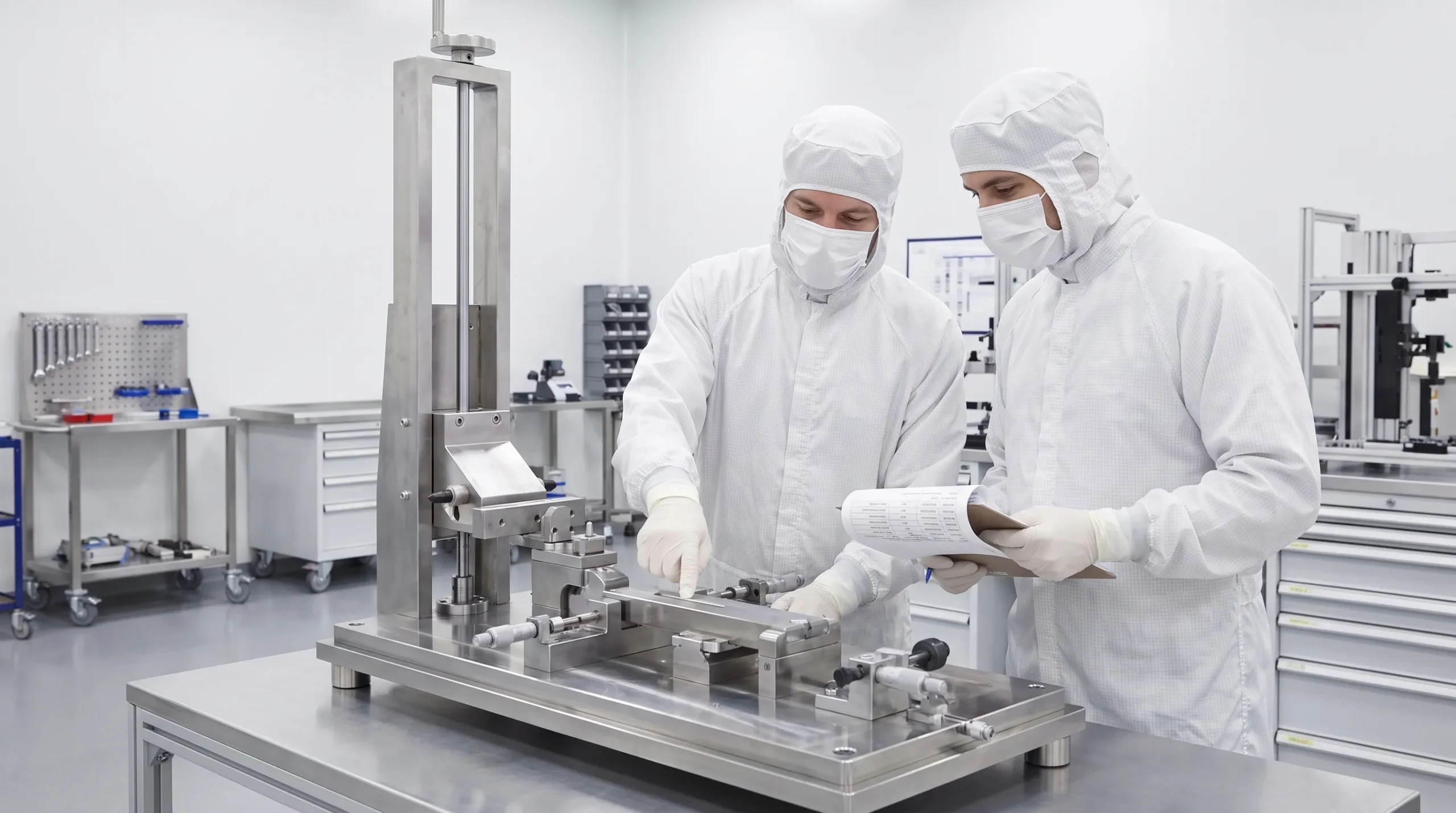
A cleanroom assembly tool for sensitive equipment should never be specified as a normal fixture with cleanroom-compatible materials added at the end. In high-tech production, the tool can influence particle generation, alignment accuracy, operator posture, load stability, documentation quality and production continuity.
For OEMs and first-tier suppliers in semiconductor, medical technology, aerospace, defence, optical and analytical equipment, the specification phase is where cleanliness, safety and usability become measurable engineering requirements. A strong specification helps engineering teams avoid two expensive mistakes: over-engineering a custom solution where a standard tool is sufficient, and under-specifying a tool that will be used in a safety-critical or contamination-sensitive process.
The goal is not simply to buy a tool that fits inside a cleanroom. The goal is to define a cleanroom assembly tool that supports the real assembly operation, protects sensitive equipment, reduces operator risk and remains inspectable and maintainable throughout its lifecycle.
Start with the assembly process, not the tool concept
Before deciding whether the tool should be a fixture, lifting adapter, mobile lift, assembly frame, handling trolley or mechatronic module, define the process it must support. Sensitive equipment is often damaged not by the main assembly step itself, but by small handling errors around that step: a misaligned interface, an uncontrolled rotation, a blocked line of sight, an unstable center of gravity or an operator having to apply force in an awkward posture.
A useful starting question is: what must never happen during this operation? The answer may include product contact in restricted zones, particles falling into a critical module, uncontrolled movement, ESD events, tool collision with a metrology surface, or an operator reaching under a suspended load.
Cleanroom classification is an important input, but it is not a complete requirement. Tool specification should connect cleanliness to the actual production risks, a point also discussed in BKL’s article on how cleanroom assembly improves quality in precision builds. If the tool will be part of a wider semiconductor process, the surrounding material flow, access routes and handling sequence should also be aligned with design priorities for a semiconductor clean room workflow.
A practical specification starts by documenting the intended use, the product interface, the operators, the environment and the acceptance criteria. Without these inputs, even a technically well-built tool may be difficult to validate or unsafe to operate.
| Requirement area | What to define | Why it matters |
|---|---|---|
| Assembly function | Lift, support, rotate, align, transport, hold or service the equipment | Prevents a tool from being designed around an incomplete use case |
| Cleanroom environment | Room classification, cleaning method, access route and storage conditions | Ensures the tool can enter, operate and remain controlled in the environment |
| Equipment sensitivity | No-contact zones, fragile surfaces, ESD sensitivity, FOD risk and alignment limits | Reduces the chance of hidden damage or process contamination |
| Load and motion | Weight, center of gravity, lifting points, movement path and worst-case orientation | Supports safe load control and realistic engineering calculations |
| Operator interaction | Gloved operation, visibility, posture, reach, handles, controls and maintenance access | Improves ergonomics and reduces the chance of incorrect use |
| Verification and documentation | Calculations, inspection reports, test results, manuals and maintenance instructions | Helps demonstrate that the tool is suitable for its intended use |
Define contamination risks, not only cleanroom class
A tool can be cleanroom-compatible in a general sense and still create risk in a specific process. For example, wheels may shed particles on a frequently used transport route, a coating may be incompatible with cleaning chemicals, or exposed threads may trap contamination that is released during repeated use.
The specification should identify the relevant contamination mechanisms for the equipment and process. Common risks include particle generation, fiber release, foreign object debris, ESD, corrosion, unsuitable lubricants, chemical residues and outgassing from selected materials. In medical technology, biological control and cleaning validation may also influence tool design, although those requirements usually sit within a broader quality and process validation framework.
Generic wording such as suitable for cleanroom use is rarely enough. It is better to state how cleanliness will be achieved and verified. That may include agreed materials, surface finishes, cleaning procedures, packaging requirements, inspection steps before cleanroom entry and rules for maintenance or re-entry after repair.
Specify load, interfaces and operating envelope
Sensitive equipment often has an asymmetric mass distribution, fragile covers, precision-machined interfaces, optical surfaces, vacuum components or installed submodules that cannot carry load. The tool specification must therefore describe the product as a load case, not just as a weight.
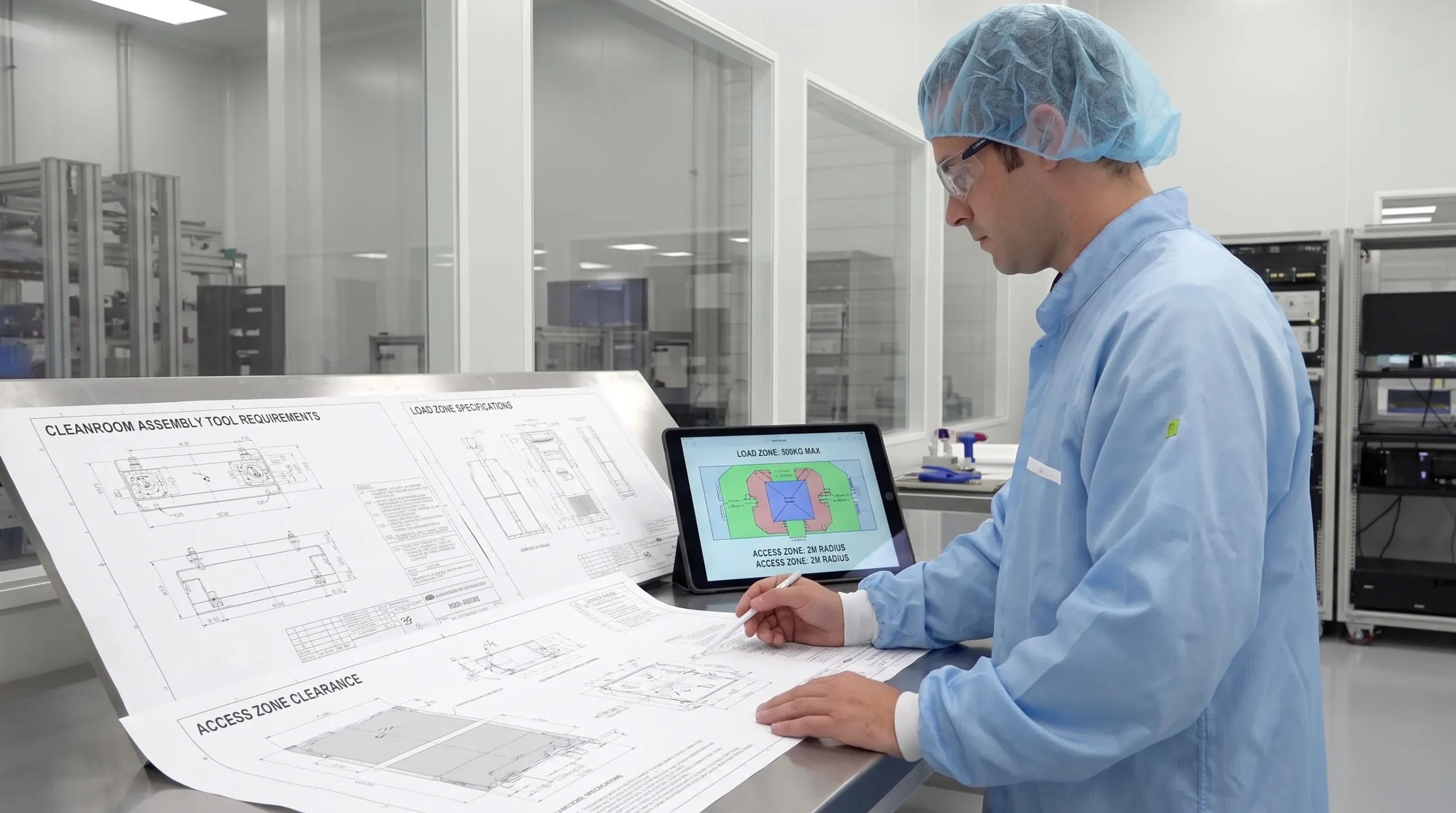
Define the working load, center of gravity, lifting or support points, permitted clamping zones, prohibited contact areas, required clearances and all orientations during the operation. If the tool will move the equipment through a doorway, airlock, cleanroom aisle or assembly cell, include the full operating envelope. This includes turning radii, floor conditions, overhead restrictions, nearby equipment and the position of operators.
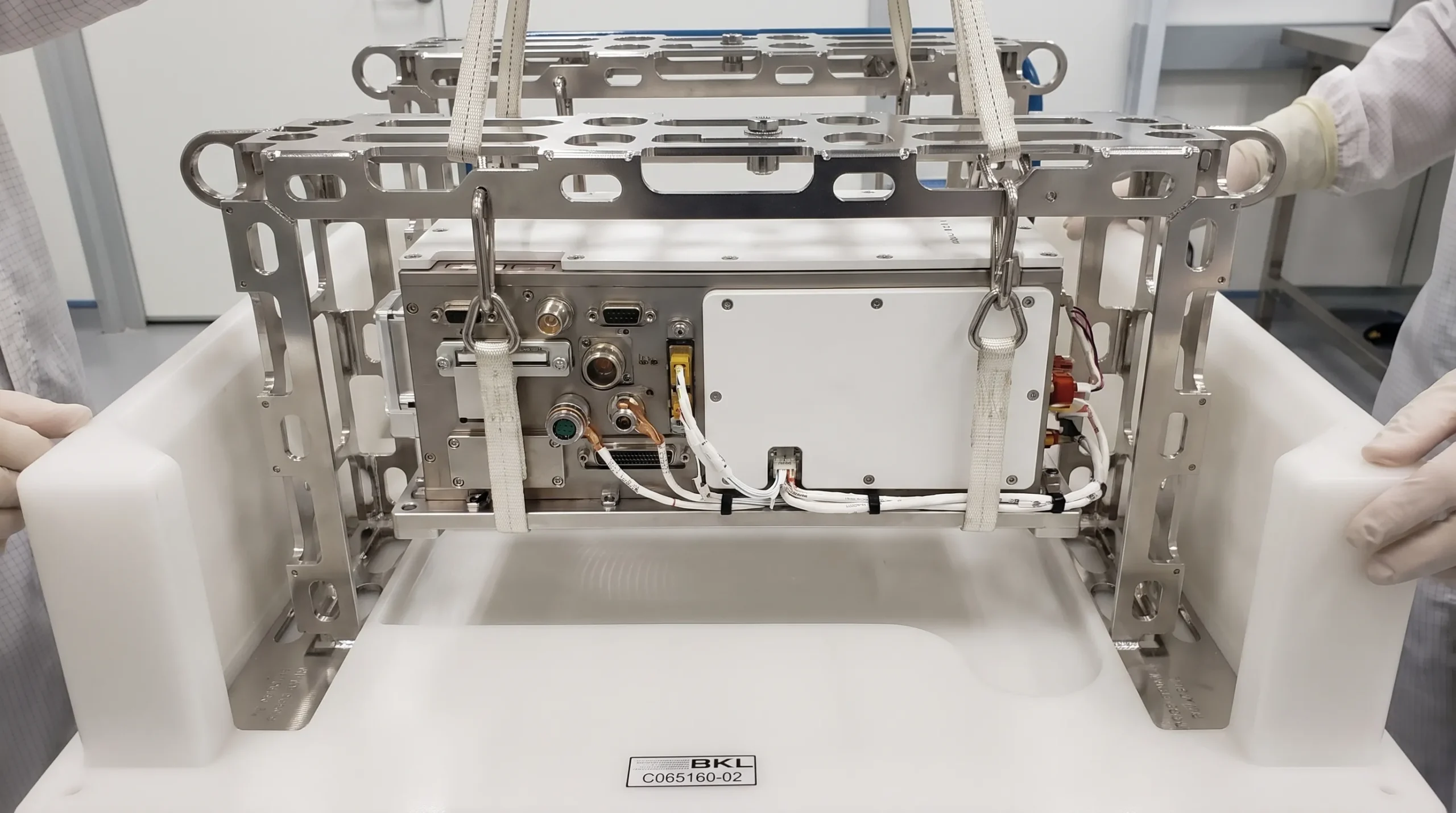
For lifting and hoisting applications, the specification should also define how the tool interfaces with cranes, hoists, lifting beams, spreader beams, mobile lifts or scissor lift tables. If the equipment is large or heavy, the challenge is often to combine contamination control with safe load control. BKL has covered this specific balance in more detail in heavy-duty cleanroom assembly without compromising safety.
The more precisely these interfaces are defined, the easier it becomes to evaluate whether a standard tool can be used, a standard tool can be modified, or a custom lifting and handling solution is required.
Decide when a standard solution is sufficient
Not every cleanroom application needs a fully custom assembly tool. A standard cleanroom lift, trolley, hoist or fixture may be the right choice when the load is simple, the risk is low, interfaces are standard and the tool can be safely used without adaptation.
Custom engineering becomes more relevant when the operation includes unusual geometry, limited access, high-value equipment, special cleanliness requirements, strict ergonomics, complex movements or safety-related constraints that standard catalogue equipment cannot address.
| Situation | Standard equipment may be sufficient when | Custom engineering should be evaluated when |
|---|---|---|
| Simple vertical lifting | The load has approved lifting points and predictable balance | The center of gravity is offset or the load must be tilted, rotated or guided |
| Cleanroom transport | The route is open, stable and suitable for existing cleanroom trolleys | The tool must pass tight airlocks, avoid sensitive zones or support alignment during transport |
| Repeated assembly operation | Operators can work safely with normal posture and simple controls | The task creates reach, force, visibility or pinch-point risks |
| Product interface | Contact points are robust and standardized | Contact is only allowed on specific surfaces or with defined pressure limits |
| Lifecycle support | Inspection and maintenance can follow supplier instructions | The tool needs application-specific inspection criteria, wear limits or load testing |
This decision should not be based on purchase price alone. A cheaper standard solution can become expensive if it causes rework, operator strain, product risk or repeated production interruptions. At the same time, custom engineering should deliver clear value through safety, usability, reliability, cleanliness or lifecycle performance.
Specify materials, surfaces and cleanroom-compatible details
Material selection is one of the most visible parts of a cleanroom assembly tool, but it should follow the functional and contamination requirements. Stainless steel, anodized aluminum and selected engineering plastics may all be appropriate in different applications. The right choice depends on load, stiffness, cleaning chemicals, wear behavior, ESD requirements, corrosion resistance, weight and manufacturing feasibility.
Pay attention to details that often determine whether the tool remains suitable after repeated use. Avoid particle traps where possible. Limit exposed threads in critical zones. Use cleanable surfaces. Consider how welds, joints, bearings, wheels, seals, cable jackets and protective covers behave under cleaning and movement. If lubrication is required, define suitable lubricants and maintenance controls.
Fasteners and small components deserve special attention. A lost screw, washer or retaining element can become foreign object debris inside sensitive equipment. In high-risk assemblies, the design should consider retained fasteners, mechanical stops, clear visual checks and maintenance procedures that reduce the chance of loose parts entering the process.
Design for ergonomic and safe operation
Cleanroom operators often work with gloves, masks, restricted visibility and limited freedom of movement. A tool that looks acceptable in a CAD model may become difficult to use when an operator is dressed for the cleanroom and working around valuable equipment.
Specify the human factors early. Define whether the tool is operated by one person or multiple people, how the operator sees alignment features, how much force is acceptable, where handles and controls should be placed, how the tool is braked or locked, and how accidental movement is prevented. Also consider whether the operator must reach over, under or around the load.
Ergonomics is not a comfort feature added after the design is finished. It is a safety control. A cleanroom assembly tool that reduces awkward posture, excessive force and unclear handling steps also reduces the chance of product damage and process variation.
Define accuracy, alignment and repeatability
Sensitive equipment often requires controlled positioning rather than simple support. The tool may need to place a module into a frame, hold an optical component in a defined orientation, align an assembly during fastening, or support a heavy subassembly while maintaining access for measurement and verification.
The specification should define tolerances, datum references, adjustment range, repeatability, locking method and acceptable play or deflection under load. If the tool includes sensors, actuators, interlocks or position feedback, define what those functions must do and how they will be tested.
Do not rely on broad statements such as accurate positioning. State the required accuracy at the relevant interface, under the relevant load and in the real operating orientation. If the requirement is uncertain, the specification can include an engineering study or concept validation step before final design release.
Address safety and conformity from the beginning
For lifting devices, assembly tools, handling equipment and mechatronic systems used in Europe, safety and conformity questions should be addressed early. Depending on the tool’s function and the legal role of the parties involved, requirements may relate to machinery safety, lifting accessories, electrical safety, control systems, risk assessment, technical documentation and CE marking.
In 2026, many companies are also preparing for the transition from the Machinery Directive 2006/42/EC to Regulation (EU) 2023/1230, which applies from January 2027. The exact conformity route depends on the tool and its intended use, so it should be assessed by competent specialists rather than treated as an administrative step at the end.
A robust specification should define responsibility for the intended use, risk assessment, calculations, verification tests, user instructions, maintenance instructions and technical documentation. For some tools, overload testing, proof load testing or formal inspection reports may be relevant. For others, the priority may be safe integration, operator instructions and documented maintenance criteria.
The key principle is simple: safety is not a final check. It should shape the concept, material choices, mechanical design, controls, documentation, inspection plan and operator use.
Specify cleaning, packaging and cleanroom entry
A cleanroom assembly tool can be well designed and still fail at the point of introduction into the cleanroom. Workshop residues, unsuitable packaging, poor storage or uncontrolled maintenance can compromise the process before the tool is ever used.
Define how the tool is cleaned before delivery, how it is packaged, how it is transported into the cleanroom and how it is stored between uses. If the tool leaves the cleanroom for repair or modification, specify the conditions for re-entry. For tools with replaceable components, include rules for spare parts, cleaning and verification before use.
Packaging should be practical for the actual facility. Large tools may need staged unpacking, dedicated transport frames, airlock planning or protected surfaces that prevent damage during movement. Small tools may need labeled containers, protective caps or double packaging where appropriate.
Include documentation, data and software interfaces
Documentation is part of the tool, especially in regulated, high-value or safety-critical environments. At minimum, the specification should define which drawings, calculations, test reports, cleaning instructions, operating instructions and maintenance records are required. If certificates, declarations or inspection reports are expected, state this explicitly and link it to the applicable scope.
Cleanroom tools are also increasingly connected to digital workflows. Maintenance status, inspection dates, usage history, calibration data, operator instructions and production readiness may need to be visible in internal systems. When the tool must exchange data with digital work instructions, maintenance platforms or AI-supported planning, it is useful to define these interfaces early. Companies that require bespoke production software sometimes work with specialists in operational AI and custom software development on EU servers to align data flows with security and deployment requirements.
Even for a purely mechanical tool, traceability matters. A clear tool ID, revision status, inspection label and controlled documentation set help maintenance, quality and production teams understand whether the tool is approved for use.
Plan inspection, maintenance and lifecycle support
A cleanroom assembly tool may remain in service for years, often under repeated load cycles and strict availability pressure. The specification should therefore include inspection and maintenance requirements from the start. This is especially important for lifting tools, hoisting interfaces, moving parts, locking mechanisms and load-bearing structures.
Define inspection intervals, acceptance criteria, wear limits, spare parts, cleaning after maintenance, storage conditions and the process for removing a tool from service. For critical lifting and handling tools, visual inspections, functional checks, load tests and documented reports may be required depending on the application and local procedures.
BKL is accredited according to ISO 17020:2012 for inspections and can support inspection activities such as visual inspections, overload testing, examinations, reports, certification where applicable and practical usage advice. The broader value is that inspection knowledge can also feed back into engineering, helping improve tool design, maintenance access and lifecycle reliability.
Use a structured specification template
A structured request for quotation gives suppliers the information needed to propose a safe, practical and commercially viable solution. It also helps internal teams align engineering, production, safety, maintenance and procurement before supplier selection.
| Specification section | Include this information |
|---|---|
| Intended use | Assembly step, operating sequence, users, frequency of use and process boundaries |
| Product data | Weight, dimensions, center of gravity, lifting points, contact restrictions and fragile zones |
| Cleanroom requirements | Classification, cleaning method, material restrictions, packaging and cleanroom entry process |
| Safety requirements | Risk scenarios, pinch points, stability, locking, emergency use and conformity expectations |
| Ergonomic requirements | Operator posture, reach, force, visibility, glove operation and required access |
| Performance requirements | Alignment accuracy, repeatability, stiffness, movement range and cycle time expectations |
| Verification | Design reviews, calculations, test plan, inspection method and acceptance criteria |
| Documentation | Drawings, manuals, maintenance instructions, test reports, inspection records and technical files |
| Lifecycle support | Service approach, spare parts, inspection intervals, requalification after repair and usage advice |
This template does not replace engineering judgement, but it gives every stakeholder a common language. It also makes trade-offs visible. For example, a lightweight tool may be easier to move but less stiff. A fully enclosed mechanism may protect operators but complicate cleaning. A manual tool may be simpler to maintain, while a mechatronic tool may improve control and repeatability.
How BKL supports cleanroom assembly tool specification
BKL develops safety-focused mechanical and mechatronic solutions for lifting, hoisting, handling, assembly and working at height. For cleanroom applications, the value is not only in producing a tool, but in connecting the complete chain: engineering, manufacturing, assembly, installation, inspection, certification where applicable, maintenance and lifecycle support.
For OEMs and first-tier suppliers, this means BKL can support a specific process step or take responsibility for a broader development route. A project may start with a concept study, risk assessment, inspection of existing equipment, custom lifting adapter, assembly fixture, cleanroom handling tool or complete module. The right scope depends on the application, the internal capacity of the customer team and the risk profile of the operation.
A good specification workshop should result in more than a concept drawing. It should produce a shared understanding of intended use, load cases, contamination risks, safety measures, documentation requirements, inspection needs and total lifecycle value. That is where smart engineering supports Quality, Logistics, Technology, Cost and Sustainability without treating safety as a separate afterthought.
FAQ's about cleanroom assembly tool specification:
What is a cleanroom assembly tool? A cleanroom assembly tool is a fixture, lifting device, handling tool, support frame or mechatronic aid designed for assembly work in a controlled environment. It must support the process while controlling cleanliness, product risk, operator safety and documentation requirements.
Which cleanroom class should I specify for the tool? Specify the cleanroom class that matches the production environment, but do not stop there. Also define contamination risks, cleaning methods, material restrictions, packaging, storage and verification criteria relevant to the equipment being assembled.
When is custom engineering needed for a cleanroom assembly tool? Custom engineering is usually worth evaluating when standard equipment cannot safely handle the load, protect sensitive interfaces, meet ergonomic requirements, support required alignment or comply with the cleanliness and documentation needs of the process.
What documentation should be requested from a supplier? Typical documentation may include drawings, calculations, risk assessment input, test reports, inspection records, cleaning instructions, user manuals, maintenance instructions and technical documentation related to conformity assessment where applicable.
How often should a cleanroom assembly tool be inspected? Inspection intervals depend on the tool type, load, frequency of use, risk level, environment and internal safety procedures. The specification should define inspection criteria, documentation requirements and the process for taking a tool out of service when wear, deformation or defects are found.
Discuss your cleanroom assembly tool with BKL
If you are preparing to specify a cleanroom assembly tool for sensitive equipment, involve engineering, safety, operations, maintenance and quality stakeholders early. The strongest specifications define not only the tool geometry, but also the load cases, cleanliness controls, operator use, verification method and lifecycle support.
BKL can help you evaluate whether a standard solution, adapted tool or custom cleanroom lifting and handling solution is the right route for your application. Contact BKL to discuss your assembly process, request an engineering review or plan a practical specification session for your next cleanroom tool project.