
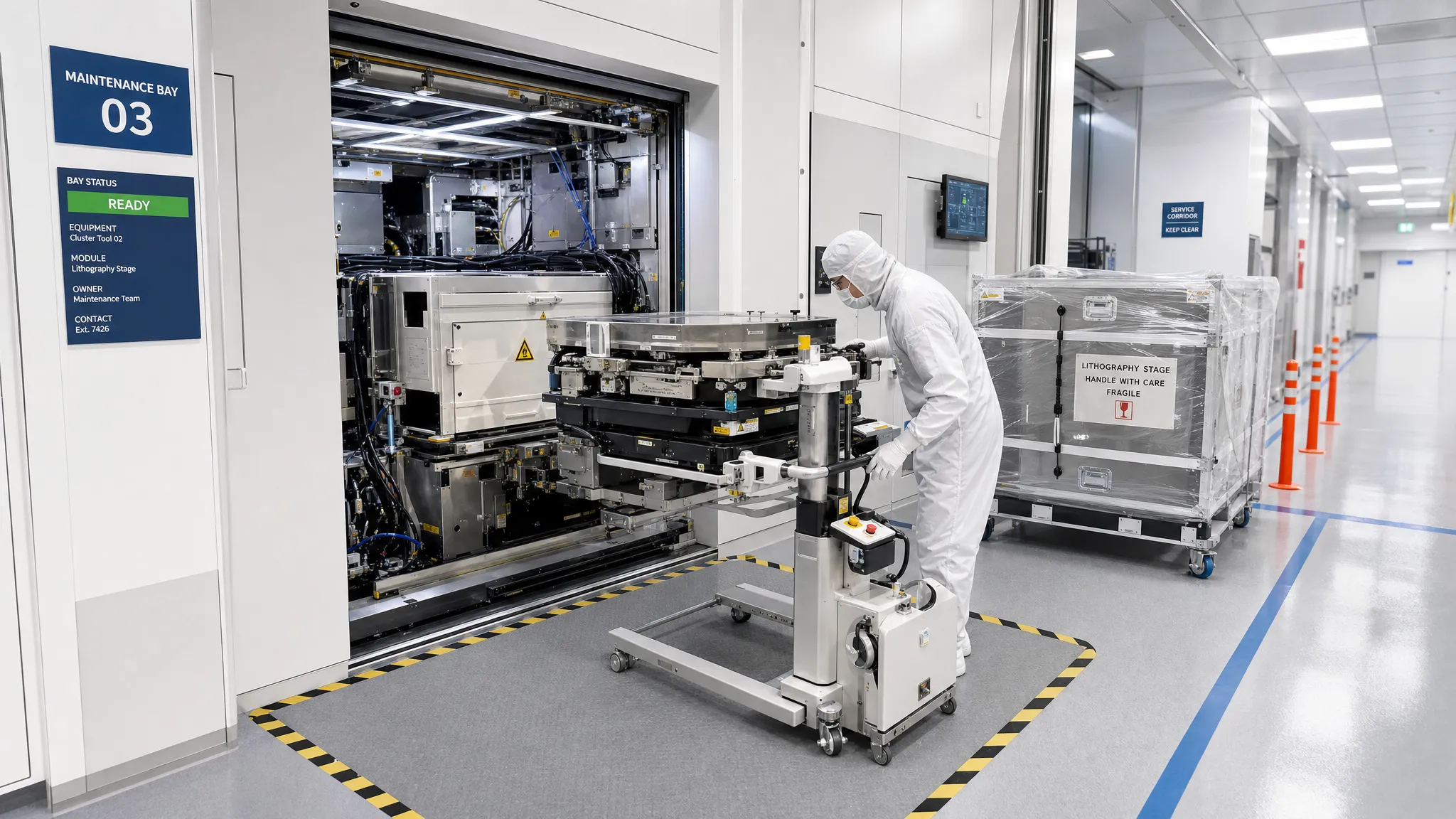
In a semiconductor clean room, workflow design is not only about achieving a cleanliness classification. It is about creating a controlled sequence of actions that protects sensitive components, supports safe work and keeps production practical under real operating conditions.
For OEMs, semiconductor equipment manufacturers and high-tech machine builders, the workflow around a module or tool can be just as critical as the technical specification of the clean room itself. A high-value component may be damaged by particles, electrostatic discharge, poor handling, uncontrolled load movement or a maintenance step that was never considered during design.
The strongest workflows are engineered before the first tool is built. They define how materials enter, how operators interact with equipment, how lifting and positioning are controlled, how safety is verified and how the system remains reliable after years of use. The priorities below help engineering, safety, operations and procurement teams make better decisions when designing or improving a semiconductor clean room workflow.
Start with the process risk, not the room classification
Clean room classification is important, but it is not a complete workflow strategy. An ISO class can describe particle concentration in the environment, but it does not automatically answer how a product should be lifted, staged, rotated, cleaned, inspected or released.
A semiconductor clean room workflow should begin with the risk profile of the product and the process. Which surfaces are critical? How long is the product exposed? Is the main risk particle contamination, electrostatic discharge, mechanical damage, thermal instability, human error or a combination of these factors? Which process steps are reversible, and which create immediate scrap or safety risk if performed incorrectly?
A practical workflow map should cover the full route from entry to release. That includes incoming parts, unpacking, gowning interfaces, cleaning steps, temporary staging, assembly, testing, rework, inspection, packaging and removal from the clean room. It should also include abnormal situations, such as a failed component, a blocked lifting path, a tool that cannot be released or an urgent maintenance intervention.
When these risks are defined early, tooling and procedures can be designed around the real constraints of the process instead of forcing operators to compensate later.
Make flow predictable for materials, people and equipment
A clean room workflow becomes vulnerable when people and materials move unpredictably. Crossings, backtracking, temporary storage and unclear handovers increase the chance of contamination and handling mistakes. They also make it harder to prove that the process is repeatable.
The layout should guide behavior. Operators should understand where items enter, where they wait, where they are processed, where they are inspected and where they leave. Clean and less-clean flows should not conflict. Waste, packaging and used tools should have a defined route out of the process rather than accumulating in work areas.
| Design priority | Why it matters | Practical design question |
|---|---|---|
| Controlled entry points | Reduces uncontrolled introduction of particles, packaging and unsuitable materials | What may enter the clean room, and in what condition? |
| Defined staging areas | Prevents informal storage and unclear product status | Is every item clearly identified as incoming, in process, inspected or rejected? |
| Predictable transport routes | Reduces collisions, awkward handling and unnecessary movement | Can the product move without crossing critical work zones? |
| Separate return flows | Prevents used tools, waste or packaging from interfering with clean work | How do nonconforming parts, waste and used fixtures leave the area? |
| Clear handover points | Improves accountability and process traceability | Who is responsible at each transfer, and what must be checked? |
Predictability is also important for emergency and maintenance scenarios. If a product is suspended from a lifting device, partially assembled in a module or positioned in a restricted envelope, the team needs a safe and documented way to stabilize the situation before troubleshooting.
Engineer lifting and handling around the real task
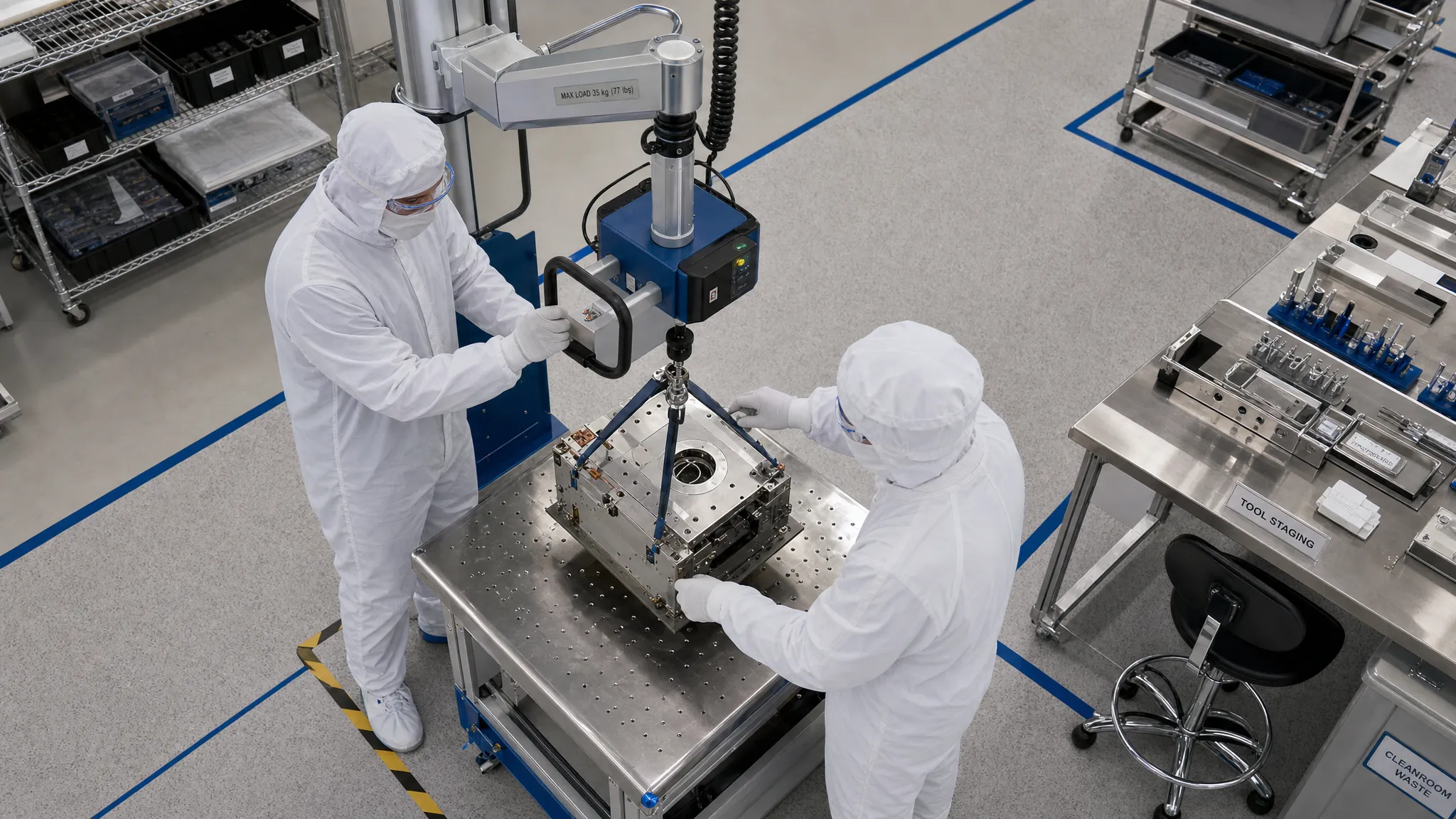
Many semiconductor clean room operations involve high-value equipment in restricted spaces. Components may be heavy, fragile, difficult to grip or sensitive to slight misalignment. The lifting or handling tool must therefore do more than meet a load capacity. It must support controlled movement, safe operator positioning and cleanroom-compatible operation.
This is where mechanical and mechatronic engineering have a direct impact on safety and quality. The design should consider the center of gravity, load path, locking method, fine positioning, clearance around the product, pinch points, operator reach and visibility. A tool that is strong but awkward to operate can still create risk if it encourages unsafe posture, uncontrolled rotation or improvised assistance.
For constrained installations, the workflow should be validated against the actual working envelope. Doorways, airlocks, ceiling height, hoist travel, floor loading, cart turning radius and access to fixing points can all affect whether a handling concept is practical. BKL has written more about these challenges in relation to safe lifting for high-value equipment and tight spaces, where the design of the lifting task is treated as part of the safety strategy rather than an afterthought.
The key question is not only whether the load can be lifted. It is whether the load can be lifted, moved, positioned, released and recovered in a controlled way by trained operators wearing clean room clothing.
Balance contamination control with operator usability
Clean room procedures often add friction to normal industrial work. Gloves reduce dexterity. Face coverings and goggles can reduce visibility. Gowning can affect communication and body movement. Cleaning and documentation steps add time. If the workflow is too difficult, operators may develop workarounds that reduce repeatability or safety.
Good workflow design makes correct behavior easier than incorrect behavior. Handles should be reachable. Controls should be visible and understandable. Locking positions should be unambiguous. Labels should remain readable after cleaning. Tools should fit the actual posture and movement range of operators in clean room garments.
Cleanliness is also a human-behavior discipline. Even in a very different care environment, customer-facing settings such as Lumina Skin Sanctuary show how structured treatment flows and visible hygiene practices help users trust a process. In semiconductor clean room work, the standards, risks and technical controls are much stricter, but the underlying lesson is similar: the workflow should make the right actions clear, consistent and easy to follow.
For technical teams, this means involving operators and maintenance staff before the workflow is frozen. A design review on paper is useful, but it will not always reveal glove clearance, awkward reach, blocked sight lines or tool cleaning issues. Practical validation helps identify these problems before they become embedded in production.
Select cleanroom-compatible materials, drives and details
A tool or module that works in a standard industrial environment may not be suitable for a semiconductor clean room. Compatibility must be considered from the engineering stage, not solved with cleaning alone at the end of production.
Material choices should account for particle generation, cleanability, corrosion resistance, wear behavior and compatibility with approved cleaning agents. Surfaces should avoid unnecessary cavities and sharp transitions where particles or residues can collect. Fasteners, bearings, guides, wheels and covers need careful selection because moving and contact parts are common sources of particles.
Mechatronic details matter as well. Cable routing should be controlled and accessible. Sensors and actuators should be protected without creating difficult-to-clean areas. Pneumatic systems may require attention to exhaust, filtration and oil-free operation depending on the process. Heat generation from drives or electronics may affect local stability. If electrostatic discharge is a concern, grounding and ESD-safe design should be part of the concept.
Cleanroom compatibility also extends to logistics. Packaging, transport frames and temporary covers should be defined before the tool enters the controlled area. Otherwise, the clean room team may receive technically correct equipment in a condition that does not fit the workflow.
Build safety, compliance and documentation into the workflow
Safety should not be treated as a final approval step after the tool or machine has been designed. In semiconductor clean room workflows, safety decisions influence layout, tooling, access, training, inspection and maintenance.
A structured risk assessment should define intended use, limits of use, reasonably foreseeable misuse, hazardous movements, load cases, operator positions and failure scenarios. For machines, lifting accessories and handling tools, the applicable EU requirements, CE marking obligations and relevant standards must be reviewed by competent specialists based on the scope of supply and intended market. With the transition from the Machinery Directive to Regulation (EU) 2023/1230, many organizations are also reviewing how future obligations may affect their internal processes and supplier expectations.
BKL approaches this subject from the perspective that safety belongs in the design process, as explained in its article on occupational safety in machine and tooling design. For a semiconductor clean room workflow, this means engineering controls, operator instructions, load tests, inspection plans and technical documentation should support each other.
| Evidence item | When to define it | Why it supports the workflow |
|---|---|---|
| Risk assessment | During concept and design development | Identifies hazards before they are locked into the workflow |
| Load calculations | Before manufacturing and testing | Supports safe design of lifting and handling equipment |
| Test and inspection reports | Before release for use | Provides evidence that defined checks have been completed |
| Cleaning and handling instructions | Before clean room introduction | Helps operators maintain the required condition of tools and parts |
| User manual and work instructions | Before operator training | Reduces variation in how the tool or process is used |
| Inspection interval and criteria | Before handover | Supports safe use throughout the equipment lifecycle |
The goal is not to create paperwork for its own sake. The goal is to make sure the workflow can be understood, operated, inspected and maintained with clear evidence behind the critical decisions.
Plan for maintenance without disrupting production unnecessarily
A workflow that performs well on day one can become a risk if inspection and maintenance were not considered. Clean room tools and modules may be difficult to remove from production. Access may be limited. Spare parts may need specific cleaning or packaging. A worn component may not be visible during normal use until it affects alignment, load stability or particle behavior.
Lifecycle planning should define what needs to be inspected, how often it should be inspected, which tests are required and how findings are documented. For lifting and handling tools, periodic visual inspections, overload testing where applicable, clear reports and practical usage advice help organizations make informed decisions about continued use, repair or replacement.
This is especially relevant for custom tools. Standard inspection checklists may not capture the actual load path, locking principle or failure modes of a project-specific lifting device. A supplier that understands the original design intent can often provide more meaningful inspection criteria and maintenance advice.
For high-tech work where clean assembly, testing or prototyping is required, BKL also operates a controlled environment cleanroom and supports clients with engineering, production, inspection and related services. That combination is useful when workflow decisions need to connect design intent with practical assembly and lifecycle support.
Align stakeholders before freezing the design
A semiconductor clean room workflow affects several departments at once. Engineering focuses on technical feasibility and performance. Operations needs repeatability and throughput. Safety teams evaluate hazards and compliance. Maintenance wants access and serviceability. Procurement compares suppliers, cost and lead time. Management looks at continuity, risk and total lifecycle value.
If these stakeholders are involved too late, the workflow can become a compromise built on assumptions. A low-cost standard tool may appear attractive until it requires manual correction, creates cleaning difficulties or cannot be inspected properly. A highly specialized custom solution may also be unnecessary if a partial improvement, better fixture, inspection or service plan solves the actual problem.
The best decision process defines acceptance criteria early. These criteria should include cleanliness requirements, load and positioning performance, operator safety, ergonomic use, documentation, inspection method, maintainability, delivery constraints and total lifecycle costs. With those criteria in place, teams can compare options on risk and operational value rather than purchase price alone.
Practical checklist for semiconductor clean room workflow design
Use the following checklist when reviewing a new or existing workflow:
- Define the required clean state for every item entering the clean room.
- Map material, personnel, tool, waste and rework flows from entry to release.
- Identify critical surfaces, exposure time and contamination risks at each step.
- Validate lifting and handling tasks in the real working envelope.
- Design controls, handles and indicators for operators wearing clean room garments.
- Select materials, surface finishes and moving components for cleanroom suitability.
- Include ESD, grounding, temperature and humidity requirements where relevant.
- Define risk assessment, CE documentation, test reports and manuals before release.
- Establish inspection intervals, acceptance criteria and service procedures.
- Review the workflow with engineering, operations, safety, maintenance and procurement.
This checklist does not replace a full engineering review, but it helps teams identify where workflow design needs more attention before equipment is released into production.
FAQ's about semiconductor clean room workflow:
What is the most important priority in a semiconductor clean room workflow? The most important priority is to define the process risk before designing the layout or tooling. Cleanliness classification matters, but the workflow must also address handling, ESD, operator safety, documentation, inspection and maintenance.
Does every semiconductor clean room workflow require custom tooling? No. Some workflows can be improved with standard equipment, better procedures, inspection, minor adaptations or partial engineering support. Custom tooling is most relevant when the product is high-value, difficult to handle, safety-critical or constrained by tight installation conditions.
How do lifting tools affect clean room quality? Lifting tools affect clean room quality through movement control, particle behavior, cleanability, operator positioning and repeatability. A poorly designed tool can introduce contamination risk or handling variation, even if the room itself meets the required classification.
When should CE and safety documentation be considered? CE requirements, risk assessment and technical documentation should be considered during concept development, not after manufacturing. The exact obligations depend on the type of machine or tool, the scope of supply and the market where it will be used.
How often should clean room lifting and handling tools be inspected? Inspection frequency depends on the tool design, intensity of use, load conditions, environment, applicable requirements and internal safety policy. The interval and inspection criteria should be defined before handover and reviewed when use conditions change.
Work with BKL on safer clean room workflows
Designing a semiconductor clean room workflow requires more than clean room knowledge alone. It requires practical engineering, safe lifting and handling expertise, manufacturing capability, inspection knowledge and an understanding of how operators use equipment in real production environments.
BKL supports OEMs, machine builders and high-tech manufacturers with mechanical and mechatronic engineering, hoisting and lifting tools, industrial modules, machines, production, inspections and lifecycle services. Whether you need support for a specific process step or a complete solution from concept to service, BKL can help translate technical requirements into safer, reliable and user-friendly equipment for demanding clean room applications.