
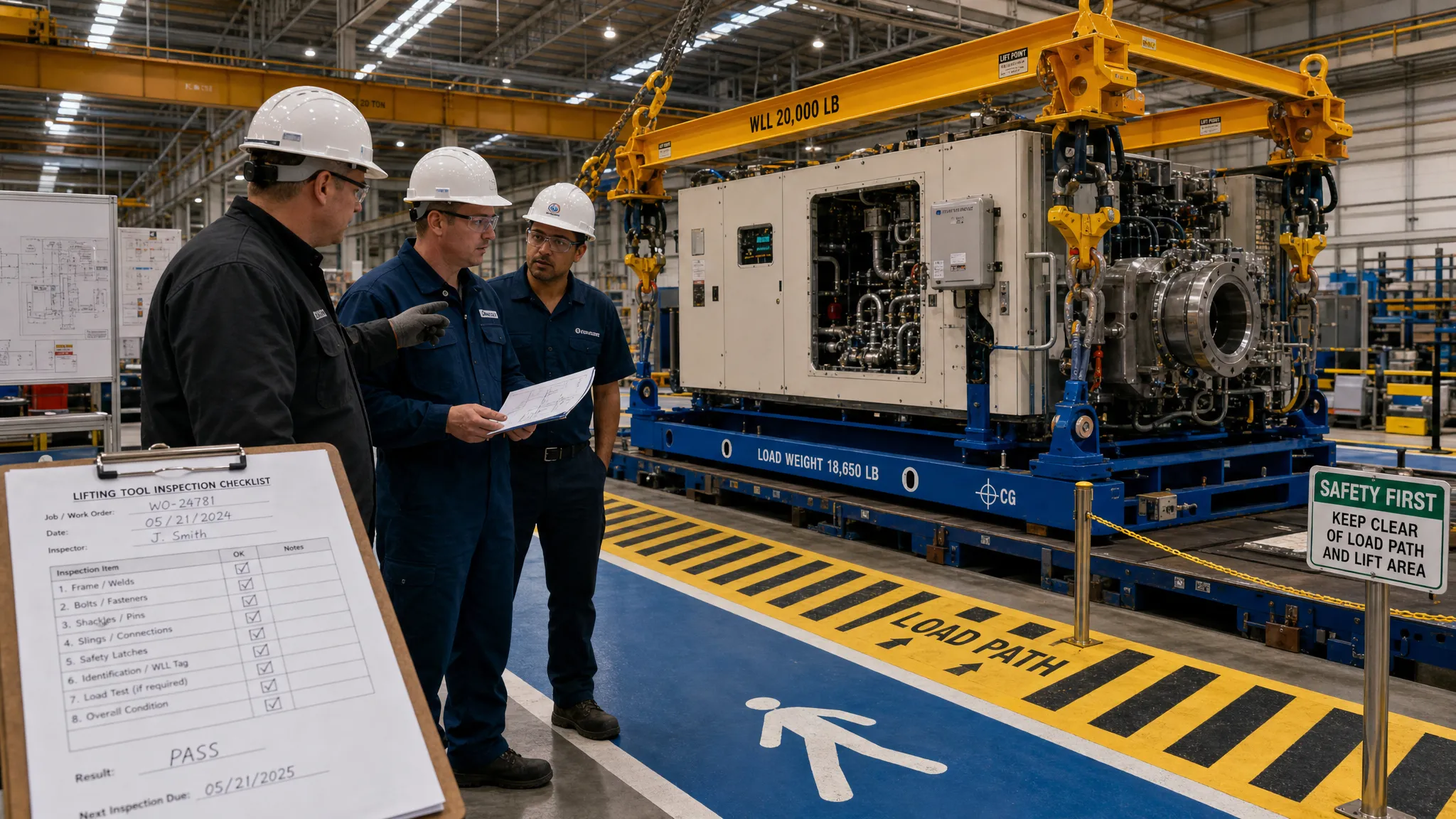
In OEM operations, lifting and hoisting safety is not limited to selecting a crane with enough capacity. The real risk often sits in the interfaces: how a valuable module is connected to a lifting tool, how the center of gravity shifts during handling, how operators position themselves, how a tool is inspected after years of use, and how design changes are controlled across production, installation and maintenance.
For machine builders, semiconductor equipment manufacturers, aerospace suppliers and high-tech OEMs, a lifting incident can damage more than the load. It can affect employee safety, production continuity, delivery reliability and customer confidence. Improving lifting and hoisting safety therefore requires a system approach: task definition, engineering, usability, compliance, inspection and lifecycle support must work together.
Why OEM lifting and hoisting risks are different
OEM environments often involve high-value equipment, limited working space, sensitive components and repeated handling tasks. A standard lifting accessory may be suitable for some operations, but it is not always enough when the load has unusual geometry, tight tolerances, fragile surfaces or restricted attachment points.
The safety challenge is also operational. The same tool may be used by different shifts, in different production stages and under time pressure. If the tool is difficult to position, if markings are unclear, or if the lifting sequence depends on undocumented experience, risk increases even when the nominal load capacity is sufficient.
Common OEM lifting and hoisting risk factors include:
- Loads with offset or uncertain centers of gravity
- Sensitive modules that cannot tolerate impact, tilting or local deformation
- Tight spaces where operators have limited visibility or escape routes
- Repeated lifting cycles that gradually affect wear points, pins, slings or bearings
- Product revisions that change weight, geometry or lifting interfaces
- Tools that remain in use after documentation, inspection status or operating limits have become unclear
The goal is not to make every lifting task complex. The goal is to understand which tasks can be handled safely with standard equipment and which tasks require engineered lifting tools, defined procedures or additional verification.
Start with the lifting task, not the lifting tool
A frequent mistake is to start by looking for a device before fully defining the task. In safety-critical OEM operations, the task should come first. The engineering team needs to understand the load, the environment, the users and the failure modes before choosing or designing the lifting solution.
A practical lifting and hoisting safety assessment should answer questions such as:
| Assessment area | Key question | Why it matters |
|---|---|---|
| Load data | What is the maximum weight, geometry and center of gravity? | Determines load capacity, stability and load path. |
| Interfaces | Where can the load be connected without damage or unintended release? | Prevents weak attachment points and unsafe adaptations. |
| Movement path | What route does the load follow during lifting, transport and positioning? | Identifies collision risks, clearance issues and operator exposure. |
| Operating conditions | Is the task performed in a clean room, production line, test area or maintenance zone? | Influences materials, ergonomics, contamination control and access. |
| Frequency | Is the lift occasional or repeated daily? | Affects fatigue, wear, inspection intervals and usability requirements. |
| Users | Who operates the tool and what training is realistic? | Supports safer controls, clear markings and practical procedures. |
| Documentation | What proof, test reports and instructions are required? | Supports traceability, compliance and future inspections. |
This early definition phase also helps avoid unnecessary cost. A minor interface improvement, updated documentation or inspection may solve some risks. In other cases, a custom lifting beam, handling tool, transport frame or mechatronic module is justified because the operational risk is too high for a generic solution.
Engineer the load path and failure modes
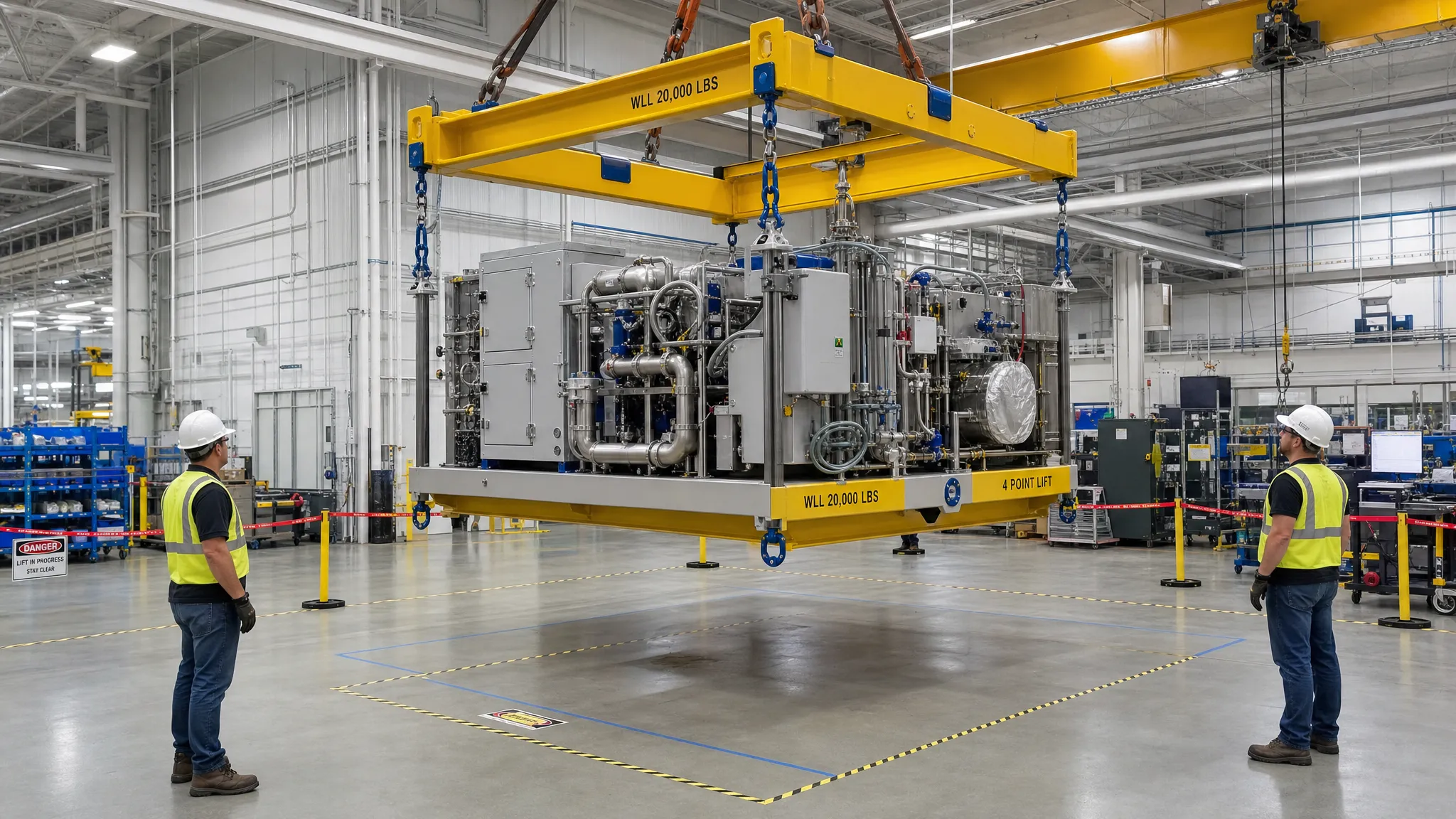
Once the task is clear, the lifting concept must be engineered around the load path. This means understanding how force travels from the hoist through the lifting accessory, connection points and load structure. Every component in that chain should be suitable for the load case, including dynamic effects, eccentric loading, accidental misalignment and realistic operator behavior.
Important engineering considerations include working load limit, safety factors, stiffness, deflection, weld quality, bolted joints, pin retention, anti-rotation features and prevention of unintended release. For powered or mechatronic tooling, control reliability, emergency stops, load holding and safe states become part of the same safety discussion.
For OEMs, the interface with the product is often the most critical part. A lifting tool can be structurally strong but still unsafe if it introduces local stress, allows tilting, damages precision surfaces or requires operators to place their hands near pinch points. Good engineering balances strength, stability, usability and product protection.
Relevant standards and legislation depend on the application, machine category and market. In Europe, lifting accessories and machinery may fall under CE-related obligations, with the Machinery Directive 2006/42/EC still relevant until the Machinery Regulation (EU) 2023/1230 becomes applicable in 2027. Standards such as EN ISO 12100 for risk assessment and EN 13155 for non-fixed load lifting attachments may be relevant, depending on the tool. These references do not replace application-specific assessment, but they provide a structured basis for safer design and documentation.
For a broader view of risk reduction in demanding environments, BKL has also discussed hoisting safety in complex industrial environments, including load paths, task definition and lifecycle thinking.
Design for operators, not only for calculations
A lifting tool can meet the calculation requirements and still create risk if it is difficult to use. OEM operations depend on repeatable work. If operators need to improvise, force parts into position or rely on memory to choose the correct lifting points, the design has not fully supported safe operation.
User-friendly lifting and hoisting tools reduce the chance of incorrect use by making the right action obvious. This can include asymmetric interfaces that only fit in the correct orientation, clear lifting point markings, guarded pinch zones, handles positioned outside danger areas, readable load labels and simple visual confirmation that locking pins are engaged.
Ergonomics also matters. Operators should not need to reach under suspended loads, manually steady unstable equipment or work in awkward positions for extended periods. In many OEM facilities, the safest solution is not simply a stronger tool, but a tool that reduces manual correction during alignment, transport or installation.
This is why safety should be considered from the first design steps, not added as a checklist item at the end. The connection between engineering decisions and operator behavior is central to occupational safety in machine and tooling design, especially where tools are used repeatedly in production and maintenance.
Treat lifting data as part of operational control
OEMs increasingly manage lifting tools as part of a wider operational system. Inspection status, test certificates, manuals, load limits, repair history and change records should be easy to access and kept under control. When documentation is fragmented across suppliers, spreadsheets and local files, it becomes harder to prove that a tool is still suitable for use.
Digital traceability does not replace engineering judgment, but it supports it. A reliable data structure helps teams see which tools are available, which tools are due for inspection, which tools have been modified and which tools should be removed from service. For multi-site OEMs, this becomes especially important because similar tools may be used in different factories under different conditions.
If an organization is modernizing operational traceability, analytics or data governance across multiple sites, it can be useful to study how technology partners approach open, hybrid digital infrastructure and data governance. The industrial safety principle is similar: critical data should be structured, controlled and usable by the people who make operational decisions.
Verify before use and keep verifying during the lifecycle
Verification is where engineering intent is compared with real equipment. Before a lifting or hoisting tool is released for use, it should be checked against the design requirements, calculations, drawings, load rating and intended operating conditions. Depending on the tool, this may include dimensional checks, material verification, weld inspection, functional testing and overload or proof load testing.
Periodic inspection is just as important. A tool that was safe at delivery can become unsafe because of wear, corrosion, deformation, overloaded use, missing components or undocumented modifications. Visual inspection can identify obvious damage, but safety-critical equipment may also require more detailed examination based on use, risk and applicable requirements.
| Verification activity | Typical purpose | Practical output |
|---|---|---|
| Visuele inspectie | Detect damage, deformation, corrosion, missing parts or incorrect use. | Inspection report and usage advice. |
| Functional check | Confirm moving parts, locking systems and controls work as intended. | Release, repair advice or removal from service. |
| Overload or proof load test | Verify the tool can withstand a defined test load under controlled conditions. | Test record and confirmation of tested condition. |
| Documentation review | Check drawings, manuals, certificates and load markings against actual use. | Updated file, corrected instructions or change request. |
| Post-repair inspection | Confirm repairs have restored the tool to the required condition. | Return-to-service decision based on evidence. |
BKL is accredited according to ISO 17020:2012 for inspections and can support visual inspections, overload testing, examinations, reports and practical usage advice. This matters for OEMs because inspection quality depends not only on checking a list, but also on understanding the tool, the load and the way the equipment is used in production, installation or maintenance.
Control changes before they create hidden risk
OEM products evolve. A module may gain weight, a housing may change material, a lifting point may move, or a production sequence may be adjusted. These changes can invalidate assumptions behind an existing lifting tool. If change control is weak, the tool may still look familiar while the risk profile has changed.
Lifting and hoisting safety should therefore be included in engineering change processes. When a product or process changes, teams should ask whether the lifting method, tool capacity, center of gravity, contact surfaces, clearances and instructions are still valid. This is especially important when a tool is used for multiple product variants.
Change control should also cover repairs and modifications to the lifting tool itself. Welding an additional bracket, replacing a pin with a locally available alternative or changing a control component may seem practical in the moment, but it can affect load rating, documentation and future inspection decisions. For safety-critical tooling, modifications should be assessed and documented by competent specialists.
Improve availability without compromising safety
Production managers are often concerned that inspections, repairs and load tests will interrupt operations. That concern is valid, especially when a specific tool is required to keep a production line moving. However, postponing inspection because the tool still appears to function can increase risk and may lead to longer downtime if damage is found late.
A better approach is to manage availability proactively. This can include planned inspection intervals, spare critical components, clear repair routes, tool status tracking and coordination between operations, maintenance and inspection partners. For critical production tooling, lifecycle planning should start at delivery, not after the first failure.
BKL supports engineering, production, inspection and service activities, which helps reduce handover problems between separate suppliers. For teams focused on uptime, the connection between inspection planning, repair capability and operational continuity is also discussed in BKL’s article on increasing tooling availability.
Align responsibilities across engineering, EHS, maintenance and procurement
Lifting and hoisting safety is rarely owned by one department. Engineering may design the tool, EHS may assess workplace risk, operations may use it daily, maintenance may repair it and procurement may select suppliers. If these roles are not aligned, important requirements can be missed.
| Role | Contribution to safer lifting and hoisting |
|---|---|
| Engineering | Defines load cases, interfaces, calculations, drawings and technical documentation. |
| EHS or safety management | Reviews workplace risk, operator exposure, training needs and safe work instructions. |
| Werkzaamheden | Confirms whether the tool fits the real workflow, space constraints and production rhythm. |
| Maintenance | Assesses maintainability, wear points, repair access and return-to-service needs. |
| Procurement | Selects suppliers based on technical capability, documentation, inspection support and lifecycle value. |
| Management | Sets priorities for safety, uptime, investment decisions and cross-functional ownership. |
This alignment is important during supplier selection. Choosing the lowest initial cost can be attractive, but it may create hidden lifecycle costs if the tool is difficult to inspect, hard to repair, poorly documented or unsuitable for future product variants. For OEM operations, total value includes safe use, production efficiency, documentation quality and long-term support.
A practical improvement roadmap for OEM teams
Improvement does not always require replacing every tool. A structured roadmap can identify high-risk gaps first and help teams prioritize action.
- Create an inventory of lifting and hoisting tools: Record tool identification, load rating, location, owner, inspection status, documentation status and typical use.
- Rank tasks by risk and operational importance: Prioritize high-value loads, frequent lifts, constrained spaces, unclear documentation and tools with known wear or repair history.
- Validate the critical load cases: Check weight, center of gravity, attachment points, route, operator position and product variants against the current lifting method.
- Review usability in the real working environment: Observe the task and identify where operators must improvise, reach into danger zones or rely on informal knowledge.
- Close documentation gaps: Update drawings, manuals, markings, test reports, inspection records and safe use instructions where needed.
- Plan inspection and lifecycle support: Define inspection intervals, repair procedures, escalation rules and responsibilities before a tool fails or becomes unavailable.
- Integrate lifting safety into change control: Make lifting impact assessment part of product, process and tooling changes.
This roadmap helps turn lifting and hoisting safety from a reactive activity into a controlled operational process. It also gives engineering managers, safety managers and production leaders a shared language for investment decisions.
Where BKL can support OEM operations
BKL works as a technical service provider in mechanics and mechatronics, with specific expertise in hoisting and lifting tools, industrial modules and machines. Support can cover individual process steps or a complete solution, from concept development and engineering to manufacturing, inspection, documentation and lifecycle service.
For OEMs, this combination is valuable because safety-critical lifting tools require both technical design knowledge and practical understanding of how equipment is used. A drawing alone is not enough. The tool must be manufacturable, inspectable, maintainable and understandable for operators. It must also fit the real production, installation or maintenance environment.
BKL can support manufacturers with product safety, risk assessment and CE-related conformity assessment processes, including technical documentation. This does not remove the need for project-specific responsibility and review, but it helps teams manage safety and compliance in a structured way.
FAQ's about lifting and hoisting safety in OEM operations:
What is the first step to improve lifting and hoisting safety in OEM operations? Start by defining the lifting task in detail. Identify the load, center of gravity, attachment points, movement path, operating environment, users, frequency and documentation requirements before selecting or designing a tool.
Does every OEM lifting task require a custom lifting tool? No. Standard equipment may be suitable when the load, interface and environment match the intended use of that equipment. Custom engineering becomes more relevant when loads are high-value, fragile, asymmetric, space-constrained or repeated in a safety-critical process.
How often should lifting and hoisting tools be inspected? Inspection frequency depends on the tool, usage intensity, environment, applicable requirements and risk level. OEMs should define inspection intervals based on competent assessment and should also inspect after overload, damage, repair, modification or unusual events.
What documentation is important for lifting tools? Important documentation can include drawings, calculations, load rating, manuals, test reports, inspection records, CE-related technical documentation where applicable, repair history and clear usage instructions. The exact file depends on the tool and its application.
Why is operator usability part of lifting safety? Operators influence how a tool is used in real conditions. Clear markings, accessible controls, safe hand positions, visual confirmation of locking and intuitive interfaces reduce the need for improvisation and help make correct use more repeatable.
How can OEMs reduce downtime caused by inspection or repair? Plan inspections, maintain tool records, define repair routes, keep critical spare parts where appropriate and coordinate lifecycle support before a tool becomes unavailable. Proactive planning improves availability without ignoring safety requirements.
Make lifting and hoisting safety part of the full lifecycle
Safer OEM operations depend on more than a compliant tool at delivery. They require engineering decisions that reflect the real load, practical operation, documentation, inspection and maintenance needs throughout the tool’s life.
If your organization handles valuable equipment, complex modules or safety-critical production tooling, BKL can help assess, design, manufacture, inspect and support lifting and hoisting solutions that fit the application. The result is a more controlled process, with better insight into risk, usability and lifecycle reliability.