
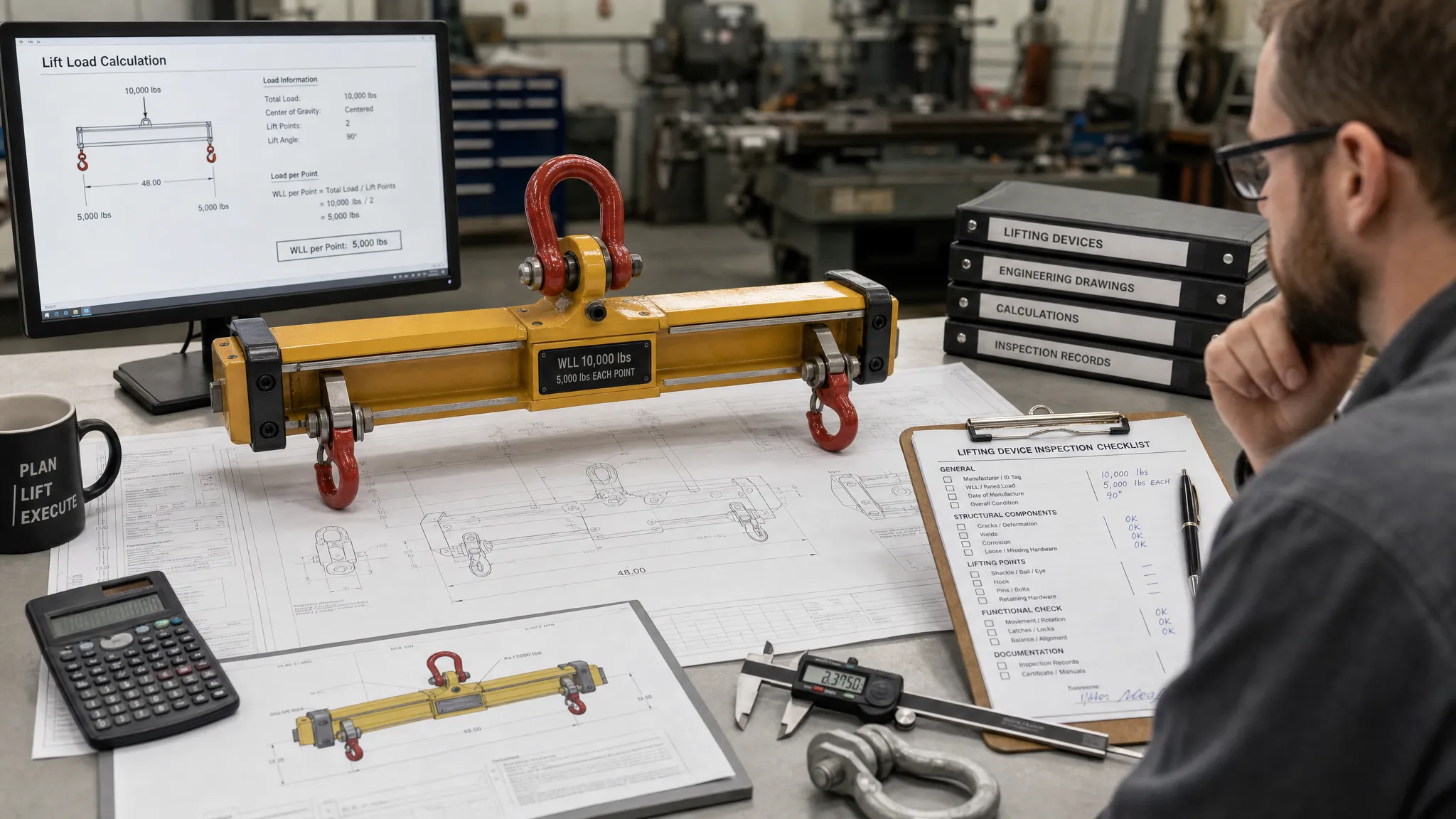
In high-tech manufacturing, aerospace, semiconductor equipment and industrial production, occupational safety is not a separate checklist after engineering is complete. It is a design requirement that affects load paths, machine movements, operator access, control logic, documentation, inspections and maintenance.
This is especially true for hoisting tools, lifting fixtures, handling equipment, industrial modules and custom machines. These assets often move valuable components, operate in constrained workspaces and depend on predictable interaction between people, mechanics and mechatronics. A design that works technically can still create risk if it is difficult to operate, hard to inspect or unclear during maintenance.
Good machine and tooling design therefore starts with one practical question: how will people use this equipment safely during its complete lifecycle?
Why occupational safety starts before a tool is built
The safest time to reduce risk is before steel is cut, parts are machined or control systems are programmed. At that stage, engineers can still change the concept, remove hazardous movements, improve ergonomics, simplify operator actions and define how the equipment will be tested and inspected.
When safety is treated as a final approval step, the project team often has fewer options. A guard may be added where a better layout would have removed the hazard. A warning label may be used where an interlock, mechanical stop or improved access point would have been more effective. A lifting tool may pass a basic load test, while still being awkward for operators to position accurately in the real production environment.
For OEMs, machine builders and industrial manufacturers, this has direct business impact. Poor safety integration can lead to rework, delayed acceptance, unclear CE documentation, operator frustration, avoidable downtime and increased lifecycle costs. In safety-critical applications, the design process itself must be structured around risk reduction.
From risk assessment to engineering requirements
A practical risk assessment is not just a document. It is a way to translate real operating conditions into technical decisions. Standards such as ISO 12100 provide a widely used framework for risk assessment and risk reduction in machinery design. Depending on the machine, additional standards may apply for electrical equipment, control systems, lifting accessories, guarding, ergonomics or specific industrial environments.
In the EU, machinery safety is also linked to conformity assessment and CE marking. The European Commission explains the transition to the Machinery Regulation, which will replace the Machinery Directive from 20 January 2027. For manufacturers and equipment owners, this reinforces the need to keep risk assessment, technical documentation and lifecycle responsibilities under control.
A useful risk assessment should consider more than the intended production cycle. It should also address installation, adjustment, cleaning, troubleshooting, inspection, repair, transport, storage and disposal. Many incidents occur outside normal production, when people are under time pressure, when a tool is used infrequently or when equipment has gradually worn over time.
| Risk input | Engineering question | Design implication |
|---|---|---|
| Load weight and center of gravity | Can the load shift, rotate or tilt unexpectedly? | Define stable load paths, locking points and safety factors. |
| Operator access | Where do hands, feet and bodies need to be during use? | Improve clearances, handles, working height and guarding. |
| Motion and energy | What happens if power, pressure or control signals are lost? | Add safe stopping, load holding, mechanical stops or controlled release. |
| Environment | Is the tool used in a cleanroom, workshop, aircraft hangar or production line? | Select suitable materials, finishes, contamination controls and maintenance access. |
| Inspection needs | Which parts will wear, deform or crack over time? | Make critical areas visible, measurable and accessible for periodic checks. |
| Documentation | What must operators, maintenance teams and inspectors know? | Provide clear instructions, test reports, usage limits and inspection criteria. |
This approach helps prevent safety from becoming a vague ambition. It turns occupational safety into measurable engineering requirements.
Design principles that make machines and tools safer to use
Safe equipment is rarely the result of one single feature. It comes from many design decisions that work together. In machine and tooling design, the most effective safety improvements often come from simple, robust choices that match the actual working environment.
Remove or reduce hazards at the source
The first preference is always to eliminate a hazard where reasonably possible. If an operator does not need to stand near a suspended load, the tooling layout should support that. If a heavy component can be guided mechanically instead of manually aligned, the design should reduce the need for physical force. If an adjustment point can be moved outside a danger zone, that should be considered before relying on procedure alone.
For lifting and handling tools, this may involve fixed interfaces, guided positioning, stable support structures, defined pick-up points or mechanical features that prevent incorrect orientation. In machine modules, it may involve safer access panels, fewer pinch points, better guarding or control sequences that reduce exposure to moving parts.
Control motion, force and load transfer
Many machine and tooling risks involve uncontrolled energy. A load may swing, a cylinder may move too quickly, a mechanism may descend under gravity or a fixture may release stored energy during maintenance. Safer design requires engineers to understand how force moves through the system.
This includes calculating load cases, defining safety factors, selecting suitable actuators, designing for stiffness, verifying welds and connections, and controlling the speed and sequence of movements. In mechatronic systems, the mechanical concept and control logic must be developed together. A control system cannot fully compensate for an unstable mechanical design, and a robust mechanical design still needs safe operating logic.
Design for real operators, not ideal operators
A machine or tool may be technically correct and still unsafe if it is difficult to use. Operators work in real conditions: limited space, gloves, protective clothing, shift changes, production pressure, noise, variable lighting and sometimes repetitive tasks.
User-friendly design supports occupational safety by making the correct action clear and practical. This can include intuitive handles, visible markings, logical controls, stable working positions, ergonomic lifting heights, clear access for fasteners and indicators that confirm whether a tool is locked or released.
A safe design should not depend on operators remembering a complicated sequence every time. It should guide safe behavior through the physical design, controls and documentation.
Make inspection and maintenance part of the design
Equipment that cannot be inspected properly becomes a lifecycle risk. Critical welds, pins, hooks, bolts, bearings, contact surfaces and load-bearing structures must be accessible enough for visual checks, measurements, non-destructive examination or replacement when required.
For high-value industrial tools, inspection access is not a detail. It determines whether the owner can prove that the equipment remains in safe condition after years of use. Designing for maintainability also reduces downtime, because service teams can identify wear, replace parts and return equipment to operation more efficiently.
Compliance and CE documentation are part of engineering quality
CE marking is often discussed at the end of a project, but the technical basis must be created throughout the design process. A conformity assessment relies on decisions made during concept development, engineering, manufacturing, testing and documentation.
For machines and safety-critical tools, the technical file may include risk assessments, drawings, calculations, control descriptions, test results, manuals, declarations, inspection instructions and information about applied standards. The exact content depends on the type of equipment and applicable legislation.
The practical value of this documentation is often underestimated. It helps engineering teams understand design limits. It helps operators use equipment correctly. It helps maintenance teams inspect the right areas. It helps management demonstrate that safety has been addressed systematically. It also supports future modifications, because changes can be assessed against the original design assumptions.
Documentation should be accurate, understandable and aligned with the actual equipment. A manual that does not match the delivered machine creates confusion. A test report without clear load conditions has limited value. A risk assessment that does not reflect real use may miss important hazards.
Manufacturing quality and testing close the loop
Even the best design can fail if manufacturing quality is inconsistent. For lifting tools, handling equipment and industrial modules, production details matter: material selection, machining accuracy, welding quality, assembly sequence, fastening methods, surface treatment and final verification all influence safe use.
Testing should be based on the intended function and risk profile of the equipment. For lifting tools, overload testing may be required or specified. For machine modules, functional testing, control verification and mechanical checks may be needed. In some cases, environmental requirements such as cleanroom compatibility, contamination control or aviation maintenance conditions also influence acceptance.
The goal of testing is not only to pass a requirement. It is to confirm that the built equipment behaves as intended, that the documentation matches the final product and that any usage limits are clear before the tool or machine enters operation.
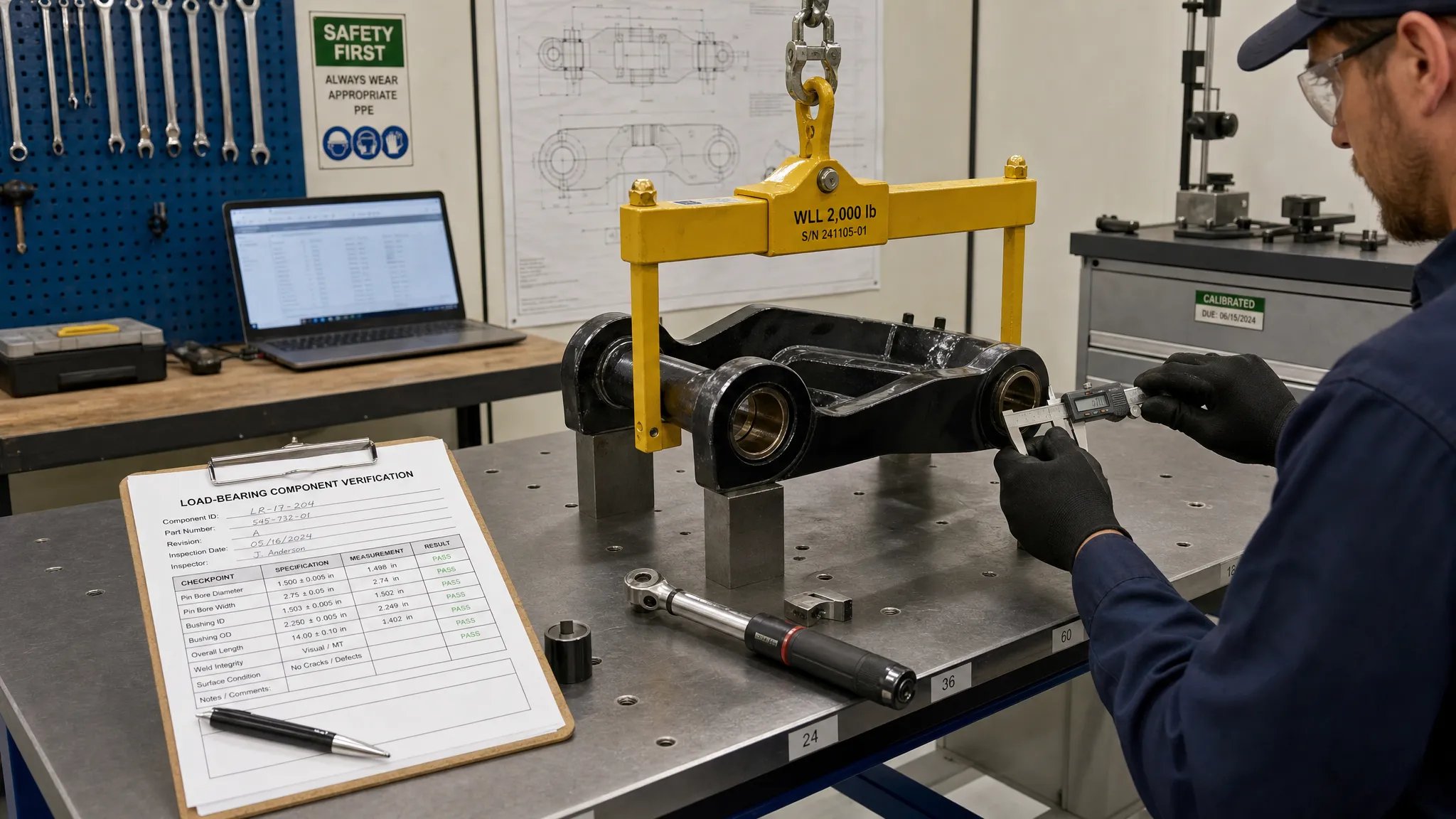
Occupational safety across the complete lifecycle
Machine and tooling safety does not stop at delivery. Over time, equipment is exposed to wear, deformation, contamination, impacts, modifications and changing production conditions. A tool that was safe when delivered may require adjustment, repair, re-inspection or replacement after intensive use.
Periodic inspections are especially important for lifting and handling tools because visible function does not always prove structural integrity. A fixture may still lift, clamp or move, while hidden wear or small cracks are developing in critical areas. Clear inspection intervals, load test records and practical usage advice help maintenance and safety teams manage this risk.
Lifecycle support should include feedback from operators and maintenance teams. They often see early warning signs first: difficult alignment, unusual noise, increased force, damaged markings, loose connections or recurring failures. When this feedback reaches engineering, it can support improvements in the existing tool or the next design generation.
This is where full lifecycle thinking creates value. The same engineering knowledge that defines the original load case can also help assess damage, decide whether repair is possible and determine whether a modification affects safe use.
Connected machines and mechatronics add new safety considerations
Modern industrial equipment increasingly combines mechanics, sensors, actuators, control systems and digital documentation. This can improve precision and usability, but it also increases the need for clear interfaces between mechanical engineering, electrical engineering, software and maintenance.
For mechatronic systems, occupational safety depends on reliable interaction between the physical machine and the control architecture. Emergency stops, safe speed, position monitoring, interlocks, fault detection and reset behavior must be considered in relation to the actual hazards. A safe control function should be validated against the machine behavior it is intended to control.
Digital continuity also matters. Maintenance data, inspection records, drawings and manuals must remain available and controlled. In connected production environments, broader operational resilience can involve specialists in infrastructure, networks and cybersecurity, such as providers of managed IT and cybersecurity services, alongside mechanical and mechatronic partners.
This does not mean every tool needs advanced digital features. It means that when digital systems are part of the equipment or its maintenance process, they must be treated as part of the safety and availability strategy.
Questions to ask before approving a machine or tooling design
Before a new machine, lifting tool or industrial module is approved, engineering, safety, operations, maintenance and procurement teams should look beyond the purchase price. The right questions help reveal whether the solution will support safe and efficient use over time.
- Does the design remove hazards where possible, or does it mainly rely on warnings and procedures?
- Are load cases, center of gravity, dynamic effects and failure modes clearly defined?
- Can operators use the equipment safely in the real workspace, with normal protective equipment and production constraints?
- Are inspection points accessible, and are inspection criteria documented clearly?
- Have manufacturing quality, testing and acceptance requirements been defined before production starts?
- Is CE documentation or other required technical documentation complete enough for the intended use?
- Is there a plan for maintenance, repair, re-inspection and lifecycle support?
These questions help prevent short-term decisions from creating long-term risk. A lower initial cost may become expensive if the tool is difficult to inspect, causes downtime, frustrates operators or needs redesign after commissioning.
How BKL supports safer machine and tooling design
BKL supports companies that need safe, reliable and user-friendly technical solutions in mechanics and mechatronics. This includes hoisting and lifting tools, industrial modules and machines for demanding environments such as high-tech, semiconductor, optical, aerospace and industrial manufacturing.
The value is not limited to one phase of the project. BKL can support individual process steps, such as engineering, production, inspection or service, or provide a more complete solution from concept development through manufacturing, testing, documentation and lifecycle support.
Safety is considered from the first design steps. That means understanding how the equipment will be used, where the risks are, how operators interact with it and how the solution will remain inspectable and serviceable during operation. BKL also supports manufacturers with product safety, risk assessment and CE-related technical documentation, without treating compliance as a final administrative exercise.
Because BKL combines engineering knowledge with manufacturing and inspection capabilities, the team can connect design intent with practical execution. This is important for custom lifting tools and handling equipment, where standard inspection approaches may not be enough. BKL is accredited according to ISO 17020:2012 for inspections and can provide visual inspections, overload testing, examinations, reports and usage advice.
For companies that want to improve safe lifting practices specifically, BKL also shares practical guidance on hoisting safety in complex industrial environments.
FAQ's about occupational safety in machine and tooling design:
What does occupational safety mean in machine and tooling design? It means designing equipment so that people can install, operate, inspect, maintain and service it with controlled risk. This includes mechanical design, mechatronics, ergonomics, documentation, testing and lifecycle support.
Why should safety be considered before manufacturing starts? Early design decisions determine load paths, access, guarding, control logic, inspection points and usability. If hazards are discovered after manufacturing, solutions are often more expensive, less effective or more disruptive to production.
Is CE marking enough to prove that a machine or tool is safe? CE marking is part of a conformity assessment process, but it should be supported by appropriate risk assessment, technical documentation, testing and clear instructions. It should not be treated as a standalone sticker or a substitute for good engineering.
How often should lifting tools and safety-critical equipment be inspected? Inspection frequency depends on the type of equipment, intensity of use, operating environment, applicable requirements and risk level. A competent inspection partner can help define practical intervals and provide reports, load testing and usage advice where appropriate.
Does every application need a fully custom machine or tool? No. Some situations can be improved with an inspection, repair, modification, partial engineering support or a standard solution. Custom design is most valuable when the load, environment, process or safety requirements cannot be handled properly by existing equipment.
Build safety into the design, not around it
Occupational safety improves when engineering, production, inspection and maintenance work together from the start. For machine builders, OEMs and industrial manufacturers, this means choosing technical solutions that are not only strong and accurate, but also practical, inspectable and safe to operate.
BKL helps companies develop, manufacture, inspect and maintain tools, modules and machines for safety-critical industrial applications. If you are reviewing an existing tool, planning a new lifting solution or looking for lifecycle support for complex equipment, contact BKL to discuss the safest and most practical next step.