
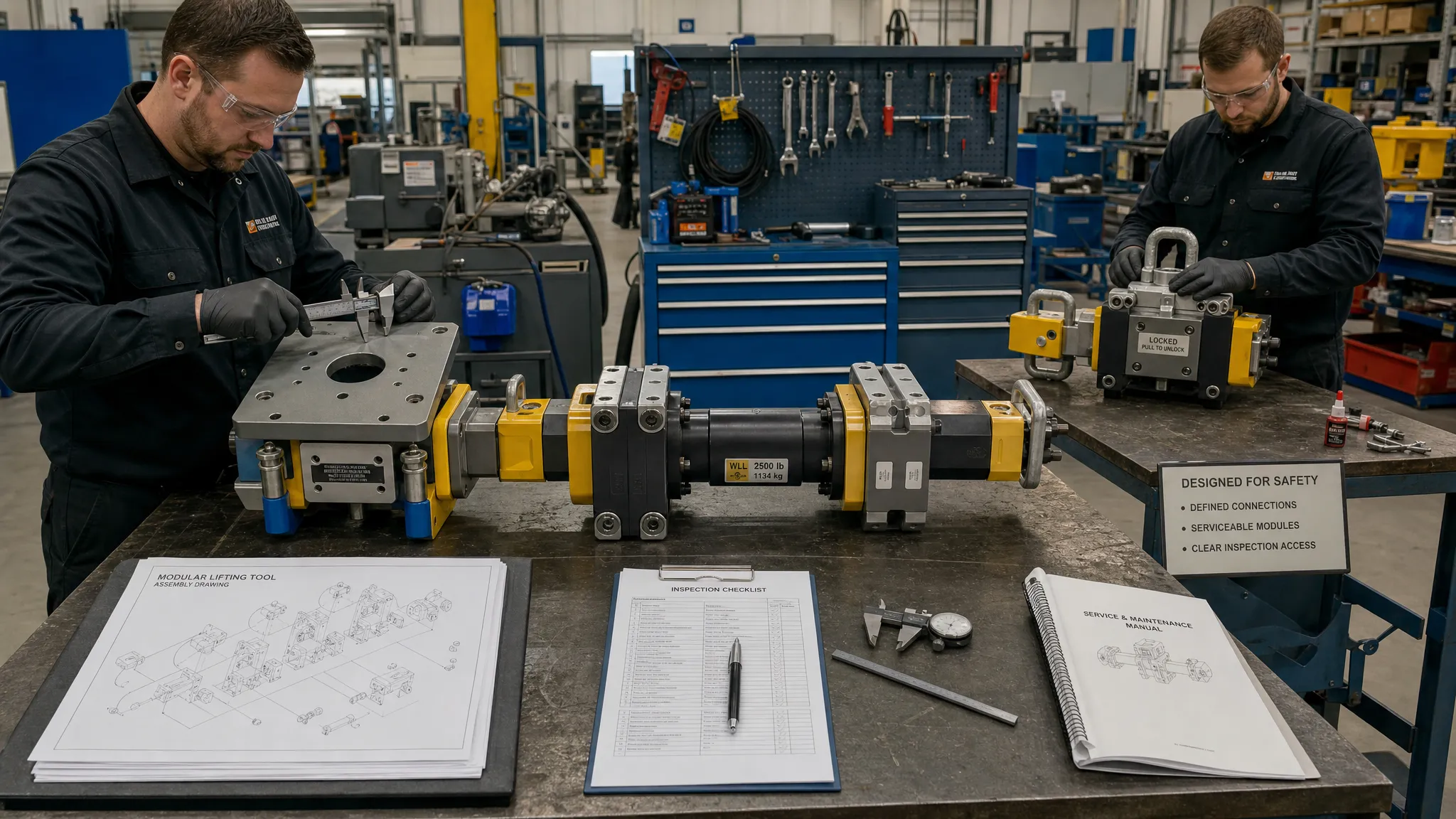
Industrial equipment becomes safer when risk is reduced by design, not when safety is treated as a final checklist item. That is where modular design can add real value. For OEMs, machine builders, high-tech manufacturers and industrial operations, a modular approach can make equipment easier to verify, maintain, inspect, adapt and operate safely.
But modular does not automatically mean safer. A machine or lifting tool made from interchangeable sections can introduce new risks if the interfaces are unclear, the load path is poorly understood or configurations are changed without proper assessment. The safety benefit comes from disciplined engineering: defined boundaries, verified connections, controlled documentation and lifecycle support.
For safety-critical tools, modules and machines, modular design is most effective when it helps operators, maintenance teams and inspectors understand exactly how the equipment should be used, loaded, checked and serviced.
What modular design means in safety-critical equipment
In industrial engineering, modular design means that equipment is built from defined functional units. These units can be combined, replaced, serviced or adapted without redesigning the entire system. A module can be mechanical, electrical, pneumatic, hydraulic, mechatronic or structural.
In a safety-critical context, a module is not simply a convenient subassembly. It has a clear function, a defined operating envelope and documented interfaces with other parts of the system. That includes details such as allowable loads, fixation points, alignment features, connection methods, sensor integration, maintenance access and inspection requirements.
For example, a custom lifting tool for high-value equipment may include a base frame, exchangeable lifting adapters, adjustable supports and a locking mechanism. If these parts are designed as controlled modules, the user can adapt the tool to different product variants without improvising unsafe workarounds. If they are not controlled, the same flexibility can become a source of misuse.
This is why modularity should be evaluated through the same safety lens as any other machine or tool design. Risk assessment, usability, verification, documentation and inspection remain essential.
When modular design improves industrial equipment safety
Modular design is especially valuable when industrial equipment must support variation without losing control. Many high-tech, semiconductor, optical, aerospace and manufacturing environments work with short product cycles, expensive assemblies and strict operational requirements. In these conditions, equipment often needs to evolve while remaining safe and predictable.
The table below shows practical situations where modular design can improve safety, provided the modules are properly engineered and documented.
| Industrial situation | Safety value of modular design | Engineering condition that must be controlled |
|---|---|---|
| Multiple product variants handled on one line | Reduces improvised adapters and uncontrolled modifications | Each configuration must have a verified load case and usage instruction |
| Complex lifting or positioning tasks | Allows dedicated lifting points, supports and guides per variant | The full load path and center of gravity must be assessed |
| Maintenance in restricted spaces | Enables easier removal of sections for access and repair | Disconnection, reassembly and lockout steps must be clear |
| Equipment used over many years | Makes it easier to replace worn parts or upgrade functions | Replacement modules must match original safety assumptions |
| Small-scale or complex series production | Supports repeatable manufacturing and inspection of proven elements | Tolerances, interfaces and documentation must be controlled |
| High-value or fragile equipment handling | Reduces unnecessary contact, manual handling and operator strain | Interfaces must prevent incorrect positioning or overload |
The common factor is control. Modular design makes industrial equipment safer when it reduces ambiguity. It should make the correct way of working easier than the incorrect way of working.
For lifting and handling applications, this starts with understanding the task itself. Load weight alone is not enough. The actual working environment, approach angle, operator position, available clearance, center of gravity, lifting sequence and equipment condition all influence safety. BKL has also covered this broader approach in its article on how to improve hoisting safety in complex industrial environments.
How modularity can reduce safety risk
A well-designed modular system can support safety in several practical ways. These benefits are not theoretical. They directly affect the daily work of operators, maintenance teams, inspectors and production managers.
The load path becomes clearer
In lifting tools, handling frames and machine modules, the load path must be understood from the point of contact to the final support structure. Modular design can make that path easier to analyze because each section has a defined role.
Instead of relying on a one-off assembly with many unknowns, engineers can calculate and verify known modules and their connections. This helps determine whether the load is transferred safely through pins, welds, bolts, bearings, supports or lifting points. It also helps inspectors focus on the areas where stress, wear or deformation are most relevant.
This only works when the interfaces are engineered, not assumed. A modular lifting adapter, for instance, must be assessed for its own strength and for how it affects the rest of the tool. The safest module is not the strongest part in isolation. It is the part that performs correctly within the complete system.
Interfaces can be designed to prevent incorrect use
Many incidents and near misses start with small deviations from the intended use. A part is mounted in the wrong orientation. A tool is used for a product variant it was not designed for. A temporary spacer becomes a permanent workaround.
Modular design can reduce these risks through physical and functional constraints. Examples include asymmetric mounting patterns, dedicated locating features, mechanical stops, clear locking positions, protected connectors and visual indicators. In mechatronic systems, sensors or interlocks may support correct positioning or sequence control, depending on the application.
The principle is simple: if a module should only fit one way, the design should make the wrong way difficult or impossible. This supports operators without relying entirely on memory, training or warning labels.
Maintenance and inspection become more practical
Equipment that is difficult to inspect is more likely to hide wear, deformation, contamination or damage. Modular design can improve access by allowing specific parts to be removed, checked, replaced or tested without dismantling the entire machine.
For maintenance teams, this can reduce unnecessary downtime. For safety managers, it can improve confidence that critical parts are actually being examined. For procurement and management, it can reduce lifecycle uncertainty because serviceable modules are easier to plan for than complex welded or integrated structures with limited access.
The inspection strategy should be part of the design. If a high-stress component needs periodic visual inspection, access must be possible. If overload testing is required, the test setup should be considered before delivery. If a module has a defined replacement interval, the documentation must make that clear.
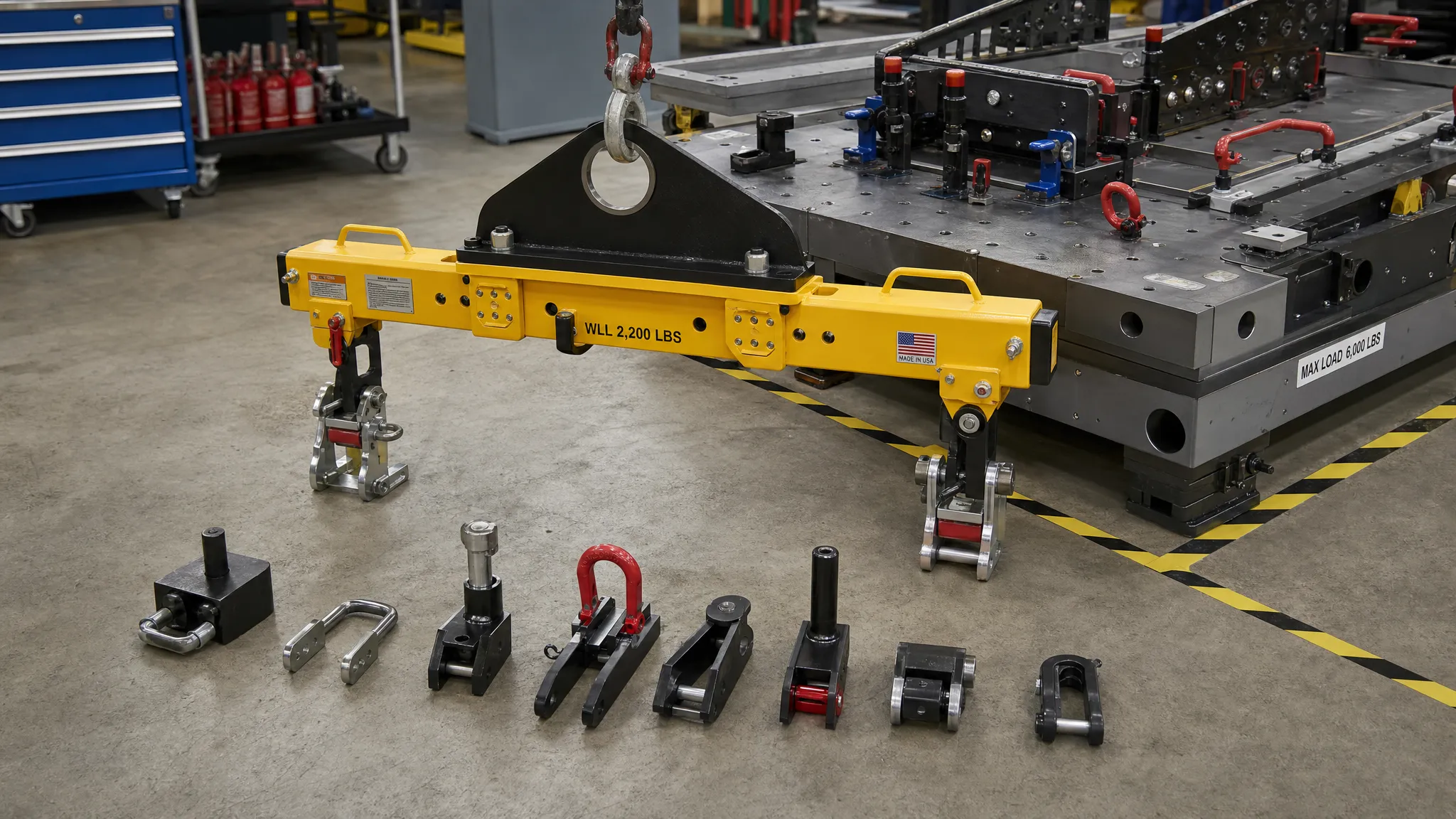
Where modular design can create new risks
Modularity adds interfaces. Every interface is a potential risk point if it is not engineered, manufactured, assembled, inspected and documented correctly. This is why modular design should not be treated as a shortcut.
A common problem is uncontrolled configurability. If a tool can be assembled in many ways, users may create combinations that were never assessed. A design that looks flexible on paper can become unsafe in operation when teams are under time pressure and need to keep production moving.
Another risk is tolerance accumulation. Individual modules may be within tolerance, but the complete assembly may create misalignment, uneven loading or unexpected stress. This is especially relevant in precision equipment, semiconductor environments and high-value machine modules where small deviations can have large operational consequences.
Modular systems can also suffer from documentation drift. A module is replaced, a bracket is modified, a sensor is moved or an adapter is added, but the technical file, manual, inspection checklist or risk assessment is not updated. Over time, the physical equipment no longer matches the documented equipment.
The following comparison helps distinguish safe modularity from risky modularity.
| Safe modular design | Risky modular design |
|---|---|
| Interfaces are calculated, tested and documented | Interfaces are treated as standard connections without application review |
| Allowed configurations are clearly defined | Users can create unverified combinations |
| Modules are designed for inspection and maintenance | Critical areas are hidden or difficult to access |
| Operators receive clear usage instructions | Correct use depends on informal knowledge |
| Changes trigger review of risk, documentation and testing | Modifications are made without lifecycle control |
| Manufacturing tolerances are managed across the assembly | Tolerance stack-up is only discovered during use |
The goal is not to avoid modular design. The goal is to apply it with enough engineering discipline to prevent flexibility from becoming uncertainty.
Designing modular equipment for real factory use
A safe modular system starts with the working environment. Engineers need to understand who uses the equipment, how often it is used, where it is stored, what can go wrong during setup and how the equipment behaves after years of operation.
This is closely related to the principle that occupational safety should be integrated at the start of machine and tooling development. BKL explains this in more detail in its article on occupational safety in machine and tooling design.
For modular industrial equipment, practical design questions include:
- Which configurations are allowed, and how are they identified?
- Can the wrong module be installed by mistake?
- Are lifting points, locking mechanisms and supports visible to the operator?
- Can critical components be inspected without excessive disassembly?
- Does the documentation match the real production, installation and maintenance process?
- Are replacement parts controlled so that the safety assumptions remain valid?
These questions are relevant for both new equipment and existing systems that need to be adapted. Sometimes the safest solution is a new custom tool. In other cases, a partial redesign, additional adapter, inspection update or improved documentation may be sufficient.
Compliance, CE marking and documentation
For machines and certain lifting or handling tools used in the European market, compliance and technical documentation are an important part of safety control. Modular design can support this process, but it can also complicate it if configurations are not clearly managed.
A conformity assessment should consider the equipment as it will actually be used. If the same base machine can accept multiple modules, then the safety implications of those modules must be assessed. This may include mechanical strength, stability, guarding, ergonomics, control functions, residual risks, manuals, labels, inspection instructions and test reports.
Standards and legislation such as ISO 12100 for risk assessment principles, machinery-related EU requirements and relevant lifting equipment standards may apply depending on the application. The exact route depends on the type of equipment, its intended use and the manufacturer’s responsibilities.
The practical point is that documentation should not be an administrative afterthought. For modular equipment, documentation is part of the safety system. It defines what is allowed, what has been verified, how the equipment should be operated and how it should be maintained over time.
Why modular design matters for OEMs and high-tech manufacturers
OEMs and machine builders face pressure to deliver efficient equipment while managing safety, cost, lead time and product variation. Modular design can help when it creates repeatable building blocks that can be reused across projects without ignoring the specific risk profile of each application.
For high-tech and semiconductor equipment manufacturers, modularity can also support clean assembly, controlled handling and predictable maintenance. If a module must be installed in a restricted space, transported through a clean environment or positioned near sensitive components, the tool design must match the physical reality of the task.
For companies scaling technical solutions commercially, engineering repeatability matters as much as sales demand. If growth teams are building market demand through internal efforts or specialized B2B customer acquisition systems, the equipment platform still needs to support safe, documented and repeatable delivery.
This is where modular design becomes a management topic, not only an engineering topic. It affects operator safety, production continuity, inspection planning, spare part strategy, procurement decisions and total lifecycle cost.
The role of lifecycle support
The safety value of modular equipment does not end after delivery. Modules may be removed, replaced, inspected, overloaded, repaired or adapted. Usage intensity may increase. Operators may change. Product variants may evolve.
A lifecycle approach helps keep the equipment aligned with its original safety assumptions. This can include periodic inspections, overload testing where applicable, visual examinations, usage advice, repair support, documentation updates and review of modifications.
BKL’s broader view of safety throughout concept, engineering, production, use and maintenance is also reflected in its article on how safety engineering reduces risk across the lifecycle.
For modular tools and machines, lifecycle control is especially important because the system is designed to change. Change must be managed. A replaced module should not introduce new uncertainty. A modified adapter should not bypass the original risk assessment. A repaired lifting component should return to service with appropriate inspection evidence and clear usage advice.
How BKL approaches modular industrial equipment
BKL is a technical service provider in mechanics and mechatronics with a strong focus on safer, smarter industrial solutions. The team supports clients with engineering, production, inspections and related services for hoisting and lifting tools, industrial modules and machines.
For modular equipment, that combination matters. Safety depends on the connection between design intent, manufacturability, verification, documentation, inspection and service. A module that is well designed but poorly manufactured can still create risk. A tool that is safe at delivery but never inspected may become unreliable over time.
BKL can support individual process steps or complete solutions, depending on the client’s needs. That may include concept development, mechanical and mechatronic engineering, manufacturing of small-scale and complex series, inspection, load testing, reporting, usage advice and lifecycle service. BKL is accredited according to ISO 17020:2012 for inspections, which supports structured inspection work for safety-critical equipment.
The practical value is continuity. When engineering, production, inspection and service are aligned, the safety assumptions made at the start of a project are easier to preserve throughout the equipment’s lifecycle.
FAQ's about modular design and industrial equipment safety:
Does modular design always make industrial equipment safer? No. Modular design improves safety only when interfaces, configurations, load paths, documentation and inspection requirements are properly engineered and controlled. Poorly managed modularity can introduce new risks.
When is modular design most useful for lifting and handling tools? It is useful when one tool must support multiple product variants, restricted working spaces or changing maintenance tasks. Each allowed configuration must still be assessed for load, stability, usability and safe operation.
How does modular design support maintenance? It can make specific parts easier to remove, inspect, replace or test. This supports planned maintenance and can reduce unnecessary disassembly, provided the modules and procedures are clearly documented.
What documentation is needed for modular industrial equipment? Documentation should define allowed configurations, operating limits, assembly instructions, inspection points, test evidence, maintenance requirements and residual risks. For CE-related processes, the required technical documentation depends on the equipment and its intended use.
Can existing equipment be made safer with modular improvements? In some cases, yes. A targeted adapter, improved locking feature, clearer interface, updated inspection plan or redesigned module may reduce risk. The existing equipment should first be reviewed to understand the actual task, condition and safety limitations.
Make modular design a controlled safety advantage
Modular design can make industrial equipment safer when it creates clarity: clear functions, clear interfaces, clear configurations and clear lifecycle responsibilities. It helps most when it reduces improvisation and supports real factory use.
If your organization works with lifting tools, handling equipment, industrial modules or safety-critical machines, BKL can help assess whether modular design is the right approach. From engineering and manufacturing to inspections and lifecycle support, the focus is the same: equipment that is practical to use, reliable to maintain and designed with safety from the start.