
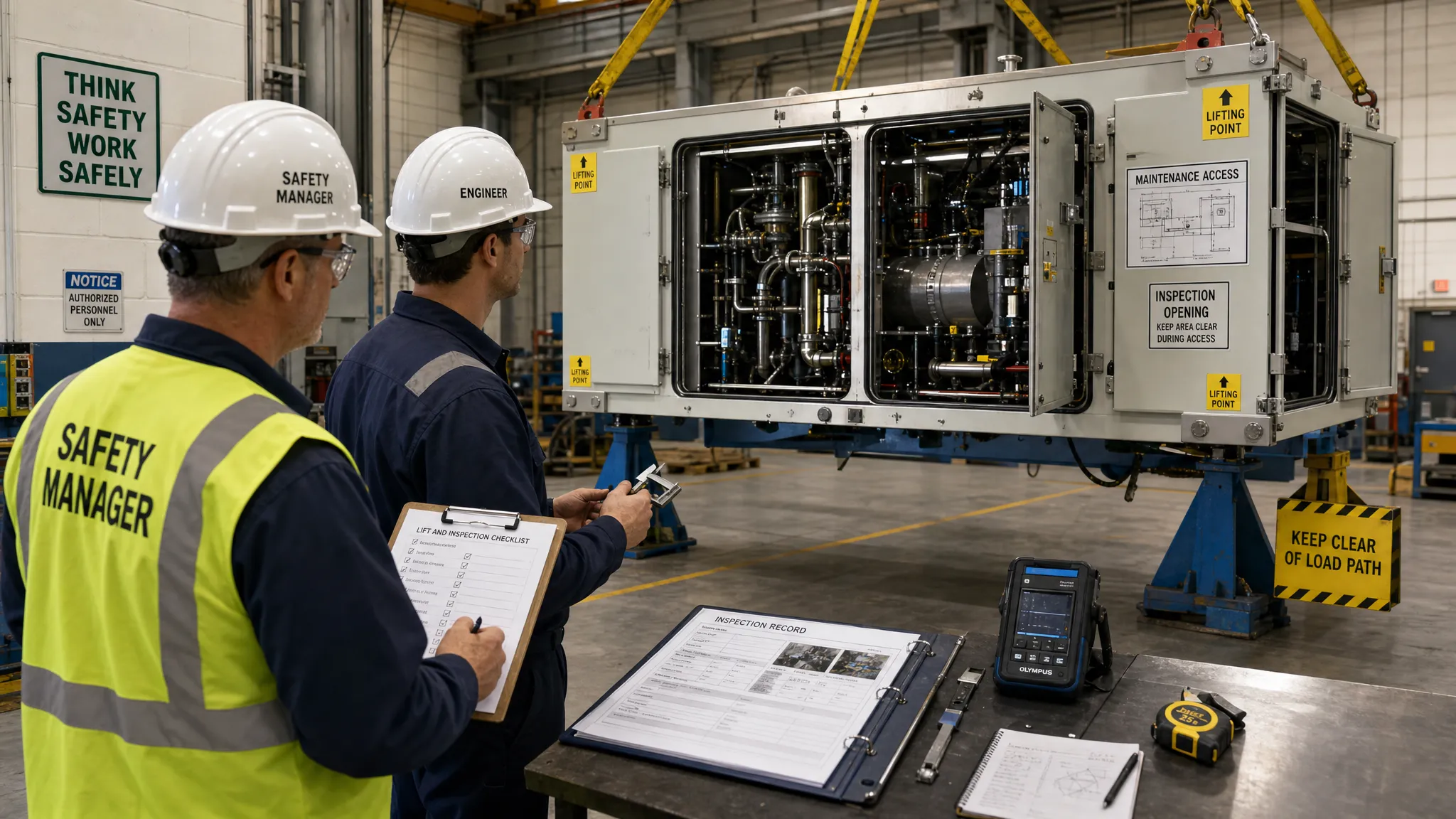
Company safety is often treated as a policy topic, but in industrial environments it is also an uptime and compliance issue. A lifting tool that is difficult to position, a module with unclear maintenance access or a machine that lacks usable documentation can all create the same business problem: production uncertainty.
For OEMs, machine builders, high-tech manufacturers and maintenance teams, safety is not separate from operational performance. It influences how reliably equipment can be used, how quickly operators can work without improvisation and how confidently managers can prove that tools and machines remain fit for purpose.
The strongest company safety approach is built into the full lifecycle. It starts with engineering decisions, continues through manufacturing and testing, and remains active through inspections, service, modifications and eventual replacement. When handled this way, safety supports both uptime and compliance without turning into a last-minute obstacle.
What company safety means beyond procedures
Company safety includes procedures, training and personal protective equipment, but those measures are only part of the system. In safety-critical industrial applications, the foundation is technical: the load path, interfaces, controls, access points, documentation and maintenance concept must all make safe use practical.
A lifting beam with a clear working load limit, controlled attachment points and a predictable center of gravity is easier to use correctly than a tool that depends on operator judgement every time. A maintenance platform with proper access, guarding and ergonomic reach reduces the need for improvised workarounds. A machine module with well-considered controls and readable instructions helps operators make the right decision under time pressure.
This is why safety should be considered early in the design process. Once a tool or machine has been built, safety improvements can become more expensive, more disruptive or less effective. BKL discusses this principle in more detail in its article on occupational safety in machine and tooling design, where risk reduction is treated as an engineering responsibility rather than a final inspection task.
For management teams, the practical point is simple: a safe design is often a more controllable design. It defines intended use, limits, inspection criteria and maintenance requirements clearly enough that the organization is not dependent on tribal knowledge.
Why safer tools and machines protect uptime
Uptime is not only affected by mechanical failure. It is also affected by hesitation, uncertainty, rework and emergency interventions. If an operator is unsure whether a lifting tool can be used for a specific configuration, work stops. If a fixture has visible wear but no inspection history, maintenance has to investigate before production can continue. If a machine is difficult to clean or access, planned service takes longer than expected.
A mature company safety approach reduces these interruptions by making the safe way of working the easiest and most repeatable way of working. It does not promise that downtime will never happen, but it makes failures, inspections and service needs easier to manage.
Key uptime benefits often include:
- More predictable operations because tools are designed around the real handling task, not just nominal load data.
- Fewer operator workarounds because access, ergonomics and control points are considered during engineering.
- Faster troubleshooting because technical files, test reports and inspection records are available when questions arise.
- Better planning because inspection intervals, load testing and maintenance needs are known in advance.
- Reduced risk of extended stops because defects can be identified before they become urgent production problems.
This is especially relevant in high-value environments such as semicon, optical systems, aerospace, aviation and complex machine building. In these sectors, the cost of damaging a module or interrupting a production process can be far higher than the cost of engineering, inspecting or improving the tool correctly.
Compliance becomes easier when evidence is created from the start
Compliance is often discussed near delivery, when CE marking, instructions, declarations, risk assessments and technical documentation need to be completed. That timing can create pressure. If the engineering process has not captured the right information, teams may have to reconstruct decisions after the fact.
A better approach is to create compliance evidence as the design matures. Risk assessments, calculations, drawings, verification results, load test reports, manuals and inspection criteria should reflect the actual equipment and its intended use. This does not remove the need for competent review, but it makes conformity assessment more structured and defensible.
At European level, the Machinery Regulation (EU) 2023/1230 will apply from 20 January 2027 and replaces the Machinery Directive after its transition period. Manufacturers and technical teams should treat this as a planning issue, not only a legal issue. Equipment that is designed, documented and maintained systematically is easier to assess than equipment that relies on assumptions.
| Company safety element | Uptime contribution | Compliance contribution |
|---|---|---|
| Clear intended use and operating limits | Reduces incorrect use and stop-work discussions | Supports risk assessment and instructions |
| Engineered load paths and interfaces | Makes lifting and handling repeatable | Supports calculations and verification |
| Usable guarding, access and controls | Helps operators work without improvisation | Supports safe design principles |
| Inspection and load test records | Enables planned maintenance decisions | Provides traceable evidence of condition |
| Technical documentation and manuals | Speeds troubleshooting and training | Supports conformity assessment and lifecycle records |
Documentation should not be treated as paperwork for its own sake. It is part of the safety architecture. When a maintenance manager, operator, auditor or safety manager can quickly see how a tool was designed, tested, used and inspected, decisions become faster and more reliable.
Practical scenarios where safety, uptime and compliance meet
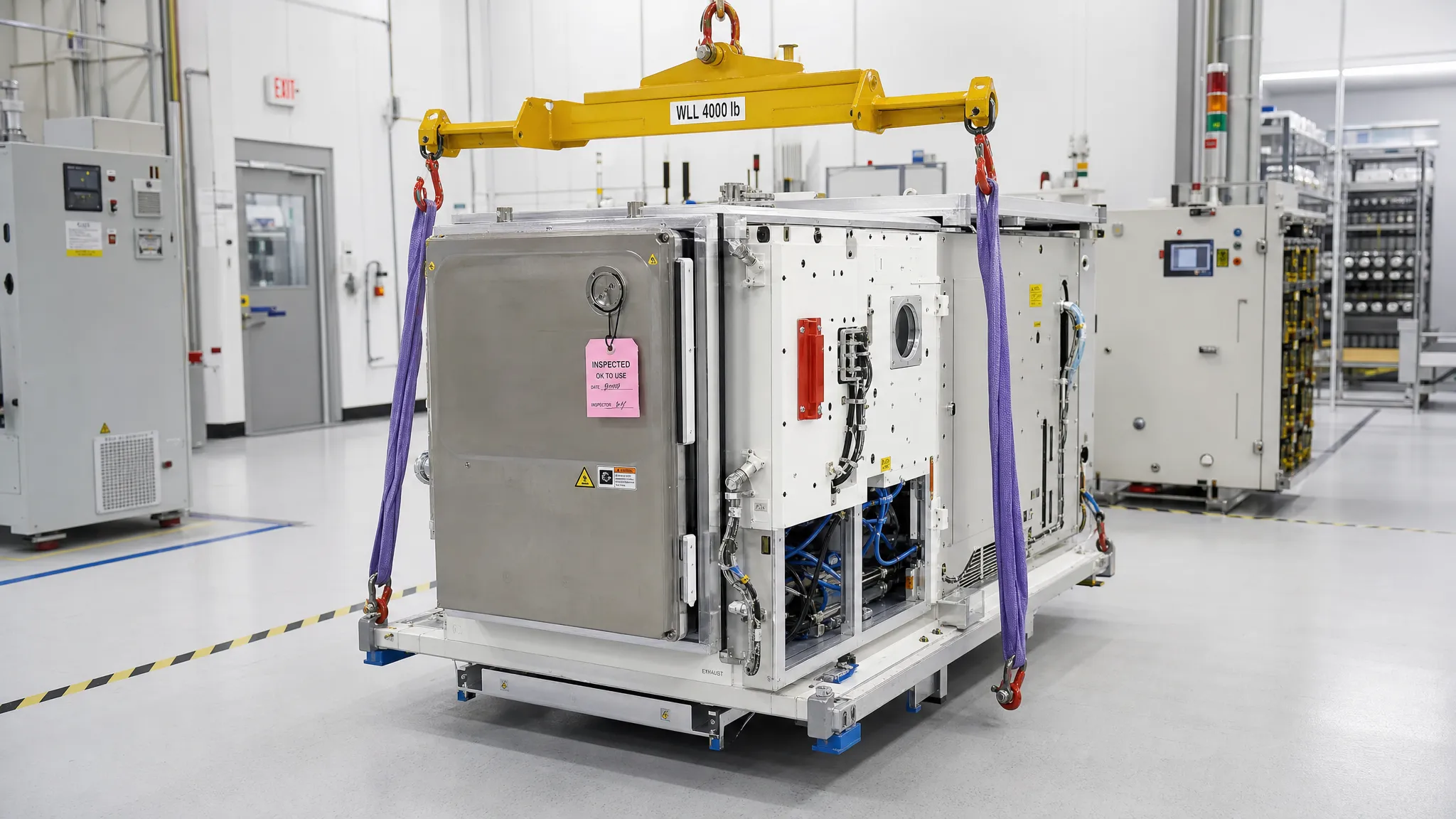
A custom lifting tool for a high-value module is a clear example. The tool may need to protect sensitive components, operate in limited space and align with specific lifting points. If the design does not control the center of gravity or protect against incorrect attachment, operators may compensate manually. That creates safety risk and slows the task. A properly engineered solution defines the load path, the handling sequence and the inspection points before the tool enters production. For more detail on this type of application, BKL has also explained how bespoke lifting solutions improve safety and uptime.
An industrial module creates a different but related challenge. The module may be safe during normal operation, but difficult to maintain. If service access requires awkward postures, temporary removal of guards or work near stored energy, maintenance tasks become slower and riskier. Designing for maintainability improves availability because service can be performed more consistently and with less disruption.
Existing equipment is another common scenario. A lifting tool may still look functional after years of use, but wear, deformation, corrosion, missing markings or undocumented modifications can change its risk profile. Visual inspection, overload testing where appropriate, examination reports and practical usage advice help companies decide whether the tool can remain in service, needs repair or should be replaced.
Company safety also matters when the physical work environment changes. During facility expansions, layout modifications or building work, responsibilities, access routes and handover points must be controlled. The same planning discipline used for industrial tooling is relevant when organizations coordinate specialist commercial renovation services alongside operational areas, although factory environments add specific risks such as lifting operations, machine interfaces and production continuity.
Turning company safety into an engineering workflow
Company safety becomes effective when it is translated into repeatable engineering and operational steps. For safety-critical tools, machines and modules, the workflow should connect design intent to real use.
- Define the task accurately: Identify the load, environment, operators, access limitations, required precision, failure modes and maintenance conditions before choosing a solution.
- Assess risk early: Evaluate hazards related to lifting, handling, movement, stored energy, ergonomics, controls, guarding, misuse and foreseeable abnormal situations.
- Engineer controls into the design: Prefer technical measures such as stable interfaces, mechanical stops, guarded zones, controlled lifting points and clear operating limits before relying on instructions alone.
- Verify before release: Use calculations, checks, functional testing, load testing where relevant and documented review to confirm that the design matches the intended use.
- Document for real users: Provide manuals, markings, inspection criteria and usage advice that operators and maintenance teams can apply in the actual work environment.
- Manage changes during the lifecycle: Reassess tools after modifications, repairs, changed loads, new configurations, incidents or significant wear.
This workflow helps avoid a common problem: equipment that is technically clever but difficult to use safely. For industrial companies, usability is not a secondary feature. If a solution is hard to position, hard to inspect or hard to understand, the risk of misuse increases.
Why inspections and lifecycle support matter after delivery
Even a well-designed tool or machine changes over time. Loads may vary, production volumes may increase, operators may change and wear may develop in areas that are not obvious during daily use. A company safety program therefore needs inspection and lifecycle support, not only good design.
Periodic inspections create a structured moment to compare current condition with intended use. For lifting equipment, this may include visual inspection, checking markings and documentation, examining wear or deformation, and performing overload testing where appropriate. The value is not just the test itself. The value is the combination of competent inspection, clear reporting and practical advice for continued safe use.
BKL is accredited according to ISO 17020:2012 for inspections and supports clients with visual inspections, overload testing, examination reports and usage advice. Because BKL also engineers and manufactures hoisting and lifting tools, modules and machines, inspection findings can be interpreted with an understanding of design intent and real operating conditions.
Lifecycle support is also important when repairs or improvements are needed. Replacing a worn component without understanding the original load path may solve a visible problem but leave a deeper risk unaddressed. Conversely, not every issue requires a completely new tool. Sometimes a repair, inspection, documentation update or practical design improvement is sufficient. BKL explores this wider lifecycle view in its article on how safety engineering reduces risk across the lifecycle.
What decision-makers should measure
For C-level decision makers, engineering managers, safety managers and operations leaders, company safety should be evaluated with both risk and performance indicators. A low purchase price is not always a low-cost decision if the equipment creates additional inspection effort, slows operators or increases the chance of unplanned stops.
Useful indicators include the number of overdue inspections, recurring defects, repair lead times, unplanned downtime related to tooling, operator-reported usability issues, missing documentation, non-conformities found during audits and the frequency of temporary workarounds. These indicators connect safety to business continuity.
Procurement teams also benefit from this view. Comparing suppliers only on initial cost can overlook engineering quality, test evidence, documentation, inspection competence and service support. In safety-critical applications, the better question is often whether the partner can support the equipment throughout its lifecycle.
How BKL supports safer uptime and compliance
BKL is a technical service provider specialized in mechanics and mechatronics, with a strong focus on safer, smarter industrial solutions. The team supports clients with engineering, production, inspections and related services for hoisting and lifting tools, industrial modules and machines.
This combination matters because safety, uptime and compliance are connected. Engineering defines the safe concept. Manufacturing turns it into a reliable product. Inspection and testing provide evidence. Service and lifecycle support help keep equipment available and fit for use. For clients in high-tech, semicon, optical industries, machine building and industrial manufacturing, working with one partner across these steps can reduce coordination effort and improve technical consistency.
BKL can support a complete process or a specific part of it. That is important for companies that already have internal engineering teams but need specialist input for lifting, handling, CE-related documentation, inspection or small-scale complex production. The goal is not to make every solution custom by default. The goal is to choose the level of engineering, production and support that matches the risk, complexity and operational importance of the application.
FAQ's about company safety, uptime and compliance:
How does company safety improve uptime? Company safety improves uptime by reducing uncertainty in daily operations. Well-designed tools, clear operating limits, documented inspections and planned maintenance help teams avoid avoidable stops, unsafe improvisation and delayed decision-making.
Does compliance automatically mean equipment is safe to use? Compliance is important, but it should not be treated as the only safety measure. Equipment also needs to match the real working environment, be usable for operators, remain in good condition and be supported by inspections, documentation and maintenance.
When should lifting tools be inspected? Inspection intervals depend on the tool, application, intensity of use, environment and applicable requirements. Companies should define intervals based on risk and use competent inspection support, especially for safety-critical or custom lifting equipment.
Can existing equipment be improved instead of replaced? In many cases, yes. Depending on the condition and design, a tool may benefit from repair, additional documentation, updated usage advice, inspection, testing or targeted engineering improvements. Replacement is not always the first or only option.
Why involve a partner early in the design process? Early involvement helps identify hazards, access constraints, load paths, maintenance needs and documentation requirements before they become expensive to correct. This can improve safety, usability and compliance readiness.
Make company safety practical across the lifecycle
If your organization depends on hoisting tools, lifting equipment, industrial modules or safety-critical machines, company safety should be more than a policy statement. It should be visible in the design, manufacturing quality, documentation, inspection records and service approach behind every tool.
BKL supports OEMs, machine builders and industrial companies with mechanical and mechatronic engineering, production, inspections and lifecycle services. Whether you need a complete solution or specialist support for one part of the process, BKL can help you develop equipment that is safer to use, easier to maintain and better prepared for compliance discussions.