
In high-tech manufacturing, lifting equipment is often used close to valuable products, sensitive modules, operators and surrounding machinery. A lifting beam, lifting adapter, cleanroom lift or mobile handling tool may look simple from the outside, but its failure modes are rarely simple. Loads shift, bolts loosen, welds fatigue, labels become unreadable and equipment that was safe for one production task may become unsuitable after a process change.
That is why inspection and certification of lifting equipment should not be treated as an administrative step. A good inspection confirms more than visible condition. It checks whether the lifting device is still safe to use for its intended task, whether documentation is traceable, whether testing is needed and whether practical usage advice is clear enough for operators and maintenance teams.
For OEMs, first-tier suppliers and technical managers in semiconductor, aerospace, medical technology, defence, energy, optical and analytical industries, this matters directly. The cost of unsafe lifting is not limited to equipment repair. It can affect employee safety, production continuity, product quality, compliance, logistics and customer commitments.
Why lifting equipment inspection is more than a compliance task
Lifting equipment is safety-critical because it carries load through a defined chain of components: the lifting points, adapters, beams, slings, hoists, pins, bolts, welds, frames, controls and support structure. If one element is damaged, overloaded, incorrectly assembled or used outside its intended configuration, the whole lifting operation can become unsafe.
In practice, inspections support three goals. First, they help identify defects before they escalate into failure. Second, they verify that the equipment is still suitable for the way it is actually being used. Third, they create traceable documentation that supports maintenance planning, audits, operator instructions and lifecycle decisions.
This is especially relevant for custom lifting tools. A catalogue lifting beam may be designed for broad use, but a custom lifting adapter for a fragile high-value module is designed around a specific load, center of gravity, interface and operating environment. The inspection therefore needs to understand the original design intent as well as the current operating reality. If you are still in the selection phase, it is worth reviewing how to select lifting and hoisting equipment wisely before deciding whether a standard or engineered solution is appropriate.
Inspection, testing and certification: what the terms mean
The words inspection, examination, testing and certification are often used together, but they are not identical. Understanding the difference helps engineering, safety, operations and procurement teams define the correct scope.
| Term | What it involves | Practical outcome |
|---|---|---|
| Inspectie | A structured check of condition, identification, markings, function, visible defects and suitability for use | Findings, recommendations and a decision on whether the equipment can remain in service |
| Thorough examination | A deeper assessment of critical parts, often based on risk, use intensity, environment and equipment type | A more detailed view of safety-critical wear, deformation, cracks or deterioration |
| Load testing or overload testing | A controlled test using a defined load and method, with measurements where needed | Evidence that the equipment behaved as expected under the test conditions |
| Certification where applicable | Formal documentation of the inspection, examination or test result within the agreed scope | Traceable proof for users, maintenance teams, safety files and audits |
| CE conformity assessment | The process used to demonstrate that a product placed on the EU market meets applicable requirements | Technical documentation, risk assessment and compliance evidence for the original product or modified design |
A certificate should never be read as unlimited permission to use the equipment in any situation. It applies to the identified equipment, the inspection scope, the configuration assessed and any limitations stated in the report. If the load, working method or environment changes, the previous conclusion may no longer be sufficient.
When lifting equipment should be inspected
Inspection intervals depend on legislation, standards, manufacturer instructions, company policy, equipment type, frequency of use and operating environment. In demanding production environments, planned periodic inspections are only part of the story. Event-driven inspections are just as important.
| Situation | Why inspection may be needed |
|---|---|
| Before first use | To verify identity, documentation, markings, condition and suitability before operators rely on the equipment |
| At periodic intervals | To detect wear, deformation, damage or loss of function caused by normal use |
| After overload, impact or abnormal use | To check for hidden damage, permanent deformation or compromised connections |
| After repair or modification | To verify that the work has not changed safety, function, documentation or CE-related assumptions |
| After a change in use | To confirm that the equipment remains suitable for a different load, interface, lifting path or environment |
| After storage or relocation | To identify corrosion, missing parts, damaged markings or incorrect assembly before recommissioning |
The key point is that inspection planning should follow risk, not only the calendar. If there are signs of damage, unclear markings, missing documents or changed use, waiting for the next planned inspection can create unnecessary exposure. BKL explains those decision points in more detail in its article on when lifting equipment inspections should not be delayed.
What the inspection process involves
A professional inspection starts before the inspector looks at the steelwork. The scope must be clear: which asset is being inspected, how it is used, what load it carries, which configuration applies and which documents are available. For custom lifting equipment, this preparation is essential because the safe use of the tool may depend on specific interfaces, lifting points, orientation, operator actions or installation steps.
Scope, asset identification and documentation review
The first step is confirming what is being inspected. This includes asset number, serial number, rated capacity or working load limit, drawings, previous reports, manuals, certificates, maintenance records, repair history and any change requests. Missing documentation does not automatically mean equipment is unsafe, but it does reduce traceability and can make it harder to prove suitability.
For engineered lifting tools, the inspector may also need access to design calculations, load assumptions, risk assessments, test reports and user instructions. If the tool is part of a larger machine, cleanroom module or installation process, the interface with surrounding equipment can be just as important as the tool itself.
Visual and dimensional assessment
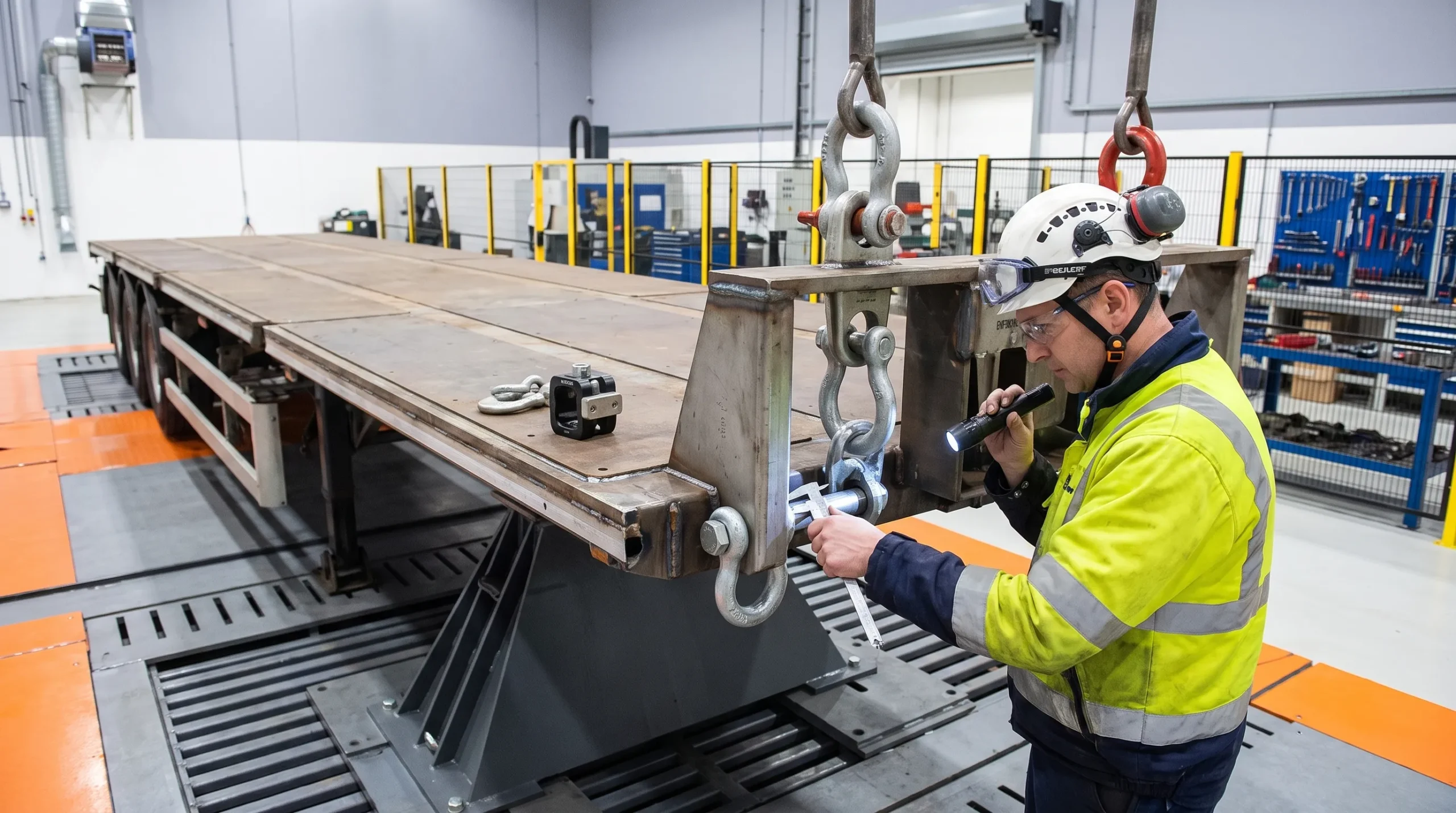
Visual inspection remains one of the most valuable methods because many early defects leave visible evidence. Inspectors look for deformation, cracks, corrosion, damaged welds, missing fasteners, worn pins, elongated holes, damaged threads, bent plates, loosened locking elements, unreadable markings and signs of overload.
Dimensional checks may be needed when small changes matter. A lifting adapter that has spread by a few millimeters, a pin hole that has elongated or a bracket that is no longer square can affect load distribution. In high-value equipment handling, small misalignment can also create product damage, even when the lifting tool itself has not failed.
For critical areas, additional examination methods may be appropriate, such as dye penetrant testing, magnetic particle testing or other non-destructive examination methods. These methods are not necessary for every inspection, but they can be useful when the risk profile, material, weld detail or operating history justifies a deeper check. Common inspection findings and their practical significance are discussed further in BKL's article on what safety inspections reveal before failures escalate.
Functional checks under realistic conditions
A lifting device can look acceptable at rest and still be unsafe or impractical in use. Functional checks verify whether moving parts, locks, pivots, hydraulic or pneumatic elements, electrical controls, interlocks, lifting points, wheels, brakes, end stops and operator interfaces work as intended.
This is where ergonomics and usability become part of safety. If operators need excessive force, awkward posture or improvised steps to position a lifting tool, the design may increase the chance of misuse. In cleanrooms, tight spaces or equipment bays with limited visibility, the inspection should also consider whether the tool can be positioned and removed without creating additional hazards.
Load testing and overload testing where appropriate
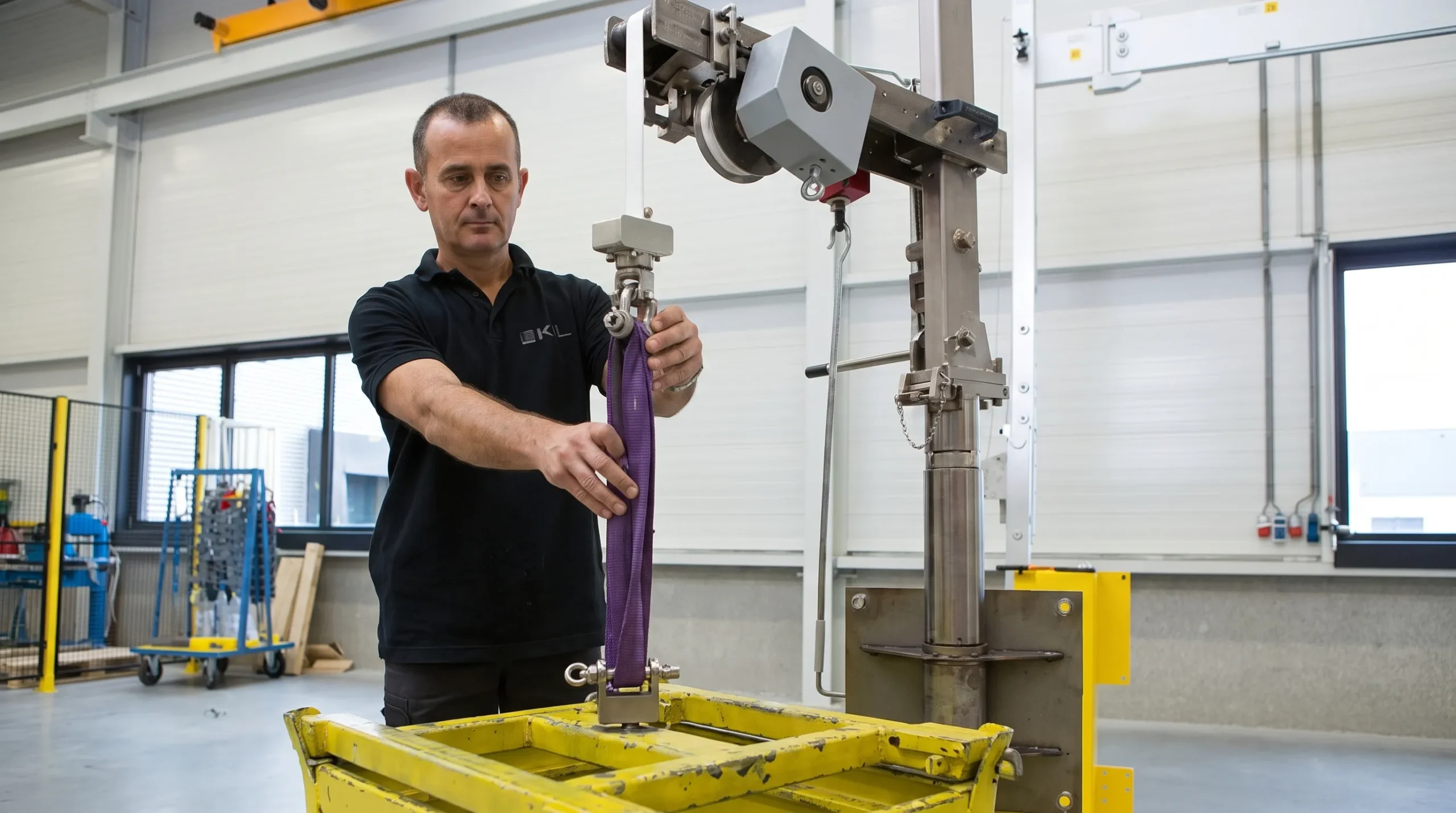
Load testing is a controlled activity, not a demonstration. The purpose is to verify behavior under a defined load and configuration. Depending on the equipment, history and applicable requirements, the test may include a proof load, an overload test, measurement before and after loading, deflection checks and confirmation that no permanent deformation or loss of function has occurred.
Load testing should be planned carefully. The test load, setup, lifting points, test area, exclusion zones, measuring methods and acceptance criteria must be defined in advance. For some equipment, unnecessary repeated overload testing can introduce stress, so the decision should be based on risk, requirements and engineering judgment.
In safety-critical applications, the test is only one part of the evidence. The inspection report should also state the configuration tested, the test load, the method, observed behavior, deviations and any limitations. If the equipment must only be used in a certain orientation, with specific accessories or under certain environmental conditions, that information needs to reach the operators.
Suitability for the actual lifting task
A strong lifting tool can still be the wrong lifting tool. Inspection and certification of lifting equipment should therefore include a practical review of whether the tool still matches the task. This is particularly important when production layouts change, product variants are introduced or maintenance procedures evolve over time.
Key questions include whether the center of gravity is still correctly considered, whether the lifting points are compatible, whether the load path is predictable, whether the operator can see and control the movement and whether surrounding machinery creates collision risks. For custom equipment, the best results come when engineering, inspection and operator feedback are connected. BKL covers this wider operational perspective in its guidance on working safely with custom lifting equipment.
What should be included in an inspection report or certificate
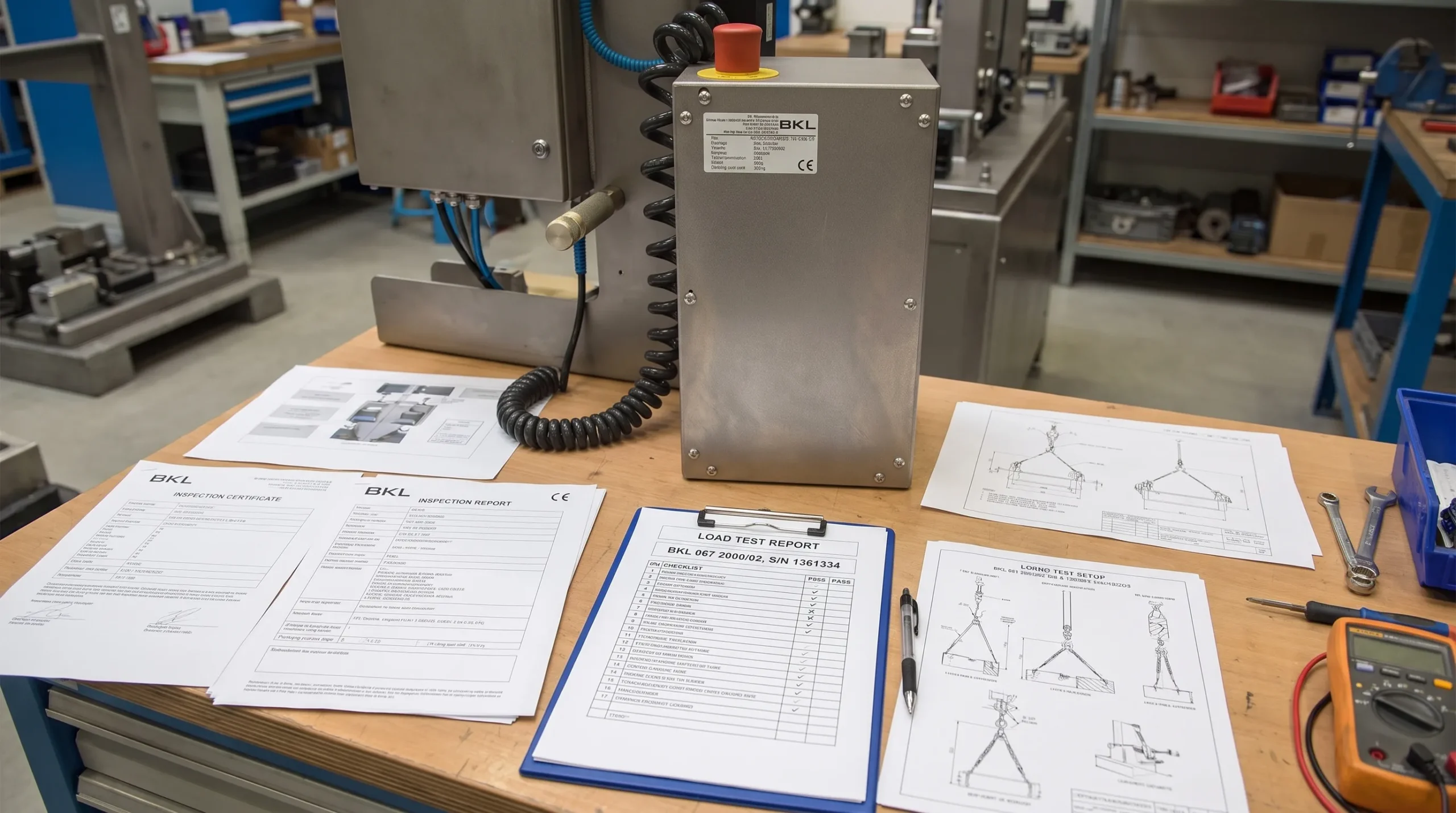
Good documentation is practical, traceable and unambiguous. It should help a safety manager understand the risk, a maintenance manager plan follow-up work, an operator understand limitations and a technical director make decisions about repair, redesign or replacement.
| Report element | Why it matters |
|---|---|
| Asset identification | Prevents confusion between similar tools, adapters or beams |
| Inspection scope | Clarifies what was and was not assessed |
| Reference documents | Links the inspection to drawings, manuals, previous reports and test procedures |
| Findings and photos | Makes defects visible and easier to discuss with engineering or maintenance teams |
| Test method and load data | Provides traceability when load testing or overload testing is performed |
| Restrictions or conditions | Defines safe boundaries for use, such as configuration or application limits |
| Conclusion | States whether the equipment can remain in service, needs repair or must be removed from use |
| Advice and follow-up | Supports maintenance planning, repair decisions and future inspection scheduling |
The report should avoid vague language. A statement such as acceptable for use is only useful when the inspected configuration, load and conditions are clear. If defects are found, the report should distinguish between immediate safety concerns, planned maintenance items and improvement opportunities.
Who should carry out inspection and certification
Competence is central. Inspectors need more than a checklist. They need to understand lifting principles, materials, welds, bolted connections, wear mechanisms, load paths, documentation, applicable requirements and the real working environment. For custom lifting and handling tools, they also need enough engineering insight to recognize when the application has moved beyond the original design assumptions.
BKL is accredited according to ISO 17020:2012 for inspections and supports clients with visual inspections, examinations, overload testing, reports, certification where applicable and usage advice. Because BKL also designs, engineers, manufactures, installs, maintains and services lifting tools, industrial modules and machines, inspection findings can be connected to practical follow-up. That may include repair, redesign, replacement parts, updated documentation or improved operator instructions.
This complete-chain view reduces the coordination burden for OEMs and technical teams. Instead of separating design, production, inspection and maintenance across multiple suppliers, companies can involve one partner that understands the lifecycle of the equipment and the operational context in which it is used.
How inspection connects to CE, maintenance and lifecycle support
CE marking and periodic inspection serve different purposes. CE-related work focuses on placing a product on the market or putting it into service in accordance with applicable requirements. Periodic inspection focuses on whether equipment remains safe and suitable during use. When equipment is modified, repaired extensively or used differently, both topics may need to be reviewed because design assumptions can change.
Maintenance and inspection should also feed each other. Repeated findings on the same component may indicate a design improvement, a training issue, a lubrication problem, incorrect storage or a mismatch between the tool and the task. This is where lifecycle support creates value beyond a certificate. Better availability, fewer urgent repairs, clearer operator instructions and safer handling can all improve Quality, Logistics, Technology, Cost and Sustainability performance.
For companies expanding production or service networks internationally, lifting and handling assets should be part of the operational plan from the start. Commercial teams may use AI-powered market readiness and channel planning to choose countries and partners, but the technical team still needs local rules, documentation, transport, installation, maintenance and inspection capacity aligned before equipment is used.
Common mistakes that reduce inspection value
Inspection quality is not only determined by the inspector. It also depends on how well the organization manages assets, documentation and follow-up decisions.
| Mistake | Practical consequence |
|---|---|
| Treating certification as a paperwork exercise | Defects, changed use or operator problems may remain unresolved |
| Inspecting the tool without reviewing the lifting task | The equipment may pass inspection but still be unsuitable for the current application |
| Ignoring minor deformation or worn interfaces | Early warning signs can develop into unsafe load paths or product damage |
| Delaying follow-up repairs | Small maintenance items can become downtime, rework or urgent replacement work |
| Keeping unclear or incomplete asset records | Teams lose traceability and may use equipment without knowing its status or limitations |
A good inspection program gives engineering, safety, operations and maintenance the same factual basis. It also helps procurement compare suppliers on more than price. For safety-critical tooling, the value lies in competent assessment, clear reporting, practical advice and the ability to act on findings.
How to prepare for a lifting equipment inspection
Preparation saves time and improves the quality of the result. Before the inspection, identify which assets are in scope, collect the available documentation, clarify the current lifting task and make sure the equipment is accessible. If load testing is planned, reserve a suitable area, confirm test loads and ensure that production planning accounts for the inspection window.
Useful preparation includes:
- A current asset list with identification numbers, locations and responsible owners
- Previous inspection reports, certificates, manuals, drawings and maintenance records
- Information about incidents, overloads, repairs, modifications or abnormal use
- Confirmation of the actual load, center of gravity, lifting points and operating environment
- Access to operators or maintenance staff who understand daily use and recurring issues
- A plan for removing equipment from service if serious defects are found
This last point is often overlooked. If an inspection identifies a safety-critical defect, the organization needs a practical response: spare equipment, repair capacity, temporary process changes or escalation to engineering. Without that plan, unsafe equipment may stay in circulation because production pressure is high.
FAQ's about inspection and certification of lifting equipment:
What does inspection and certification of lifting equipment involve? It usually involves asset identification, documentation review, visual and functional checks, examination of critical components, load testing where appropriate, reporting and certification where applicable. The exact scope depends on the equipment, use, environment and applicable requirements.
Is a visual inspection enough for lifting equipment? A visual inspection is important, but it may not be enough on its own. Critical or heavily used lifting equipment may need dimensional checks, functional testing, load testing or additional examination methods depending on the risk and condition of the equipment.
Does a certificate mean lifting equipment can be used for any load? No. A certificate applies to the identified equipment, scope, configuration and conditions stated in the report. Operators must still follow the stated working load limit, instructions, restrictions and intended use.
When should custom lifting tools be inspected? Custom lifting tools should be inspected before first use, at planned intervals and after events such as overload, impact, repair, modification, relocation or changed use. The interval should reflect risk, frequency of use, environment and company requirements.
Can inspection findings lead to redesign or improvement? Yes. Repeated wear, difficult operation, deformation or operator feedback may show that a lifting tool no longer fits the process well. In those cases, engineering support can help improve safety, ergonomics, reliability or maintainability.
Need support with inspection, certification or lifecycle decisions?
If your lifting equipment is custom-made, used in a high-value production environment or difficult to assess with a standard checklist, involve a technical partner that understands both inspection and engineering.
BKL supports OEMs and high-tech manufacturers with the design, engineering, production, installation, maintenance, inspection and certification of lifting and handling solutions. Whether you need a periodic inspection, overload test, clear usage advice, repair support or a review of an existing lifting tool, the objective is the same: keeping equipment safe, practical and available for the work it must perform.
To discuss your application, inspection scope or documentation needs, contact BKL by phone or email, schedule an appointment or request a quotation for inspection, certification, engineering, maintenance or lifecycle support.