
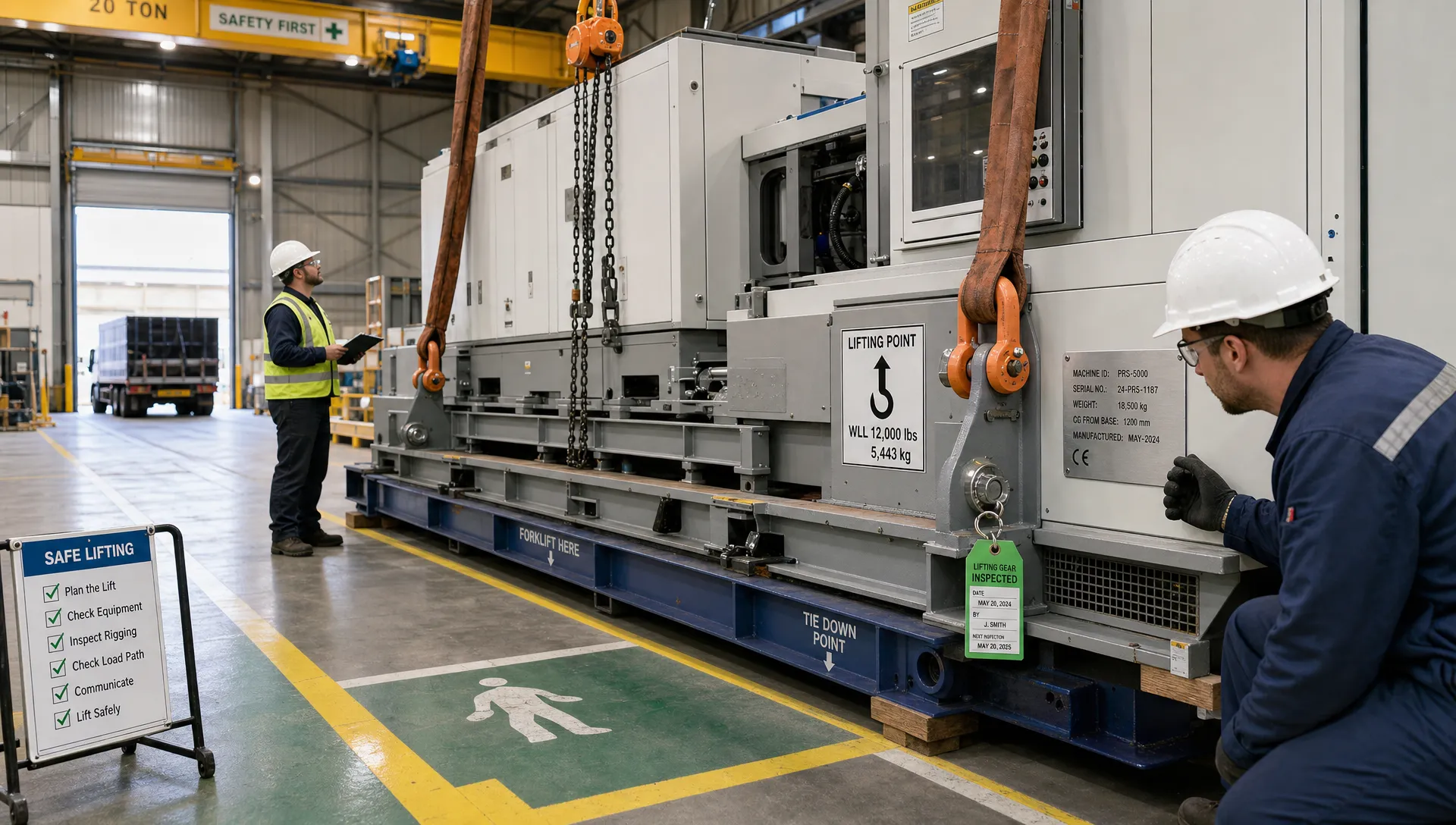
Selecting lifting and hoisting equipment wisely is not a catalogue exercise. For OEMs, machine builders, high-tech manufacturers, aerospace companies and industrial operations, the right choice affects employee safety, equipment availability, product quality and compliance throughout the full lifecycle of the tool or machine.
A lifting device with the correct rated capacity can still be unsuitable if the load is unstable, the center of gravity is poorly understood, the operator has limited visibility or the equipment cannot be inspected properly after years of use. Wise selection starts with the actual lifting task and ends only when documentation, testing, inspection and maintenance are defined.
Start with the lifting task, not the catalogue
Before comparing lifting and hoisting equipment, define the work it must perform. This may sound obvious, but many safety and usability problems begin when teams select equipment based on capacity alone. The lifting task includes the load, the route, the environment, the operator actions and the interfaces with surrounding equipment.
A good task definition should answer practical questions such as:
- What is the maximum load, including tolerances, attachments, packaging and temporary tooling?
- Where is the center of gravity, and can it shift during lifting, transport or installation?
- Which lifting points are available, and are they designed for the intended direction of force?
- How often will the lift be performed, and by whom?
- Are there tight spaces, cleanroom requirements, fragile components or expensive modules nearby?
- What happens if the load rotates, tilts, catches on surrounding equipment or must be positioned with high accuracy?
- Which documentation, testing and inspection evidence will be needed during the equipment lifecycle?
Not every application needs a custom solution. A standard hoist, crane, sling or lifting beam may be appropriate for a repeatable task with a stable load and sufficient working space. However, complex loads, restricted access, high-value components or strict operator safety requirements often justify a tailored lifting tool or engineered handling solution.
Compare equipment types against the real risk
Different types of lifting and hoisting equipment solve different problems. The safest choice is not always the most sophisticated option. It is the option that controls the relevant risks in the simplest, most reliable and most operator-friendly way.
| Situation | Possible equipment approach | Key selection focus |
|---|---|---|
| Routine vertical lifting of robust loads | Standard hoist, crane and certified accessories | Capacity, compatibility, inspection status and operator training |
| Wide or flexible loads | Lifting beam or spreader frame | Load distribution, sling angles, deformation control and stability |
| High-value equipment with sensitive interfaces | Engineered lifting tool or handling fixture | Controlled load path, protection of interfaces and accurate positioning |
| Repeated production or maintenance handling | Dedicated module, trolley or mechatronic handling aid | Repeatability, ergonomics, usability and lifecycle support |
| Existing equipment with uncertain condition | Inspection, load testing or engineering review | Remaining safety, wear, deformation, documentation and practical usage advice |
The selection process should also consider whether the lift is part of production, installation, service, maintenance or transport. A tool that works during assembly may not be suitable for field service. A lifting frame designed for one configuration may not be safe when the product design changes. Wise selection includes the full context of use.
Engineer the load path before choosing hardware
The load path is the route through which forces travel from the load, through the lifting points and tooling, into the hoisting system and supporting structure. If the load path is unclear, the risk is unclear.
Rated capacity is only one part of the answer. Engineering teams should also assess bending, torsion, eccentric loading, sling angles, dynamic forces and possible unintended contact with the environment. For example, a sling angle can significantly increase the force in each sling leg. A slightly off-center lift can introduce rotation. A tool that appears rigid enough visually may still deflect in a way that affects alignment, clearance or operator control.
For safety-critical or high-value applications, calculations, drawings, material choices, weld details, fastening concepts and testing requirements should be aligned from the beginning. Load testing can verify important aspects of performance, but it should not compensate for weak task definition or poor engineering assumptions.
This is especially important when lifting takes place around expensive machines, optical systems, semiconductor equipment or aerospace components. In these environments, dropping a load is not the only concern. Small deformations, uncontrolled contact, contamination, misalignment or operator workarounds can also create major operational risk. For a deeper look at these constraints, BKL has also covered safe lifting for high-value equipment and tight spaces.
Make safe operation practical for employees
The best lifting method is the one operators can use correctly under real working conditions. If a tool is theoretically safe but difficult to position, heavy to handle, unclear to lock or awkward to inspect, people may develop workarounds. Those workarounds can undermine the original safety concept.
User-friendly design is therefore not a comfort feature. It is part of risk reduction. Operators need clear attachment points, stable positioning, predictable movement, safe hand positions and visible status indicators. If a pin must be fully engaged, the design should make incorrect engagement difficult to miss. If a tool must be used in a specific orientation, the interface should guide the operator toward the correct orientation.
Mechatronic elements can sometimes improve control, feedback or repeatability, but they also introduce additional questions. What happens during power loss? Is the control logic understandable? Can the operator see the load while using the controls? Are emergency stops, interlocks or sensors appropriate for the risk? The goal is not to add complexity, but to make safe use more reliable.
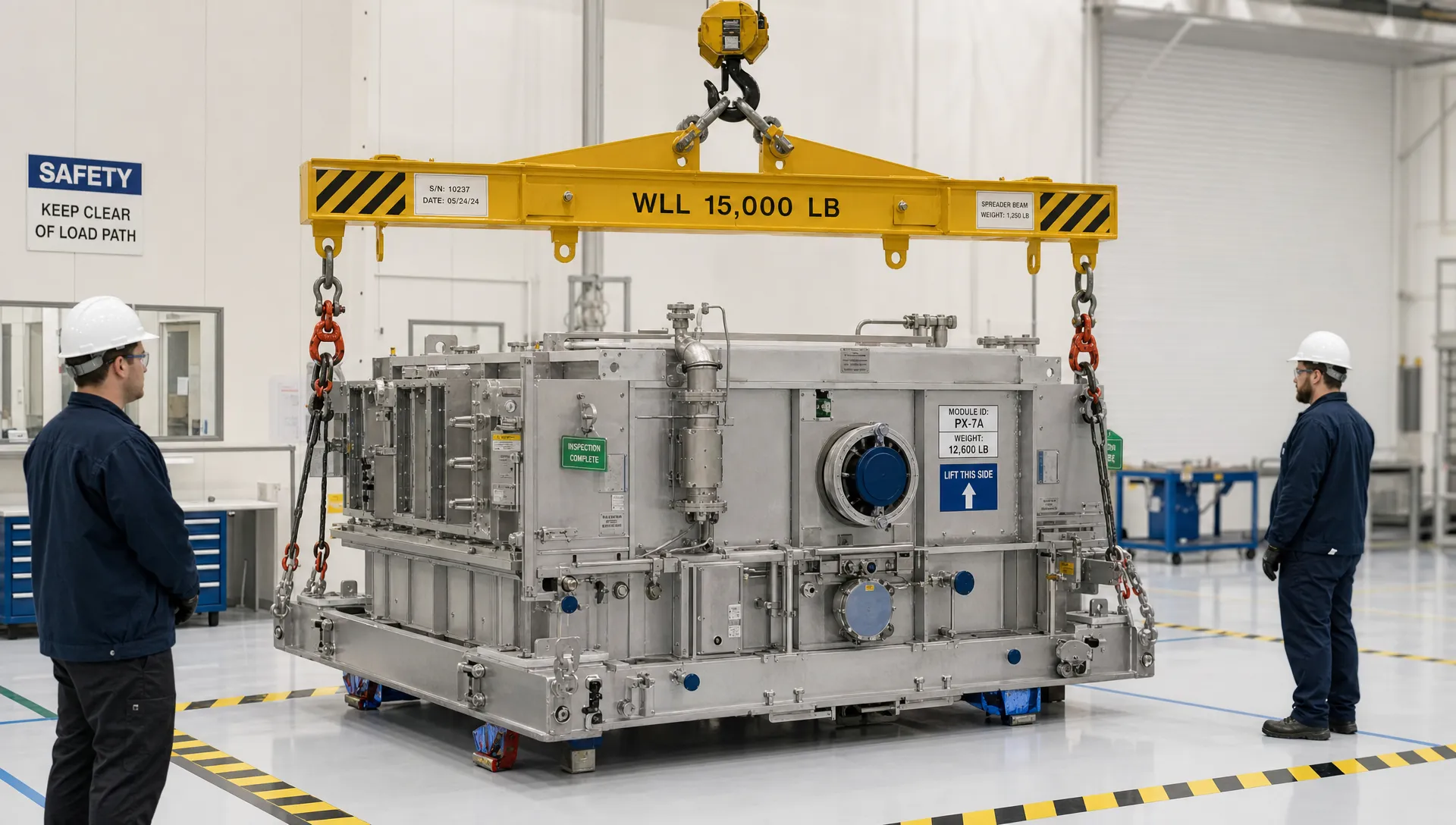
Build compliance and documentation into selection
Lifting and hoisting equipment must be selected with relevant legislation, standards and company safety requirements in mind. In Europe, this often involves CE-related obligations, risk assessment, technical documentation, user instructions and conformity assessment responsibilities. The exact route depends on the equipment type, intended use and role of the parties involved.
Compliance should not be treated as paperwork after the tool is already built. Design choices affect the risk assessment. Risk assessment affects guarding, operating instructions, labeling, testing and inspection needs. Documentation affects whether future users, maintenance teams and auditors can understand the intended safe use of the equipment.
Useful documentation may include drawings, calculations, material information, welding or production records where relevant, inspection reports, overload test reports, manuals, declarations where applicable and clear usage limitations. For equipment used intensively over many years, a clear asset history is also valuable.
The same principle applies in broader business systems: poor data makes future decisions harder. Guidance on structured CRM data import and migration shows why preparing, checking and organizing data before it enters a system matters. Lifting equipment registers deserve the same discipline, because inspection dates, load test results, repairs and configuration changes must remain traceable.
Plan inspections and maintenance before buying
Inspection and maintenance should influence the selection of lifting and hoisting equipment before purchase. A tool that cannot be inspected properly may become difficult to manage later, especially when it is used in safety-critical operations.
Ask whether critical welds, pins, hooks, lifting eyes, fasteners, bearings, wear surfaces and deformation-sensitive areas are accessible for inspection. Consider whether wear parts can be replaced without major downtime. Check whether identification plates, load markings and inspection tags will remain visible in the real working environment. If the equipment will be used in cleanrooms, near abrasive materials, outdoors or around chemicals, the inspection plan should reflect those conditions.
Inspection intervals should not be based only on habit. They should consider usage frequency, environment, load severity, previous findings and any changes in the lifting task. When there are signs of damage, overload, changed use or missing documentation, waiting for the next planned interval can increase risk. BKL explains these triggers in more detail in when lifting equipment inspections should not be delayed.
For companies with large fleets of lifting tools, lifecycle support can be as important as the original design. Periodic inspections, overload testing, clear reports and practical usage advice help maintenance and safety teams keep equipment available and fit for use. They also make it easier to prioritize repair, replacement or redesign decisions.
Evaluate supplier capability, not only the quotation
Price matters, but the lowest initial price can be misleading if the solution creates extra coordination, unclear responsibility, poor documentation or higher lifecycle risk. A supplier for lifting and hoisting equipment should be evaluated on engineering capability, production quality, inspection knowledge and understanding of real operating conditions.
Relevant questions include:
- Can the supplier assess the task, load path, usability and lifecycle requirements together?
- Does the supplier understand mechanical and, where needed, mechatronic engineering?
- Can the supplier manufacture small-scale or complex series with suitable quality control?
- Can the supplier support inspections, overload testing, reports and practical usage advice?
- Is the supplier familiar with CE-related documentation and risk assessment processes?
- Can the supplier support partial process steps as well as complete end-to-end solutions?
This is where an integrated technical partner can reduce coordination work. BKL supports clients with engineering, production, inspections and related services for hoisting and lifting tools, industrial modules and machines. The company is specialized in mechanics and mechatronics, and its inspection activities are accredited according to ISO 17020:2012. That combination is valuable when equipment must be engineered, built, inspected and supported over time.
Use a decision matrix to compare options
When multiple solutions are possible, a simple decision matrix helps teams compare more than purchase price. The matrix should be completed by engineering, safety, operations, maintenance and procurement together, because each department sees different risks.
| Selection criterion | What to assess | Why it matters |
|---|---|---|
| Fit to lifting task | Load shape, center of gravity, lift path, frequency and environment | Prevents mismatch between equipment and real use |
| Load path control | Structural design, attachment points, sling angles and stability | Reduces uncertainty in force transfer and movement |
| Operator usability | Handling effort, visibility, clear interfaces and safe hand positions | Makes correct use practical during daily work |
| Compliance support | Risk assessment, documentation, markings and instructions | Helps demonstrate intended safe use and technical reasoning |
| Inspectability | Access to critical areas, identification and inspection records | Supports long-term confidence in equipment condition |
| Lifecycle support | Repair, maintenance, spare parts, testing and usage advice | Improves availability and reduces unmanaged risk |
| Total cost of ownership | Purchase cost, downtime, inspection effort, repairs and replacement | Shows the real operational impact of the choice |
This matrix does not replace engineering judgement. It creates a structured conversation and helps avoid decisions based only on rated capacity or initial cost.
Common selection mistakes to avoid
A frequent mistake is buying lifting equipment because it can carry the load on paper. Capacity is essential, but it does not answer whether the load will remain stable, whether the tool fits the workspace or whether operators can use it safely and consistently.
Another mistake is assuming that existing equipment remains suitable because it still functions. Equipment can become unsuitable when the product changes, lifting points are modified, usage frequency increases, operators change or inspection evidence is incomplete. Visible function is not the same as verified condition.
A third mistake is separating design, production and inspection too much. When the inspection partner does not understand the design intent, important warning signs may be missed. When the designer does not understand how the tool will be inspected and maintained, critical areas may become hard to access. Wise selection connects design, manufacturing, use, inspection and service.
Finally, many companies underestimate operator feedback. People who perform the lift often know where visibility is poor, where hands are too close to pinch points, where clearances are tight and where workarounds appear. Their input should be captured before final design or purchase decisions are made.
FAQ's about selecting lifting and hoisting equipment:
What is the most important factor when selecting lifting and hoisting equipment? The most important factor is whether the equipment fits the actual lifting task. Rated capacity is essential, but the selection must also account for center of gravity, load path, working environment, operator actions, inspection needs and documentation.
When should a company choose custom lifting equipment instead of a standard solution? A custom or engineered solution may be appropriate when the load is complex, valuable, fragile, difficult to access or repeatedly handled in a way that standard equipment does not control well. Standard equipment may still be sufficient for simple, stable and well-defined lifts.
How does operator usability affect lifting safety? Operator usability affects whether the safest method is also the easiest method to follow. Clear interfaces, visible locking, stable positioning and ergonomic handling reduce the chance of incorrect attachment, poor communication or unsafe workarounds.
How often should lifting equipment be inspected? Inspection frequency depends on equipment type, use intensity, environment, legal requirements, manufacturer guidance and previous findings. Inspections should also be brought forward after damage, overload, changed use, missing documentation or other signs that the equipment condition may be uncertain.
Can BKL support only part of the process? Yes. BKL can support individual steps such as engineering, production, inspection or service, and can also provide more complete solutions depending on the project needs. This is useful when internal teams need specialist capacity or an external safety-focused engineering partner.
Select equipment with the full lifecycle in mind
Wise selection of lifting and hoisting equipment is not only about the first lift. It is about safe design, practical operation, reliable production, clear documentation, periodic inspection, serviceability and continued availability over the equipment lifecycle.
If your organization needs support with lifting tools, handling equipment, industrial modules or safety-critical tooling, BKL can help assess the task, engineer practical solutions, manufacture equipment, perform inspections and support lifecycle reliability.