
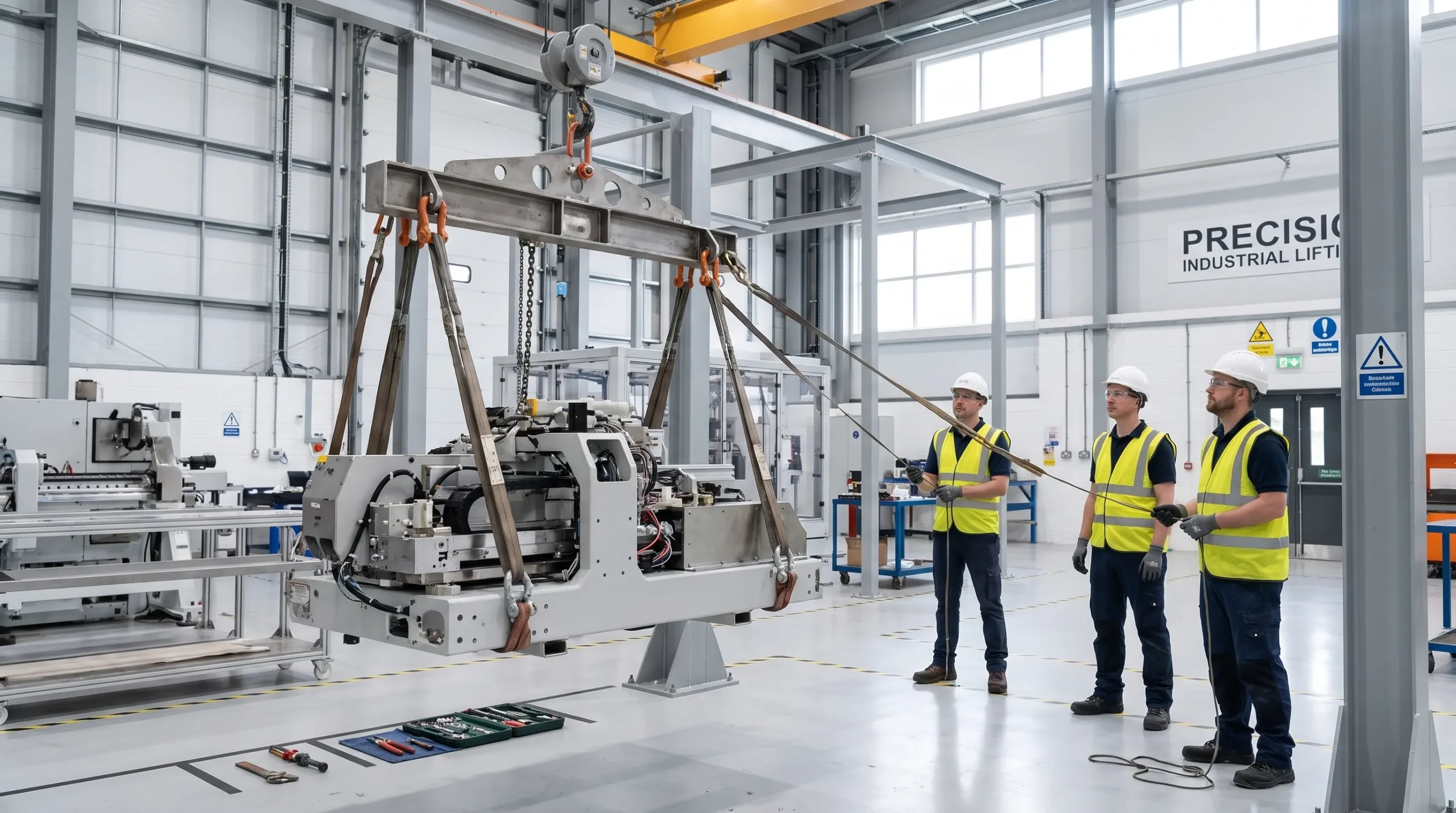
For many industrial lifting tasks, the question is not only whether the equipment can carry the weight. The more important question is whether the load can be controlled throughout the complete movement, from pick-up to final placement.
That distinction matters in high-tech manufacturing, semiconductor equipment, aerospace, optical systems and OEM environments. Components are often expensive, asymmetrical, sensitive to deformation and surrounded by other equipment. A load may be within the rated capacity of a crane or hoist, yet still be difficult to guide safely because the center of gravity is offset, access is limited or the lifting points do not align with the real load path.
Een custom lifting beam helps improve control by matching the lifting tool to the actual geometry, behavior and operating environment of the load. Instead of forcing operators to compensate for an imperfect setup, the beam is engineered to support predictable orientation, stable movement and practical usability.
Control starts before the load leaves the ground
A lifting beam is often judged by its working load limit, material thickness or connection points. These are important, but they do not describe the complete lifting challenge. Control starts with understanding how the load behaves before it is lifted.
For example, a machine module may have several strong lifting points, but they may not be positioned symmetrically around the center of gravity. A delicate assembly may need to remain horizontal within a narrow tolerance. A high-value component may need to be lifted through a narrow production area where rotation would create collision risk. In these cases, a standard beam may be strong enough, but not specific enough.
The engineering question becomes: how can the lifting arrangement keep the load stable, accessible and predictable under real operating conditions?
This is why it is important to define the lifting task before selecting the tool. Weight, lifting points, center of gravity, available headroom, operator access and final placement all influence whether a lifting beam will provide the right level of control.
What makes a load complex?
A complex load is not always large or heavy. Complexity often comes from how the load must be handled. In safety-critical environments, a relatively small component can still require a carefully engineered lifting solution if the consequences of uncontrolled movement are high.
Common factors that make a load complex include:
- An offset or uncertain center of gravity
- Multiple lifting points with unequal load distribution
- Sensitive surfaces, precision alignments or fragile subassemblies
- Limited headroom or restricted crane hook position
- Tight spaces with nearby machines, frames, walls or utilities
- A requirement to maintain a fixed angle during lifting or installation
- A need to rotate, tilt or position the load in a controlled way
- Repeated production lifts where operator consistency matters
In many facilities, the lifting environment is just as important as the load itself. A beam may need to fit between guarding, pass through a clean production area or allow operators to connect slings without climbing, reaching awkwardly or standing under suspended parts.
For high-value equipment and restricted work areas, control is closely linked to safe access. The principles discussed in safe lifting for high-value equipment and tight spaces also apply to lifting beam design: the tool should support the actual movement route, not only the theoretical lift.
How a custom lifting beam improves load control
A standard lifting beam can be the right choice for simple, repeatable lifts with clear load geometry. A custom lifting beam becomes valuable when the lifting arrangement must be adapted to a specific load, process or risk profile.
It aligns lifting points with the real load path
Control depends on how forces travel from the crane hook, through the lifting beam and rigging, into the load. If the connection points do not match the structure of the load, operators may see tilting, uneven sling tension or unwanted rotation.
A custom beam can position lifting points so forces are introduced where the load is designed to accept them. This may reduce bending or twisting in the product being lifted and can help avoid improvised rigging arrangements. For machine builders and OEMs, this is especially relevant when lifting frames, modules or assemblies that were not designed around standard crane geometry.
It helps manage center of gravity challenges
The center of gravity determines how a load will hang. If the center of gravity is not directly below the hoist hook, the load will seek a new equilibrium when lifted. This can cause sudden movement as the load leaves its supports.
A custom lifting beam can include adjusted pick-up points, multiple connection positions or engineered offsets to help align the hook position with the expected center of gravity. For loads where the center of gravity may vary between configurations, a beam can be designed with clearly defined adjustment options, provided these are engineered, tested and documented for the intended use.
The goal is not to remove all operator judgment. The goal is to reduce uncertainty, make correct use easier and avoid reliance on informal trial-and-error during critical lifts.
It controls orientation during movement
Some loads must stay level. Others must be lifted at a defined angle to clear a fixture, enter a machine frame or support installation. Without a suitable beam, operators may need to use additional slings, manual tag lines or repeated corrections to maintain orientation.
A custom lifting beam can help maintain the required orientation by controlling connection geometry and sling angles. It can also support a planned tilt or fixed installation angle when this is part of the lifting task. In precision environments, predictable orientation can be as important as lifting capacity because small unintended movements may affect alignment, safety or product quality.
It reduces dependency on manual correction
When a lifting arrangement is poorly matched to the task, operators often compensate with manual guidance. That may include pushing, pulling, holding tag lines or repositioning the load during the lift. Some manual guidance is normal, but excessive correction is a signal that the lifting setup is not providing enough control.
A custom beam can reduce the need for hands-on correction by improving balance and guiding the load more predictably. This supports safer working methods, especially where operators would otherwise need to stand close to pinch points or high-value equipment.
| Control challenge | Why it matters | How a custom lifting beam can help |
|---|---|---|
| Offset center of gravity | The load may tilt or shift when lifted | Pick-up geometry can be aligned with the expected center of gravity |
| Unequal lifting point spacing | Sling forces may become uneven | Beam connection points can be positioned for the actual load structure |
| Tight headroom | Standard rigging may not fit | Beam height, hook interface and rigging length can be optimized |
| Sensitive components | Contact or vibration can damage the load | Tool geometry can avoid sensitive zones and improve stable handling |
| Repeated production lifts | Variation between operators can increase risk | Clear connection points and user-friendly design support consistency |
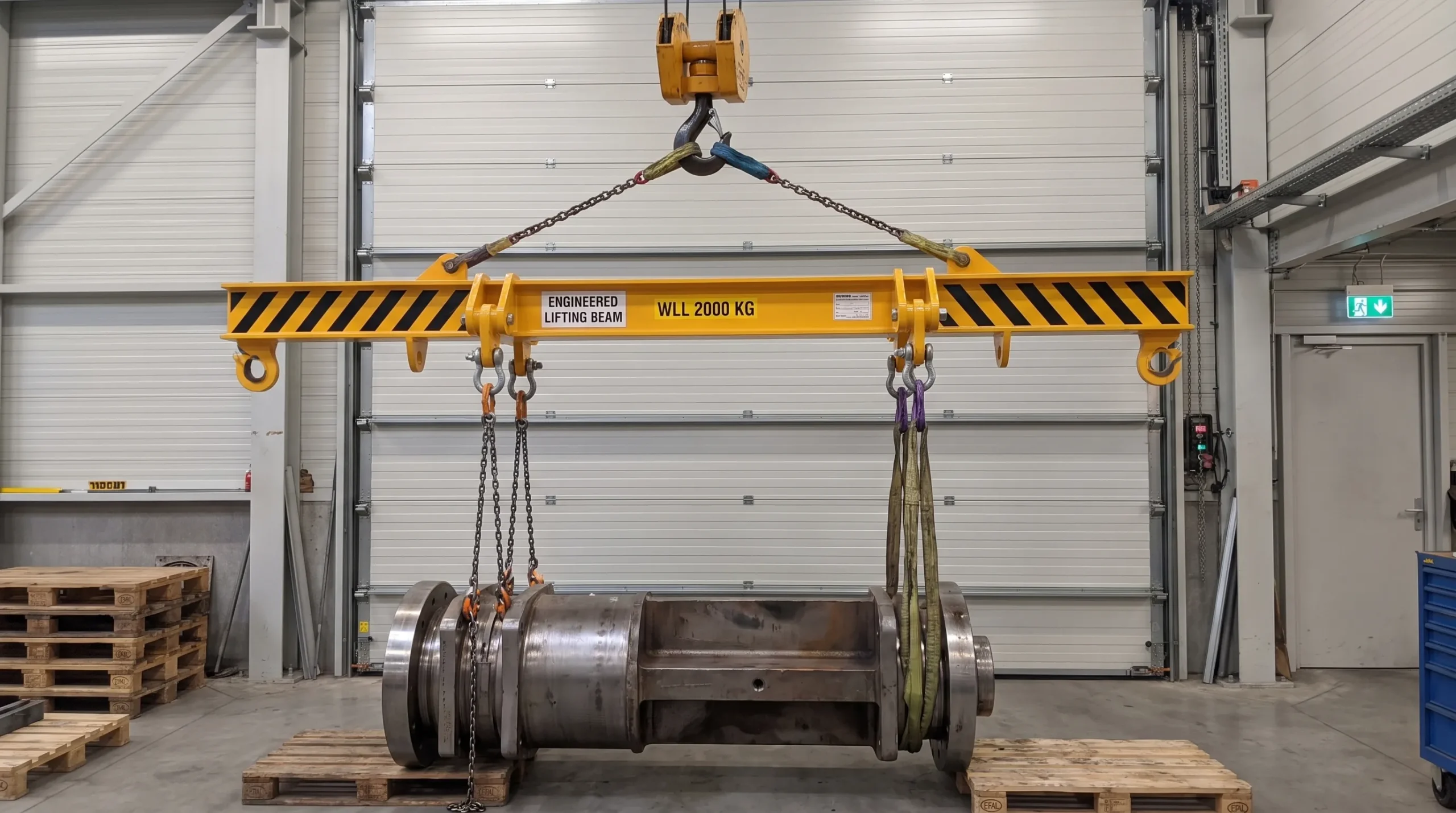
Engineering considerations behind a controlled lifting beam
A lifting beam for complex loads should not be treated as a fabricated steel bar with hooks. It is a load-bearing tool that must be engineered for its intended application, documented clearly and used within defined limits.
The design process typically starts with the lifting task. Engineers need to understand the load, lifting points, available crane or hoist, operating space, pick-up and placement sequence, frequency of use and any special environmental requirements. In high-tech and semiconductor environments, this may also include cleanliness, accessibility, protection of precision surfaces and integration with existing tooling.
From there, the engineering team can assess the load path and structural behavior. This includes expected forces in the beam, attachment points, lifting lugs, bolts, pins, welds and interfaces with the load. Sling angles are particularly important because they influence tension and introduce horizontal forces. A beam that keeps slings vertical or within defined angles can make the lift more predictable.
Risk assessment should be part of the design process, not a final administrative step. The widely used ISO 12100 standard describes principles for risk assessment and risk reduction in machinery design. For lifting accessories and machinery placed on the EU market, applicable safety requirements, CE marking obligations and technical documentation depend on the product and scope. The European Commission machinery sector information provides an official starting point for understanding the machinery framework.
A controlled lifting beam design may include:
- Clearly defined working load limits and permitted configurations
- Engineered lifting lugs, interfaces, pins or attachment points
- Geometry that supports the intended center of gravity and load path
- Practical markings to guide correct connection and use
- Documentation such as calculations, drawings, test reports and instructions
- Inspection and maintenance requirements based on use and risk
These details help engineering, safety and operations teams evaluate the tool as part of the complete lifting process. They also help maintenance teams understand what must be checked over time.
Usability is part of control
A technically correct lifting beam can still create risk if it is difficult to use in the real workplace. Operators may be wearing gloves, working in limited space or handling heavy rigging components. If the correct connection point is unclear or hard to access, the chance of incorrect use increases.
User-friendly design supports control by making the intended method the most practical method. That may involve visible markings, logical connection points, suitable handholds, transport features, storage provisions or interfaces that reduce ambiguity. The beam should support the operator during preparation, lifting, positioning and removal.
This is especially important for repeated production lifts. A lift that happens once can be managed with additional planning and supervision. A lift that happens every week or every shift needs a tool that works reliably in normal operating conditions. The design should reduce unnecessary variation between operators and make it easier to follow the documented procedure.
For decision-makers, usability is also a lifecycle cost issue. If a lifting beam is slow to connect, difficult to store or frequently causes alignment problems, the cost is not limited to the purchase price. It affects production flow, maintenance workload and operator confidence.
Lifecycle support keeps control reliable over time
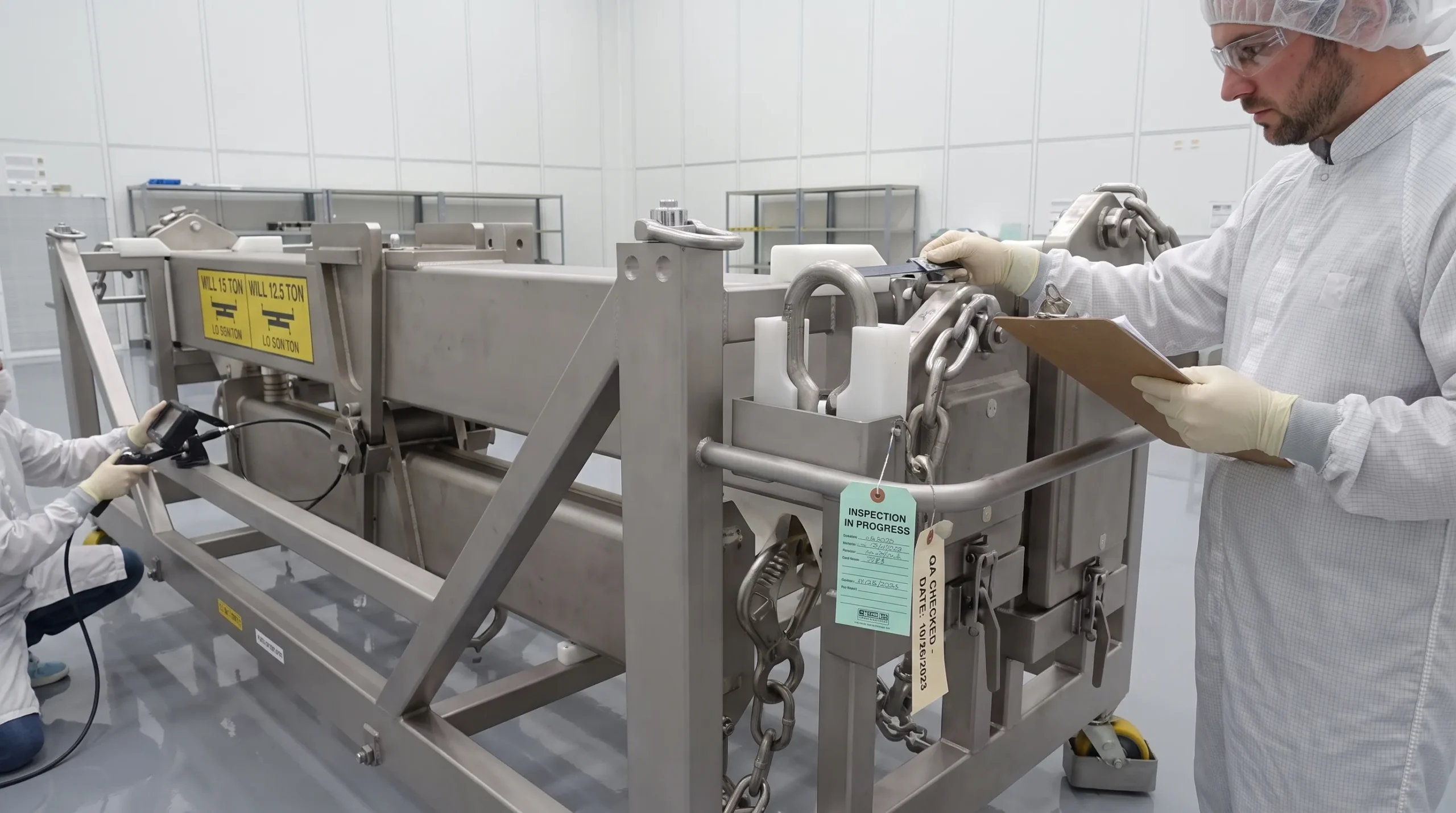
A custom lifting beam is not finished when it is delivered. Its ability to provide control depends on its condition throughout its service life. Wear, deformation, corrosion, impact damage, overloaded use or missing documentation can all reduce confidence in the tool.
Periodic inspection and, where appropriate, load testing help confirm whether lifting equipment remains suitable for use. In the Netherlands and across many industrial environments, inspection expectations are shaped by applicable regulations, company procedures and the risk profile of the equipment. The UK Health and Safety Executive's LOLER guidance is often referenced internationally for the principle that lifting operations should be properly planned, supervised and carried out safely by competent people.
For custom tools, inspection quality matters because the inspector must understand the intended use, load path and critical features. A superficial visual check may miss issues that are relevant to a custom beam, such as deformation near a lifting lug, wear in pin holes, incorrect replacement parts or damage to an interface that supports alignment.
BKL is accredited according to ISO 17020:2012 for inspections and can support visual inspections, overload testing, examination, reporting and usage advice. Because BKL also engineers and manufactures hoisting and lifting tools, inspections can be connected to practical knowledge of how the equipment is used, loaded and maintained.
When a custom lifting beam is worth considering
Not every lifting task requires a custom solution. If the load is simple, the center of gravity is clear, the route is open and a certified standard beam fits the task, standard equipment may be sufficient. A custom approach becomes more relevant when the lift involves uncertainty, tight tolerances or recurring operational risk.
The business case is usually strongest when the beam affects more than one department. Engineering wants a predictable load path. Operations wants a tool that can be used efficiently. Safety wants reduced exposure to uncontrolled movement and manual correction. Maintenance wants equipment that can be inspected, repaired and kept available. Procurement wants a supplier that can provide documentation and long-term support.
| Situation | Why a custom beam may add value |
|---|---|
| High-value equipment is lifted near other assets | Better control can reduce the likelihood of contact, impact or alignment issues |
| The center of gravity is offset or configuration-dependent | Engineered pick-up positions can make lifting behavior more predictable |
| Operators currently use improvised rigging | A dedicated tool can define the correct method and reduce variation |
| The lift is repeated in production or maintenance | Usability and consistency can improve efficiency over time |
| Existing tools are difficult to inspect or document | A designed and documented solution can support clearer lifecycle management |
| Space or headroom is limited | Beam geometry can be adapted to the real work area |
This is where a bespoke approach can influence both safety and uptime. As discussed in BKL's article on how bespoke lifting solutions improve safety and uptime, the value is not only in the tool itself. It is in reducing practical risk throughout engineering, use, inspection and maintenance.
What to discuss before engineering a custom lifting beam
A productive design discussion starts with the real lifting scenario. Drawings and load weights are useful, but they are not enough. The engineering team also needs practical information from operations, maintenance and safety teams.
Useful inputs include the load geometry, mass, center of gravity information, lifting points, available crane hook position, headroom, travel path, placement method, frequency of use, operator access and existing lifting procedures. If the beam will be used for multiple product variants, those variants should be defined early. If the tool must interface with transport frames, installation fixtures or machine modules, those interfaces should also be included in the design scope.
For existing tools, inspection history and known issues are valuable. Wear patterns, operator feedback and recurring alignment problems often reveal where the current lifting method lacks control. In some cases, the best solution may be a new custom beam. In other cases, practical modifications, clearer documentation, inspection, repair or updated usage advice may be sufficient.
How BKL supports controlled lifting applications
BKL supports companies that need safe, reliable and user-friendly solutions for hoisting, lifting, handling, industrial modules and machines. The team combines mechanical and mechatronic engineering with manufacturing, inspection and service support, which is valuable when a lifting tool must work in a specific technical environment.
For a custom lifting beam, this means safety and usability can be considered from the first design discussions through production, documentation, inspection and lifecycle support. BKL can support individual process steps or complete solutions, depending on what the project requires.
In demanding environments such as high-tech manufacturing, semiconductors, optics, aerospace and OEM production, controlled lifting is not a secondary detail. It is part of protecting people, equipment and production continuity.
FAQ's about custom lifting beams:
What is a custom lifting beam? A custom lifting beam is a load-bearing lifting tool engineered for a specific load, lifting task or operating environment. It is designed around factors such as load geometry, center of gravity, lifting points, headroom, usability and inspection requirements.
When is a custom lifting beam better than a standard lifting beam? A custom beam may be better when a standard solution does not provide enough control over load orientation, sling angles, center of gravity, clearance or operator access. Standard beams can still be suitable for simple lifts when they match the task and required safety factors.
How does a custom lifting beam improve safety? It can improve safety by defining a predictable load path, reducing uncontrolled tilting or rotation, making correct rigging easier and supporting clear documentation, testing and inspection. It does not remove the need for competent planning, correct use and periodic checks.
Can a custom lifting beam help reduce downtime? Yes, when it improves repeatability, reduces setup time, limits improvised rigging and supports easier inspection or maintenance. The effect depends on the lifting task, frequency of use and how well the tool is integrated into the working process.
Does a custom lifting beam need inspection and load testing? Lifting equipment should be inspected according to applicable regulations, company procedures, usage intensity and risk profile. Load testing may be required or advisable depending on the design, application and inspection regime. Clear documentation helps define what must be checked and when.
What information is needed to design a custom lifting beam? Important information includes load weight, geometry, center of gravity, lifting points, crane or hoist data, headroom, travel path, placement requirements, frequency of use, operator access and any applicable safety or documentation requirements.
Discuss a controlled lifting solution with BKL
If a lifting task involves complex geometry, sensitive equipment, limited space or recurring operator challenges, it is worth reviewing whether the lifting beam provides enough control. BKL can support engineering, manufacturing, inspection and lifecycle services for safety-critical lifting and handling applications.
To explore the right approach for your application, contact BKL and discuss the load, environment and operational requirements behind your lifting challenge.