
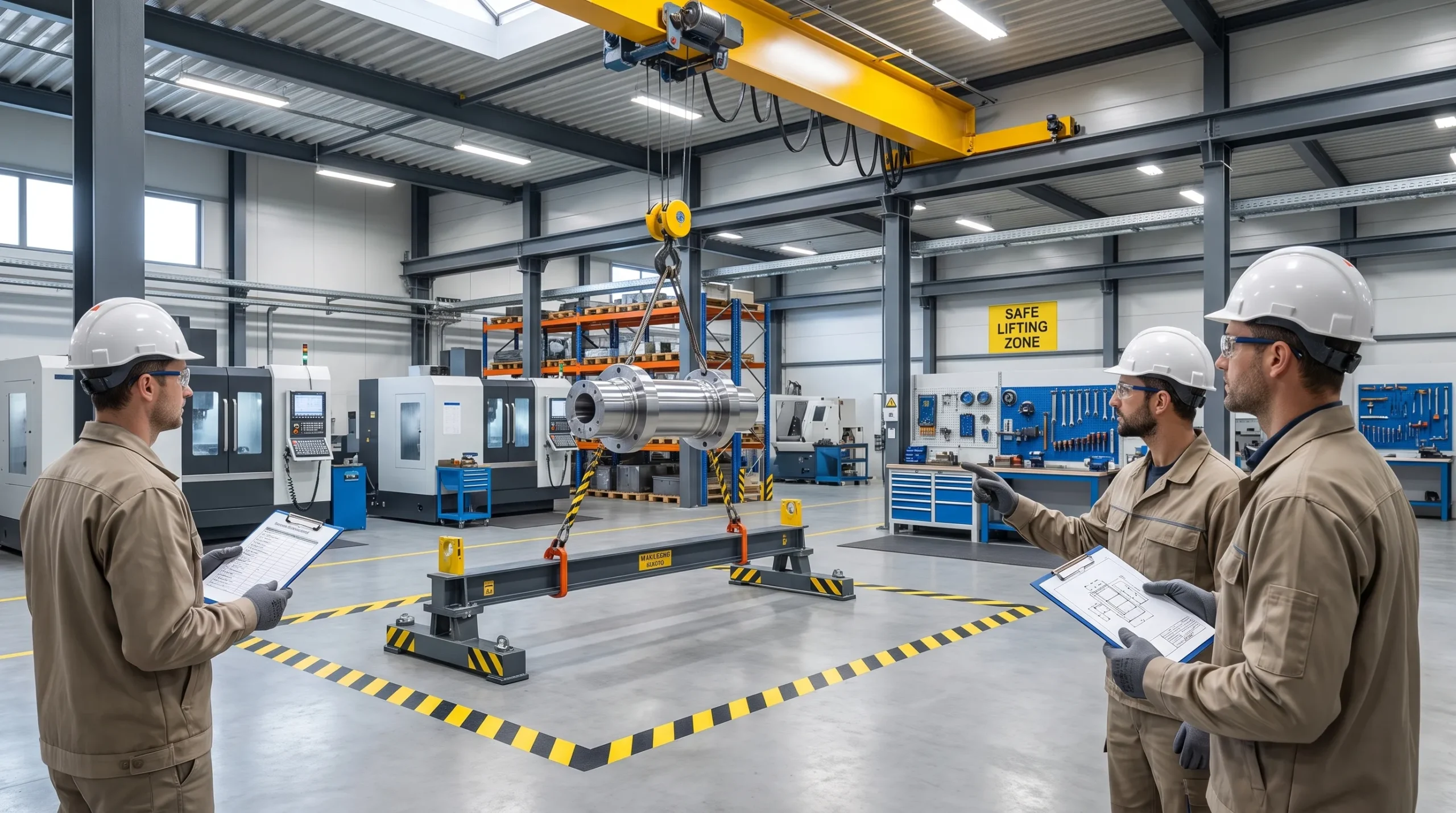
A hoisting machine is safe in daily operation when its design, condition, controls, documentation and use all support the same objective: moving the load predictably without creating unnecessary risk for operators, equipment or the surrounding process.
That sounds straightforward, but in industrial practice the safety of a hoisting machine is rarely determined by one component. Rated capacity matters, yet it is only one part of the picture. A hoist with sufficient capacity can still be unsafe if the load path is poorly defined, the controls invite mistakes, the environment restricts visibility, the supporting structure is not suitable, or the equipment has not been inspected after intensive use.
For OEMs, high-tech manufacturers, aerospace companies, machine builders and production environments, daily hoisting safety depends on how well engineering choices match the real lifting task. The question is not only “can this machine lift the load?” The better question is “can trained employees use this hoisting machine repeatedly, in this environment, with controlled risk and clear evidence that it remains fit for purpose?”
Start with the actual lifting task
A safe hoisting machine begins with a clearly defined task. Many operational problems appear when a hoist is selected around load weight alone. Weight is important, but the load’s geometry, center of gravity, lifting points, movement path and sensitivity are just as relevant.
In high-value equipment handling, for example, the risk may not be the mass of the load but its instability, limited clearance or vulnerability to shock. In maintenance operations, the challenge may be that the hoisting machine is used infrequently, by different teams, or in a location with restricted access. In semicon or optical environments, the issue may be precision, cleanliness, repeatability and the need to avoid uncontrolled contact.
A reliable task definition should clarify:
- What must be lifted, including mass, dimensions and center of gravity.
- Where the load is picked up, transported, rotated, positioned or lowered.
- Which people, machines, structures and sensitive assets are nearby.
- How often the lift is performed and under what operating conditions.
- Which abnormal situations are credible, such as a jammed load, power loss, operator error or changed lifting point.
This is why good hoisting safety is connected to process knowledge. A hoisting machine that looks suitable on paper can become problematic if the real workflow, available space and operator behavior were not considered early enough. For a deeper look at the connection between equipment selection and operational reliability, BKL’s article on how lift and hoist choices affect safety and uptime explains why capacity alone is not enough.
Make the load path predictable
A hoisting machine should move the load in a controlled and predictable way. This requires more than motor power. The full load path must be engineered, including the hoist, lifting attachment, connection points, supporting structure and any guides, frames or positioning features used during the movement.
A predictable load path reduces uncertainty for the operator. It helps prevent swinging, tilting, unexpected rotation and contact with nearby equipment. This is particularly important when lifting valuable modules, production tooling, machine parts or aircraft-related components where even minor uncontrolled movement can have major operational consequences.
Key engineering questions include whether the load remains stable throughout the lift, whether the lifting points are positioned correctly, and whether the supporting structure can handle the forces involved. Dynamic effects must also be considered. Starting, stopping, acceleration, deceleration and small misalignments can introduce forces that are not visible when only static weight is reviewed.
The safest hoisting solution is often the one that removes avoidable freedom of movement. Guides, mechanical stops, balanced lifting beams, defined parking positions and clear alignment features can all support safer operation when applied correctly. The goal is not to make the machine complex. The goal is to make the safe movement the easiest and most natural movement.
Design controls for real operators
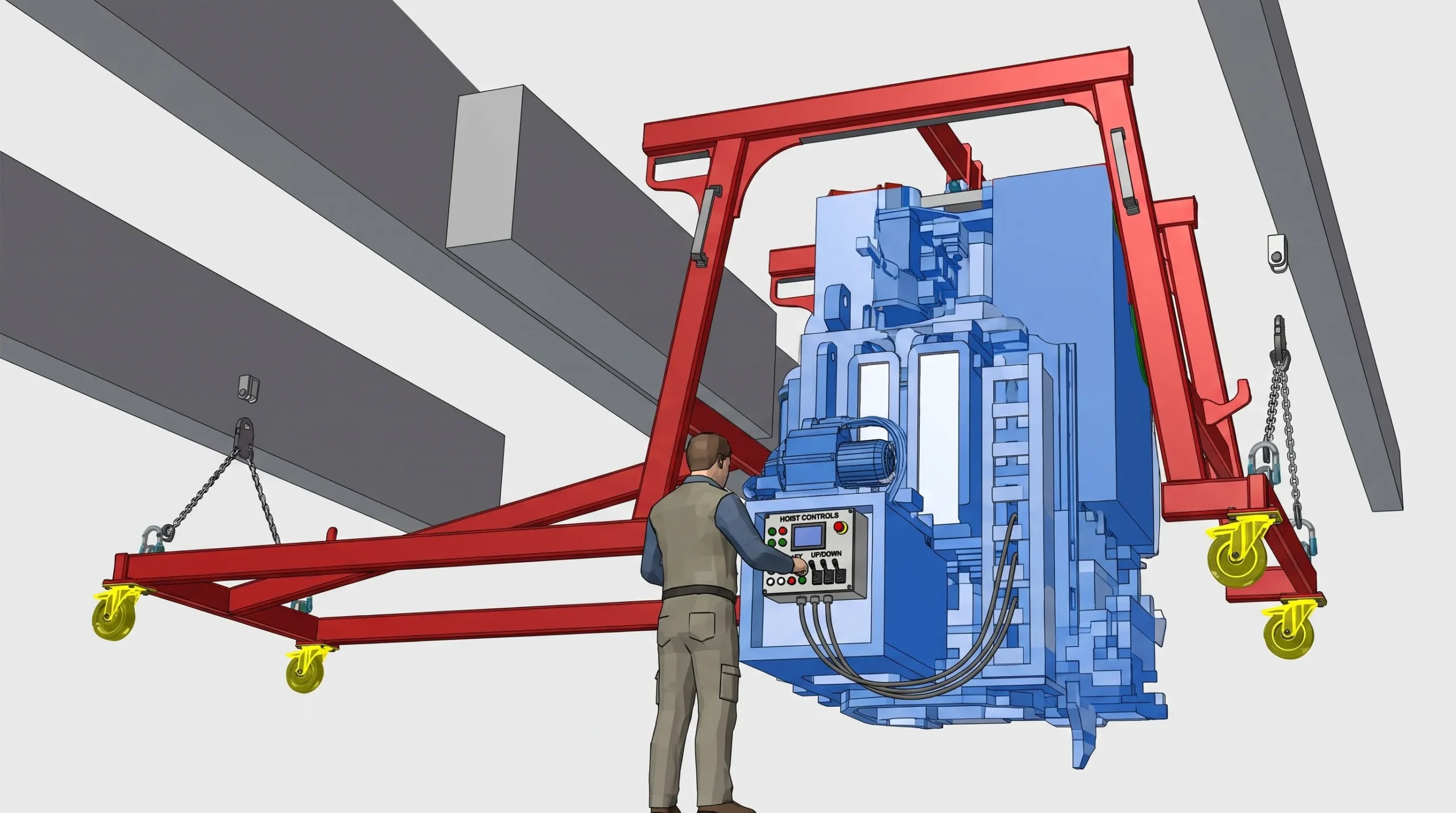
Daily safety depends heavily on how people interact with the hoisting machine. Even a technically strong design can create risk if controls are confusing, feedback is unclear or the operator must stand in an unsafe position to see the load.
User-friendly design is not a cosmetic issue. It is a safety measure. Operators need controls that are logical, clearly marked, easy to reach and consistent with the movement of the hoist. If a button, joystick or pendant control behaves differently from what the operator expects, the chance of incorrect movement increases.
Visibility is equally important. The operator should be able to monitor the load, the lifting points and the surroundings during critical movements. If that is not possible, the process may need additional measures such as spotters, cameras, fixed positioning aids or revised operating procedures. The best solution depends on the application, but the principle remains the same: the person controlling the hoisting machine must have enough information to make safe decisions.
Emergency stop functions, movement limits and overload protection also need to be integrated in a way that suits the machine and task. These measures should not be treated as separate add-ons. They must support the intended use and foreseeable misuse identified during the risk assessment.
Build safety into the machine, not only around it
Procedures, training and signage are valuable, but they cannot compensate for poor engineering. A safe hoisting machine should include risk reduction measures within the design wherever reasonably possible.
For example, if a load could be positioned incorrectly, a mechanical locating feature may be more reliable than relying only on an instruction in the manual. If a sling angle could become unsafe, a dedicated lifting beam or fixture may reduce dependence on operator interpretation. If a component must be held in place during maintenance, positive locking or controlled lowering may be required rather than relying only on friction or balance.
This is the hierarchy that experienced safety engineers apply in practice. First, eliminate or reduce hazards through design. Then add safeguarding and protective measures where needed. Finally, support remaining risks with instructions, labels, training and inspection routines.
A daily-use hoisting machine should also be robust enough for the actual environment. Dust, humidity, temperature, vibration, cleaning processes, impacts and frequent handling can all affect long-term condition. In production environments, the machine may be used under time pressure. In maintenance settings, it may be stored for long periods and then used for a critical operation. Design choices must reflect these realities.
Use compliance as a framework, not a checkbox
For companies operating in Europe, hoisting machines and related lifting equipment may fall under product safety and work equipment requirements, depending on the exact configuration, use and supply situation. The Machinery Directive 2006/42/EC remains central until the EU Machinery Regulation (EU) 2023/1230 becomes applicable from 20 January 2027. Standards such as EN ISO 12100 for risk assessment and EN 13155 for non-fixed load lifting attachments can also be relevant, depending on the application.
Compliance should be treated as an engineering framework, not as an administrative formality. A technical file, risk assessment, calculations, test reports, inspection records and user instructions all help demonstrate how risks were considered and controlled. They also help maintenance and operations teams understand safe use over time.
At the same time, regulatory interpretation can be situation-specific. Engineering teams should not confuse technical documentation with legal advice. When projects cross borders or involve administrative obligations outside the usual industrial context, it may be appropriate to consult qualified legal specialists, such as Diana Ordoñez Abogada for administrative and contractual legal matters, alongside the technical safety assessment.
The practical takeaway is simple: CE marking and documentation are not a final decoration on a finished machine. They should be supported by the design process, the risk assessment and the evidence collected before the machine is placed into use.
Inspect what daily use can change
A hoisting machine may be safe when delivered but become less safe after months or years of operation. Wear, deformation, corrosion, loose fasteners, damaged controls, electrical faults, overload events and undocumented modifications can all change the risk profile.
This is why inspections must be more than a calendar task. Periodic checks are important, but additional inspections may be needed after overloads, collisions, repairs, changes in use, relocation or signs of damage. The right interval depends on the equipment type, intensity of use, environment and consequences of failure.
A useful inspection program should produce clear answers, not vague reassurance. It should identify whether the equipment is suitable for continued use, whether repairs are needed, whether load testing or further examination is required, and whether operators need updated usage advice.
| Daily operation factor | Safety question to ask | Practical control measure |
|---|---|---|
| Load condition | Has the load, lifting point or center of gravity changed? | Confirm task data before use and update tooling if the product changes. |
| Hoist condition | Are hooks, chains, wire ropes, brakes, controls and limiters in acceptable condition? | Perform pre-use checks and scheduled technical inspections. |
| Environment | Is there enough clearance, visibility and floor stability? | Define the lifting zone and remove unnecessary obstacles. |
| Operator interaction | Can the operator control movement without standing in a hazardous position? | Improve control location, visibility, guidance or work procedure. |
| Documentation | Are instructions, inspection reports and load limits available and understood? | Keep records current and accessible to operations and maintenance teams. |
BKL is accredited according to ISO 17020:2012 for inspections and supports clients with visual inspections, overload testing, examinations, reports and usage advice. This matters because inspection quality depends on more than checking a list. Custom lifting tools, industrial modules and application-specific hoisting equipment require understanding of design intent, load paths and real use.
If there are signs that equipment condition or use has changed, it may not be wise to wait for the next planned date. BKL’s guidance on when lifting equipment inspections should not be delayed explains common triggers that should prompt earlier action.
Keep documentation useful for the people who need it
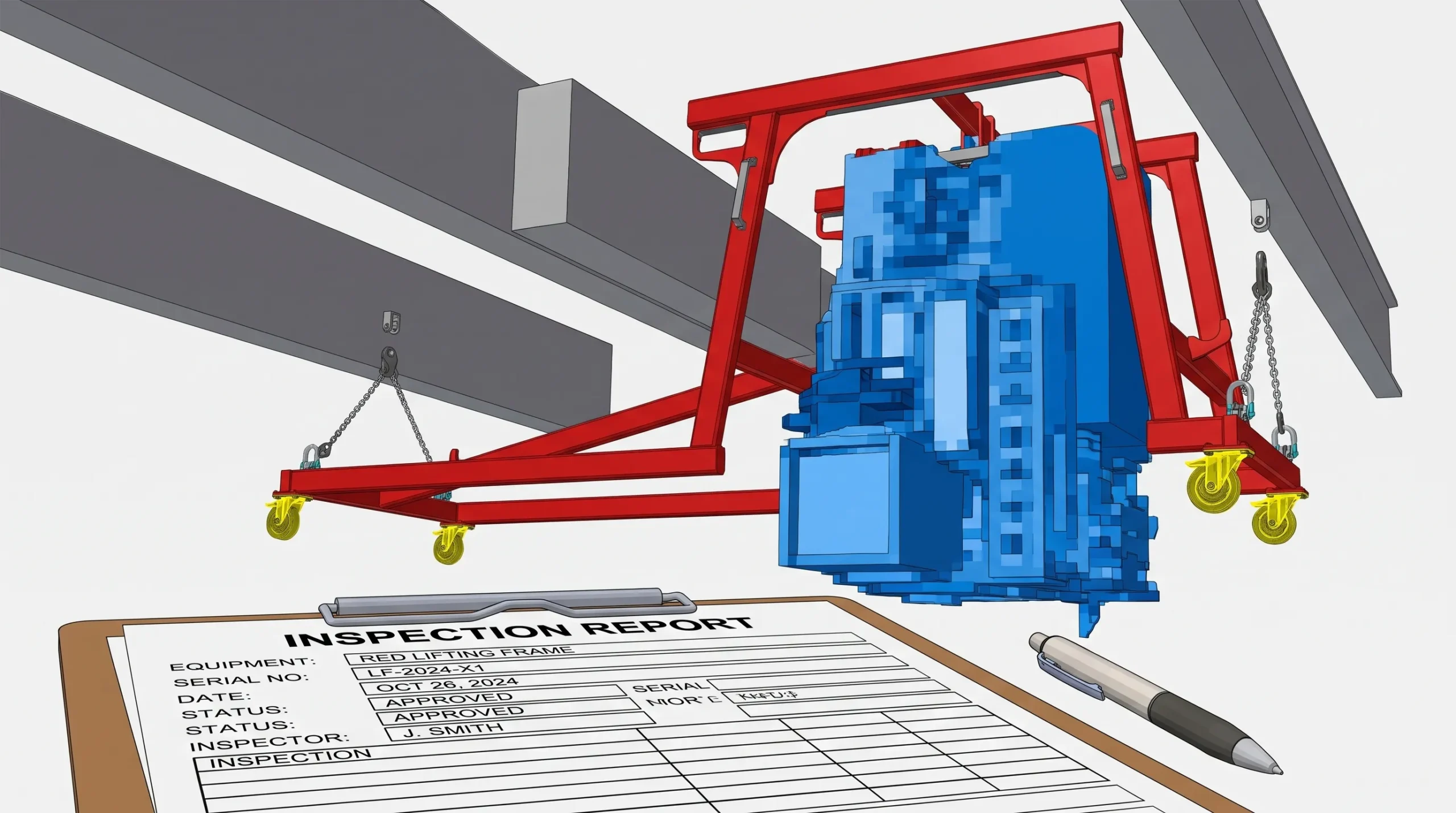
Documentation supports safety only when it is accurate, accessible and practical. A manual that remains unread in a file server does not help an operator during a difficult lift. A calculation report that is disconnected from the current machine configuration does not help a maintenance manager decide whether equipment remains fit for use.
For daily operation, documentation should help teams answer specific questions. What is the safe working load? What lifting points may be used? What pre-use checks are required? Which parts are wear-sensitive? What are the inspection intervals? What must be done after an overload, impact or repair? Which use cases are outside the intended scope?
Good documentation also helps management and procurement teams make better lifecycle decisions. If equipment history is clear, it becomes easier to plan maintenance, justify replacement, schedule inspections and avoid unnecessary production interruptions. This is especially important for tools that are critical to installation, transport, maintenance or production continuity.
Consider the full lifecycle cost of safety
Initial purchase price is only one factor in hoisting machine safety. A lower-cost solution can become expensive if it increases operator effort, requires frequent adjustments, creates inspection uncertainty or causes downtime when parts wear or fail. Conversely, a well-engineered solution may reduce operational friction because it fits the task, is easier to inspect and supports clear maintenance planning.
Lifecycle thinking does not automatically mean every situation needs a fully custom hoisting machine. Sometimes the right answer is a standard hoist with a properly engineered lifting attachment. In other cases, a partial redesign, inspection, overload test, documentation update or service intervention is sufficient. For complex lifting tasks, however, a custom engineering approach may be necessary to control load behavior, ergonomics and integration with surrounding equipment.
The most effective decision is usually made when engineering, safety, operations, maintenance and procurement evaluate the application together. Each team sees different risks. Operators understand practical usability. Maintenance understands wear and repairability. Safety managers focus on risk reduction and evidence. Procurement sees supplier coordination and lifecycle cost. Engineering connects these requirements into a workable technical solution.
What BKL looks at when supporting safer hoisting operation
BKL supports clients with mechanics and mechatronics, hoisting and lifting tools, industrial modules, machines, inspections, manufacturing and lifecycle-related services. That combination is important because hoisting safety is not isolated to one phase.
During engineering, safety can be included in the concept, calculations, risk assessment, layout and control philosophy. During production, manufacturability, assembly quality and traceability influence reliability. During inspection and testing, the condition and performance of the equipment are checked against practical use. During service and maintenance, defects, wear and availability are managed so that important tooling remains usable and safe within defined limits.
For OEMs and high-tech manufacturers, this integrated approach can reduce coordination between separate suppliers. It also helps ensure that design choices are not made without considering inspection, maintenance and operator use. BKL can support individual process steps or complete solutions, depending on what the client needs.
If your organization is reviewing a hoisting machine, planning a new lifting tool or questioning whether existing equipment still fits the task, it helps to start with the real operating conditions. BKL’s article on improving hoisting safety in complex industrial environments expands on this lifecycle view.
Signs a hoisting machine deserves closer review
Not every issue means the machine is immediately unsafe, but several signals should trigger a more detailed review. These signs often appear gradually, which is why they are easy to overlook in busy production environments.
Common warning signs include unusual noise, jerky movement, visible deformation, damaged hooks or chains, unreliable controls, missing labels, unclear load ratings, expired inspection status, changed product geometry, operator workarounds or uncertainty about previous overloads. A hoisting machine also deserves review when it is moved to a new area, integrated into a new process or used for a load that differs from the original task definition.
The key is not to wait until equipment fails visibly. Many safety-critical issues begin as small changes in condition, documentation or use. When these changes are detected early, organizations have more options: repair, retest, update documentation, redesign a fixture, train operators or replace equipment in a planned way.
FAQ's about hoisting machine safety in daily operation:
What is the most important factor in hoisting machine safety? The most important factor is whether the complete lifting task has been understood and engineered correctly. Rated capacity is essential, but safety also depends on load stability, the load path, operator control, environment, inspection status and documentation.
How often should a hoisting machine be inspected? Inspection frequency depends on the type of equipment, intensity of use, environment, applicable requirements and consequences of failure. Periodic inspections should be supplemented by additional checks after overloads, impacts, repairs, modifications, relocation or visible damage.
Does CE marking mean a hoisting machine is always safe to use? CE marking indicates that the manufacturer has followed the applicable conformity assessment process for placing the machine on the market. It does not replace correct use, maintenance, periodic inspection or reassessment when the machine is modified or used differently.
When is a custom hoisting solution necessary? A custom solution may be needed when the load is unstable, valuable, difficult to access, sensitive to movement, used in a tight space or not suitable for standard lifting attachments. However, some applications can be addressed with a standard hoist, a partial improvement, an inspection or updated documentation.
What should operators check before using a hoisting machine? Operators should verify that the equipment is approved for use, the load is within the stated limits, lifting points are correct, controls function properly, visible components are undamaged, the lifting path is clear and the required instructions are available.
Make daily hoisting safety an engineering decision
A safe hoisting machine is not created by one certificate, one inspection or one component. It is the result of task definition, mechanical and mechatronic engineering, usable controls, correct documentation, competent inspection and lifecycle support.
If your organization needs support with hoisting and lifting tools, industrial modules, inspections, manufacturing or service, BKL can help assess the technical challenge and determine the right level of support. From partial engineering input to complete development, production, inspection and lifecycle assistance, the focus remains the same: safer, smarter and more reliable industrial operation.
Neem contact op met BKL to discuss your hoisting machine application, existing equipment or upcoming lifting challenge.