
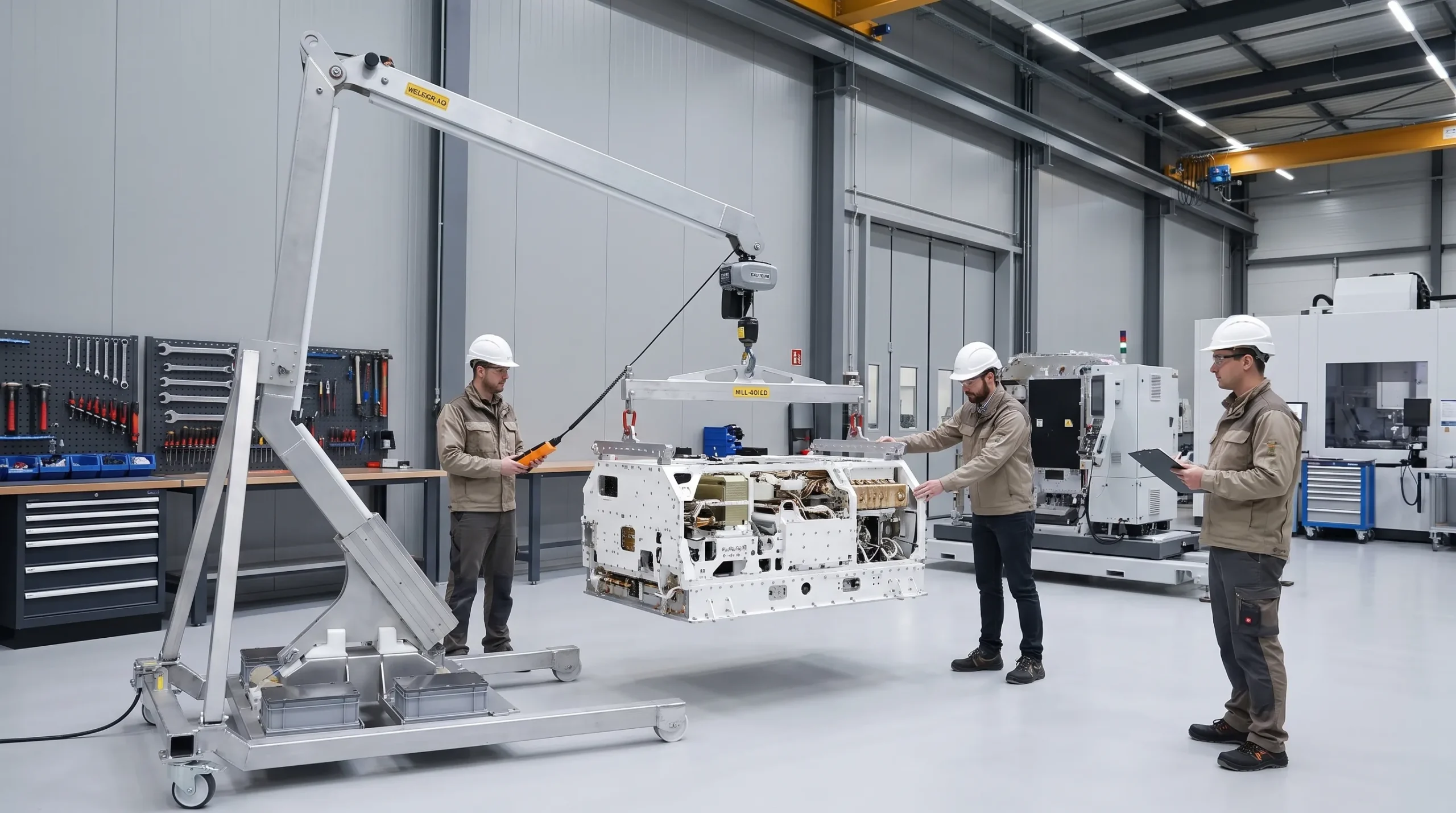
A portable gantry crane is often attractive because it gives engineering, maintenance and production teams lifting capacity where a fixed crane is not available. It can be moved, assembled for temporary work, and used in areas where permanent infrastructure would be difficult or uneconomical.
For critical lifts, however, portability is only one part of the decision. A lift becomes critical when the consequences of a failed or poorly controlled movement are high. That may involve a high-value semiconductor module, an aerospace component with strict dimensional tolerances, a sensitive optical assembly, a medical technology machine, or a load that must pass through a restricted production area with people, tooling and equipment nearby.
Choosing the right portable gantry crane is therefore not simply a matter of selecting a rated capacity from a catalogue. The real question is whether the crane, hoist, trolley, floor, lifting attachments, operators and inspection regime form a safe and practical lifting system for the actual task.
What makes a portable gantry crane suitable for critical lifts?
A portable gantry crane is suitable for critical lifts only when it can control the load throughout the complete movement. The rated capacity is important, but it does not answer questions about stability, hook approach, load rotation, floor conditions, user ergonomics or repeatability.
In high-tech environments, a 300 kg load can be more critical than a 3,000 kg load if it is fragile, difficult to replace, or positioned close to sensitive machinery. A lift may also be critical when the working area is tight, the centre of gravity is uncertain, the load must remain level, or the consequences of downtime are severe.
Before choosing a crane, define why the lift is critical. Is the main risk personnel safety, product damage, contamination, downtime, poor ergonomics, uncontrolled load movement, or a combination of these factors? This definition drives the engineering choices that follow.
A practical starting point is to document the complete lifting scenario, not just the object being lifted. This includes the pick-up location, travel path, working height, drop-off position, nearby obstacles, operator position, available headroom, floor condition, frequency of use and maintenance requirements. BKL has covered this broader decision logic in more detail in its article on how to choose lifting and hoisting equipment from the task rather than the catalogue.
Start with the load, not the crane
The load determines the lifting solution. For critical lifts, the first engineering step is to understand the load in enough detail to control it safely.
Key load information should include:
- Confirmed weight, including tooling, packaging, adapters, lifting frames and any temporary fixtures.
- Centre of gravity, including whether it is known, variable, offset or affected by removable parts.
- Approved lifting points, structural limitations and areas that must not be contacted.
- Required orientation during lifting, travel, rotation and placement.
- Sensitivity to shock, vibration, tilting, contamination, electrostatic discharge or surface damage.
- Available clearance around the load, including the hook height needed to attach slings or lifting adapters safely.
If the centre of gravity is offset or uncertain, a standard hook and sling arrangement may create uncontrolled tilting. In that case, a lifting beam, spreader beam, lifting adapter or custom lifting tool may be needed to create a stable load path. The gantry crane is then only one part of the system.
For high-value equipment, the cost of a poor lift is rarely limited to the damaged component. It may also include recalibration, customer delays, investigation time, cleanroom disruption, safety reporting, production downtime and loss of confidence in the process. This is why critical lifts should be engineered around the load path, not around the cheapest available device.
Core selection criteria for a portable gantry crane
A portable gantry crane can be a strong solution when the application is well understood and the equipment is chosen with the right technical criteria. The following table gives a practical overview.
| Selection criterion | What to verify | Why it matters for critical lifts |
|---|---|---|
| Rated capacity | Crane, hoist, trolley, lifting attachments and any adapters must all be suitable for the maximum load case | The system is only as strong as its weakest component |
| Span and working height | Required hook height, usable span, approach to the load and headroom above the crane | Poor geometry can force unsafe rigging or awkward operator positions |
| Stability | Base width, load position, side forces, floor condition and whether travel with load is permitted | Critical loads require controlled movement without tipping or unexpected sway |
| Mobility | Castor type, wheel diameter, brakes, steering behaviour and floor suitability | A portable crane that is hard to move can create ergonomic and safety risks |
| Hoist and trolley | Manual or powered operation, lifting speed, control precision, braking and positioning accuracy | Sensitive loads often need smooth and predictable movement |
| Material and finish | Steel, aluminium, surface treatment, cleanliness requirements and corrosion resistance | The working environment may influence strength, handling, cleanability and durability |
| Assembly and setup | Number of operators, required tools, locking pins, repeatability and inspection before use | Portable equipment is only safe when it can be assembled correctly every time |
| Documentation | Operating instructions, inspection records, test reports, declarations where applicable and usage limits | Critical lifts need traceability and clear proof of suitability |
This table also shows why a portable gantry crane should not be assessed in isolation. The hoist, trolley, sling, lifting beam, floor and operators all influence the safety of the lift.
Mobility is useful, but it can introduce risk
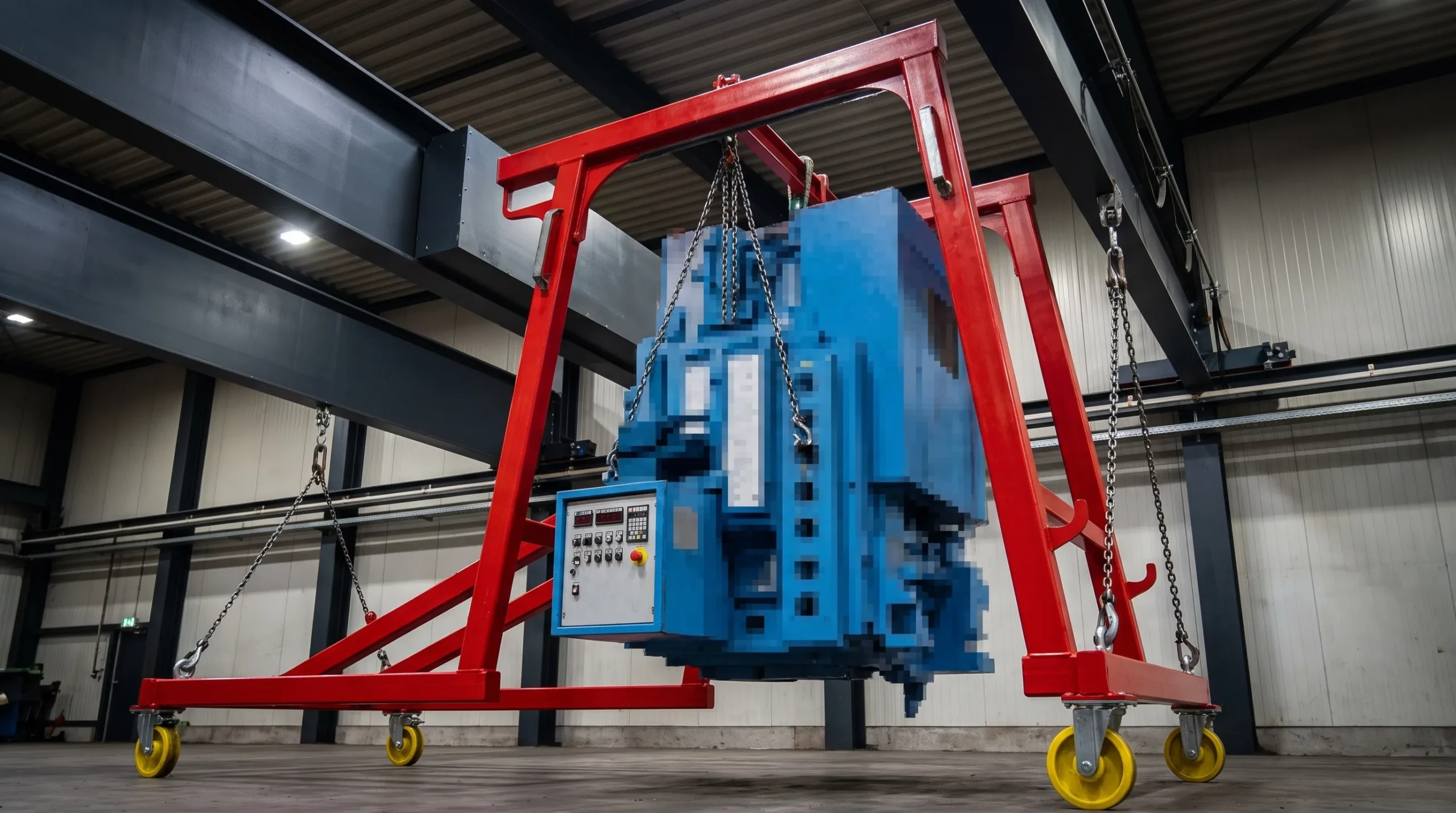
Portability is one of the main advantages of a gantry crane, especially in maintenance areas, assembly zones and locations without overhead crane coverage. Yet mobility can also create risk if it is misunderstood.
One important question is whether the crane only needs to be moved into position before lifting, or whether it must travel while carrying the load. Many portable gantry cranes are not intended to be moved under load unless the manufacturer explicitly permits it under defined conditions. If travel under load is required, this must be engineered and validated for the actual floor, route, load height, load stability and operator control method.
Castors deserve careful attention. Small wheels can be difficult to move over uneven floors, thresholds, expansion joints or debris. Hard wheels may transmit vibration to sensitive loads. Brakes must hold the crane securely during lifting and placement. Swivel behaviour must not make the crane unpredictable when operators reposition it.
The route around the crane is also part of the lifting system. Doorways, service bay access, workshop partitions and loading areas must remain reliable and free from avoidable obstruction. Even in non-industrial environments, residential garage door specialists emphasize the importance of keeping moving access systems dependable and safely maintained. In critical industrial lift routes, the same maintenance mindset should be applied with stricter controls, because a jammed or unreliable access point can disrupt a planned lift or create unsafe improvisation.
For cleanrooms, laboratories and high-tech assembly environments, mobility requirements may also include particle control, cleanable surfaces, specific wheel materials and compatibility with local procedures. In these cases, a standard portable gantry crane may need modification, or a purpose-designed cleanroom lift or handling tool may be more appropriate.
When a standard portable gantry crane may be enough
Not every application needs a custom engineered solution. A standard portable gantry crane may be sufficient when the load is well defined, stable, within the equipment limits, lifted from approved points and moved in a predictable environment.
A standard solution is more likely to be suitable when the lift is occasional, the route is clear, the floor is level and strong enough, the hook height is adequate, and operators can work without awkward posture or manual overexertion. The equipment should still be supplied with clear documentation, inspected before use, and included in the site’s lifting equipment management process.
The decision should not be based on rated capacity alone. A crane with sufficient capacity can still be unsuitable if the hook cannot reach the correct position, the load rotates during lifting, the operator must stand in a poor position, or the trolley movement is too abrupt for the component being handled.
For less complex tasks, the best solution may be a standard crane with a properly selected hoist and lifting attachment. For more complex tasks, the gantry may need to be combined with a custom lifting adapter, controlled positioning system, load balancing method or dedicated handling fixture.
When custom engineering becomes necessary
Custom engineering becomes important when the lifting challenge cannot be made safe and efficient by selecting standard components. This does not always mean designing a complete crane from scratch. It may mean modifying the lifting interface, adding a dedicated lifting beam, designing a custom adapter, improving operator controls, or validating the full lifting process.
Typical triggers for a custom approach include restricted headroom, offset centre of gravity, sensitive surfaces, limited access to lifting points, required load rotation, cleanroom requirements, repeated high-precision placement, or high consequences of product damage. Custom engineering may also be needed when several departments will use the equipment and the design must reduce the chance of incorrect setup.
In semiconductor, aerospace, defence, medical and analytical equipment environments, a lifting solution often has to fit the product, the facility and the operating procedure. The tool must be mechanically sound, but also practical for operators, maintainable for the maintenance team and understandable for safety or compliance specialists.
BKL discusses related challenges in its article on safe lifting of high-value equipment in tight spaces, where limited access and sensitive surroundings make the lift more than a simple capacity calculation.
Compliance, documentation and inspection considerations
For critical lifts, documentation is not administrative overhead. It is part of risk control. Teams need to know what the equipment is designed for, how it should be used, what its limits are, and whether it remains in safe condition after repeated use.
In Europe, machinery and lifting equipment may fall under relevant CE requirements, depending on the product and scope of supply. The Machinery Directive 2006/42/EC remains important, and the Machinery Regulation (EU) 2023/1230 will become applicable from January 2027. Depending on the design, application and components, standards related to cranes, non-fixed load lifting attachments and structural design may also be relevant. The exact requirements should be assessed for the specific solution.
For a portable gantry crane used in critical lifting, documentation may include design calculations, risk assessment, operating instructions, maintenance instructions, inspection records, load test reports where applicable, certificates where applicable, and a clear statement of intended use and limitations.
Inspection intervals should reflect the application, frequency of use, environment and consequences of failure. Visual checks before use remain important, but they do not replace periodic inspection by competent personnel. If there is visible deformation, suspected overload, damage, changed use, missing documentation or unusual behaviour during operation, the equipment should not simply wait for the next planned inspection. BKL explains this principle further in its article on when lifting equipment inspections should not be delayed.
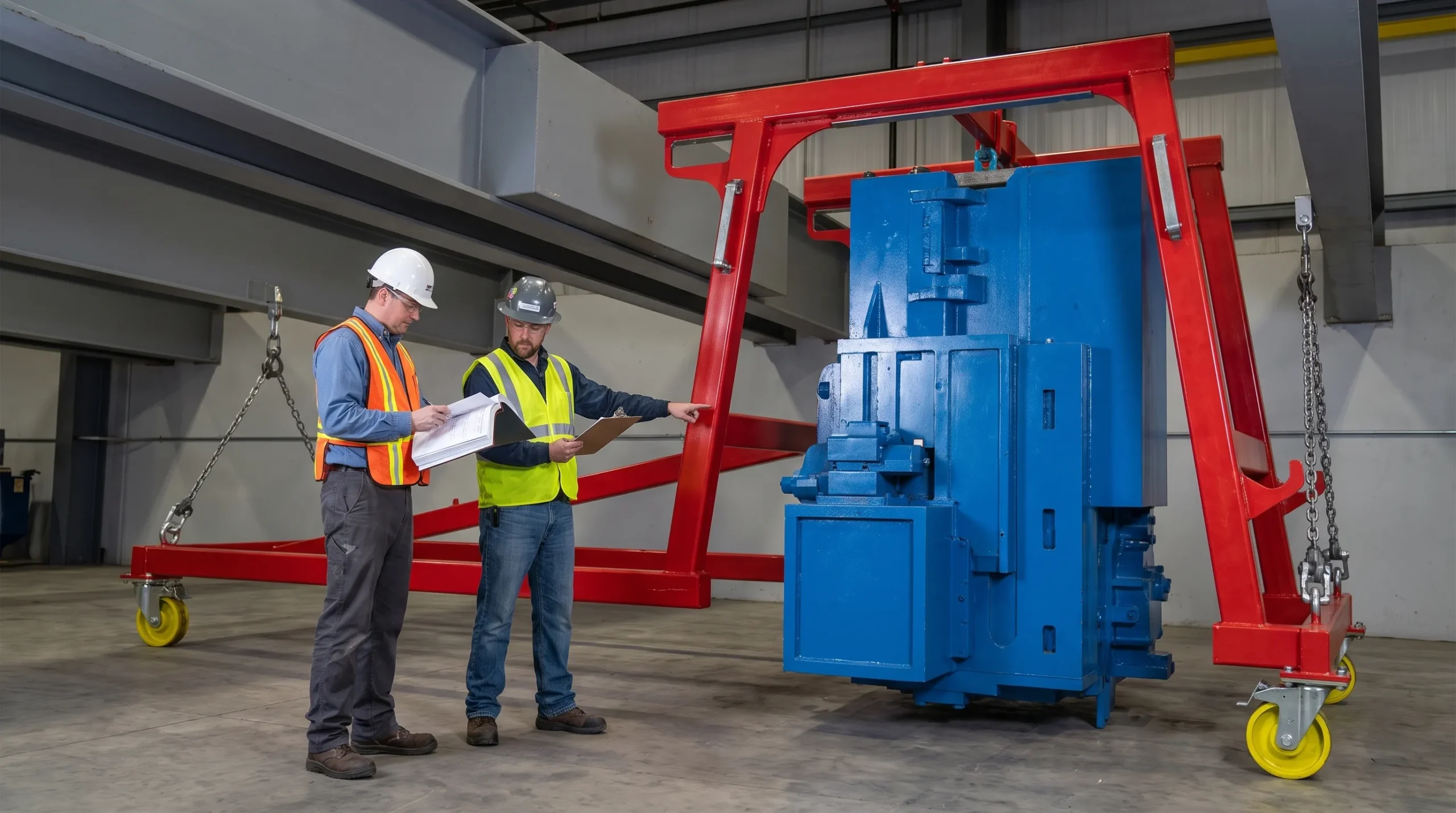
BKL is accredited according to ISO 17020:2012 for inspections. For companies using lifting tools and handling equipment in demanding environments, this can support structured visual inspections, overload testing, examinations, reports, certification where applicable and practical usage advice. The value is not only in finding defects, but in connecting inspection findings to real operating conditions.
Ergonomics and operator control are part of safety
A technically strong crane can still be unsafe if operators cannot use it comfortably and consistently. Critical lifts often require slow, controlled movements, good visibility and clear communication between team members. If the operator must pull the load manually, reach above shoulder height, work from an unstable position or apply excessive force to move the crane, risk increases.
Ergonomics should be considered at the concept stage. Important questions include whether the operator can attach the lifting device without strain, whether the controls are intuitive, whether pinch points are avoided, whether the load can be positioned without pushing it by hand, and whether visibility is adequate throughout the movement.
Powered lifting, fine speed control, guided movement or a custom handling fixture may be justified when the lift is repeated, precise or physically demanding. The investment should be compared with the long-term cost of poor ergonomics, rework, operator fatigue, product damage and production delays.
In critical environments, usability also supports compliance. If equipment is difficult to use correctly, people are more likely to create workarounds. A good lifting solution makes the safe method the practical method.
Look beyond the purchase price
Procurement teams naturally compare initial cost, but critical lifts should be assessed through lifecycle value. The lowest purchase price may not be the lowest total cost if the equipment is difficult to inspect, unreliable in use, unsuitable for future products, ergonomically poor or dependent on multiple suppliers for support.
Lifecycle value includes engineering quality, ease of operation, inspection access, spare part availability, maintenance requirements, repair options, documentation quality and the ability to adapt the tool when the process changes. For OEMs and first-tier suppliers, it also includes the effect on production continuity and customer commitments.
A portable gantry crane may be a cost-effective choice when it avoids the need for fixed infrastructure and can be used safely in several locations. It may be a poor choice if it encourages uncontrolled movement, manual pushing of suspended loads or repeated setup errors. The right decision balances Quality, Logistics, Technology, Cost and Sustainability, not just the acquisition cost.
Sustainability also has a practical engineering dimension. Durable equipment, repairable components, clear maintenance procedures and adaptable tooling can reduce waste and extend useful life. For high-tech manufacturers, this can support both operational reliability and sustainability objectives.
Questions to ask before selecting a supplier
The supplier you choose should understand both the equipment and the operational context. For critical lifts, buying components from different sources and integrating them internally can work if the team has the capacity and competence. It can also create gaps in responsibility if engineering, production, inspection and maintenance are not aligned.
Useful supplier questions include:
- Can the supplier assess the complete lift scenario, including load, route, floor, operators and environment?
- Can they provide engineering support when standard equipment is not sufficient?
- Can they manufacture or assemble the required tooling, adapters or modules?
- Can they support installation, inspection, testing and maintenance after delivery?
- Can they provide clear documentation, usage limits and inspection advice?
- Do they understand the requirements of high-tech, cleanroom, aerospace, medical or other demanding environments?
- Can they support partial process steps as well as complete end-to-end solutions?
- Can they discuss lifecycle costs, availability and practical usability, not only purchase price?
The goal is not to make every project more complex than necessary. The goal is to make the solution appropriate for the risk level of the lift.
How BKL supports portable gantry crane decisions
BKL supports companies that need safe, reliable and user-friendly lifting, hoisting, handling and working-at-height solutions. For portable gantry crane applications, that support can start with the lifting task itself: the load, the environment, the operator, the route and the consequences of failure.
Depending on the application, BKL can help with engineering, production, assembly, installation, inspection, certification where applicable, maintenance and related services. This can involve a complete solution or support for one specific process step. For example, a customer may already have a suitable gantry crane but need a custom lifting adapter, inspection support, load testing or practical advice on safe use.
For OEMs and first-tier suppliers, the advantage of this broader approach is alignment. The team designing or assessing the lifting tool understands how it will be manufactured, used, inspected and maintained. That reduces the risk of a design that works on paper but creates problems in production.
The most important selection principle is simple: a portable gantry crane should make the critical lift safer, more controlled and more practical. If it only adds capacity without improving control, the application may need a different lifting concept.
FAQ's about portable gantry cranes for critical lifts:
What is a portable gantry crane used for? A portable gantry crane is used to create temporary or movable lifting capacity in workshops, production areas, maintenance zones and assembly environments. It can be useful where a fixed overhead crane is unavailable or unnecessary, provided the crane is suitable for the load, floor, route and operating conditions.
Is rated capacity enough to select a portable gantry crane? No. Rated capacity is only one requirement. Critical lifts also require attention to centre of gravity, stability, hook height, span, mobility, floor condition, lifting attachments, operator ergonomics, documentation and inspection requirements.
Can a portable gantry crane be moved while carrying a load? Only if the crane is explicitly designed and permitted for that use under the relevant conditions. Many portable gantry cranes are intended to be positioned before lifting, not moved with a suspended load. If travel under load is required, the complete route and stability conditions must be assessed.
When is a custom lifting tool needed with a gantry crane? A custom lifting tool may be needed when the load has an offset centre of gravity, sensitive surfaces, limited lifting points, strict orientation requirements, restricted access or high consequences of damage. A custom lifting adapter or lifting beam can help create a safer and more predictable load path.
How often should a portable gantry crane be inspected? Inspection frequency depends on use, environment, risk level, manufacturer instructions and applicable regulations or internal procedures. Equipment should also be checked before use and reassessed after damage, suspected overload, changed use or unusual behaviour.
Is a portable gantry crane suitable for cleanroom use? It can be, but only if the materials, finish, wheels, lubrication, cleaning method and operating procedure are compatible with the cleanroom requirements. In some cases, a purpose-designed cleanroom lift or handling tool is more appropriate.
Discuss your critical lift before choosing equipment
If you are considering a portable gantry crane for a critical lift, start with the application rather than the catalogue. Define the load, route, constraints, operators, documentation needs and lifecycle expectations first.
BKL can help assess whether a standard crane, adapted lifting setup or custom engineered solution is the most practical and safe option. Contact BKL to discuss your lifting task, request support for engineering or inspection, or schedule an appointment to review the complete lifting process with a technical specialist.