
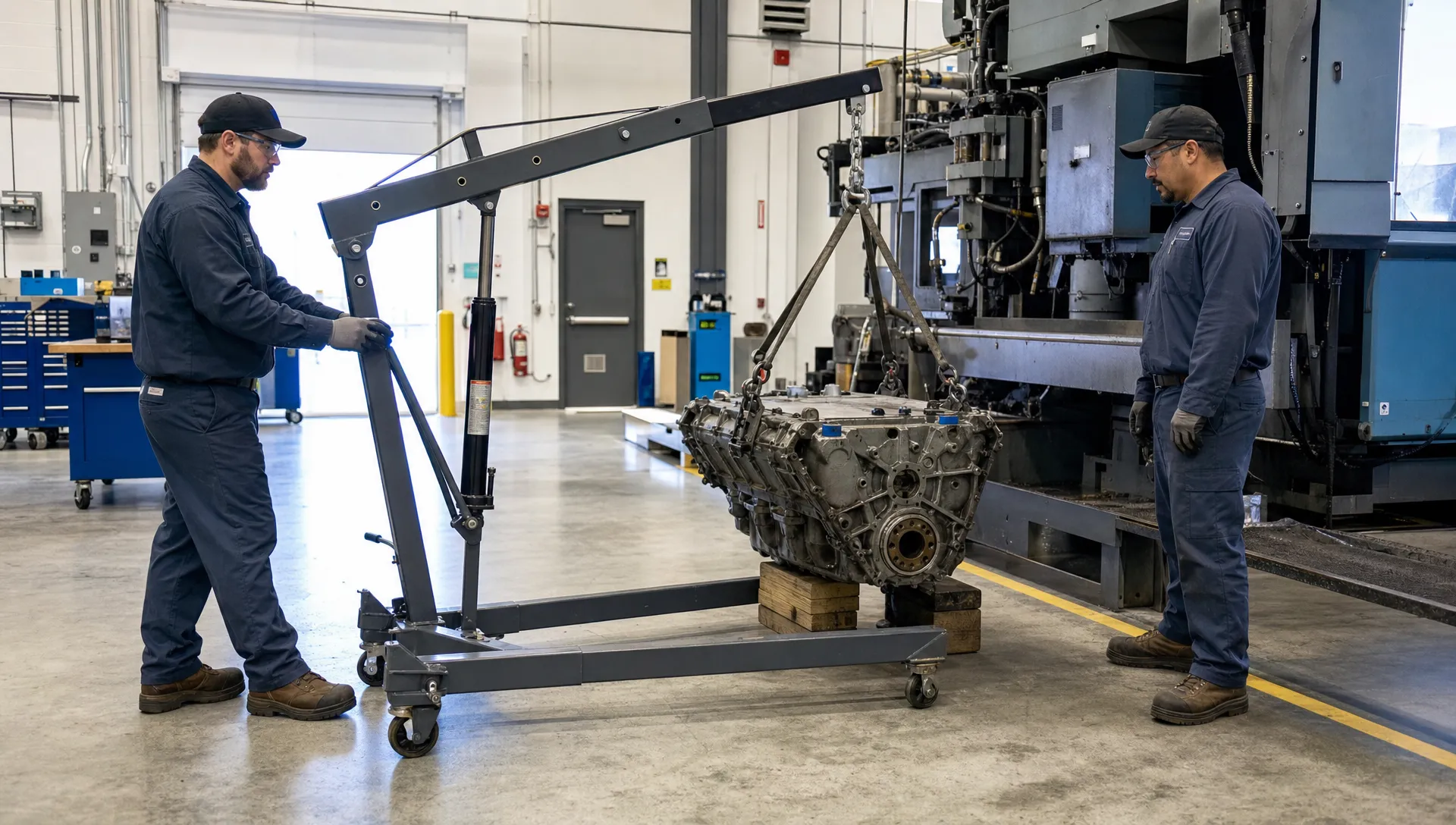
Selecting an engine hoist for maintenance work is not only a question of rated capacity. In OEM, high-tech manufacturing and industrial maintenance environments, the real decision is whether the lifting device can move a heavy, awkward or high-value component safely through the actual workspace, with predictable control and minimal strain on operators.
For maintenance managers, engineers and safety teams, the best choice starts with the task: what must be lifted, how often, by whom, in which environment and under which constraints. A standard workshop hoist may be sufficient for simple work. For critical assets, cleanroom equipment, aerospace modules, drive units or precision assemblies, the selection process needs more engineering depth.
Choose an engine hoist around the actual maintenance task
A good specification begins with the maintenance operation, not with the catalogue page. The right engine hoist must fit the component, the work area, the operator and the risk level of the lift. Capacity is one parameter, but it does not describe reach, stability, control, floor loading, lifting height or how the load behaves during movement.
Start by describing the lift in practical terms. Identify the component mass, lifting points, center of gravity, required travel path, lowest and highest hook position, available floor space and any obstacles around the machine. If the component is removed from a confined machine frame, the required reach may be more important than the nominal load rating.
Maintenance teams should also define whether the load needs to be lifted vertically only, rotated, tilted, translated, positioned into guide pins or held in place during assembly. These details determine whether a basic hydraulic shop crane, mobile gantry, lifting beam, lifting adapter or custom handling solution is appropriate.
Load, center of gravity and stability come first
The rated capacity of an engine hoist must exceed the maximum load, including lifting accessories, adapters and any uncertainty in the component weight. For industrial use, the weight on the drawing is not always the whole story. Added fluids, contamination, wear parts or auxiliary brackets can change the real mass during maintenance.
Center of gravity is just as important. A compact electric motor with a central lifting eye behaves differently from a long gearbox, pump skid or engine module with offset mass. If the center of gravity is not below the suspension point, the load may tilt when it leaves its supports. That tilt can damage interfaces, pinch hands or overload one side of the lifting arrangement.
Stability also depends on where the load sits in relation to the hoist base. Many mobile hoists lose usable capacity as boom extension increases. This is not a minor detail. A hoist that is safe at short reach may be unsuitable when the boom must extend over a machine frame, pallet, test stand or maintenance platform.
| Selection factor | What to verify | Why it matters |
|---|---|---|
| Maximum load | Component weight plus adapters and accessories | Prevents overloading of the lifting device |
| Center of gravity | Position relative to the lifting point | Reduces uncontrolled tilt and side loading |
| Boom reach | Capacity at the required extension | Avoids using the hoist outside its rated configuration |
| Base stability | Wheelbase, leg position and load path | Reduces tipping risk during lifting and movement |
| Floor condition | Flatness, strength, thresholds and gaps | Supports stable travel and predictable handling |
Reach, height and movement path determine usability
An engine hoist that cannot reach the load safely will tempt operators into unsafe workarounds. They may extend the boom too far, pull the load sideways, lift from a poor angle or use additional slings to compensate. These improvised adjustments often create more risk than the original maintenance task.
Check the full movement path before choosing equipment. The hoist must approach the machine, position its hook above the lifting point, raise the component high enough to clear fixtures and move away without striking guards, pipework, frames, cleanroom walls or other equipment. In a production area, the path may also need to avoid walkways, sensitive tools and live processes.
Movement control matters when the component is valuable or difficult to align. Manual pumping may be acceptable for occasional heavy lifting, but it can be tiring and imprecise when fine positioning is required. Powered lifting, controlled lowering, guided movement or a purpose-designed lifting adapter may be safer and more efficient for repeat tasks.
If the work requires movement through narrow routes or across uneven floors, consider whether another lifting concept is better. A portable gantry, overhead system or custom mobile lift may offer a more controlled load path than a conventional floor crane. BKL discusses related decision factors in its article on how to choose a portable gantry crane for critical lifts.
Decide when a standard solution is sufficient
A standard engine hoist can be a practical option when the load is known, the lift is occasional, the workspace is open and the maintenance operation is not safety-critical beyond normal lifting precautions. It may also be the right choice for auxiliary workshop tasks where precision positioning is not required.
The decision changes when the component is expensive, fragile, awkwardly shaped or located inside a restricted machine area. High-tech environments often add further constraints such as cleanroom compatibility, low particle generation, ergonomic access, repeatable positioning and controlled documentation. In these cases, choosing equipment only by capacity and price is too narrow.
Procurement discipline also matters. Routine workshop consumables may be suitable for purchase through a general online marketplace in the UAE, but lifting equipment for maintenance work should be specified, checked and documented according to the risk of the task. Safety-critical tooling should not be treated like a commodity purchase.
Use the following comparison as a first filter, then validate the choice through a task-specific risk assessment.
| Situation | Standard hoist may be enough | Custom engineering may be needed |
|---|---|---|
| Load shape | Compact and stable | Offset, fragile or difficult to support |
| Access | Open floor and clear lifting point | Confined machine frame or limited headroom |
| Frequency | Occasional maintenance | Repetitive production or service activity |
| Positioning | Rough placement is acceptable | Accurate alignment is required |
| Environment | General workshop | Cleanroom, aerospace, medical or precision area |
| Documentation | Basic records are sufficient | Technical file, calculations or specific test evidence needed |
Safety and ergonomics in daily maintenance use
A safe engine hoist should support the operator, not force the operator to compensate for design limitations. Handles, wheels, controls, locking points and pump effort all affect whether people can use the equipment correctly throughout a long shift or during time-critical maintenance.
Ergonomics is not only about comfort. Poor posture, excessive pushing force, awkward hand positions or poor visibility can increase the chance of operational mistakes. If two operators are needed to control a lift, define their roles clearly and make sure the equipment allows communication and visibility throughout the movement.
For high-value assemblies, slow and predictable motion is often more important than fast lifting. Sudden lowering, uncontrolled swing or wheel movement can damage machine interfaces or create pinch points. The hoist should make the intended safe behavior easy and the unsafe behavior difficult.
Useful design and selection checks include:
- Clear load rating visible at the relevant boom positions
- Stable handles and pushing points outside pinch zones
- Wheels suitable for the floor, thresholds and turning radius
- Controlled lowering and secure holding of the suspended load
- Compatible lifting eyes, slings, shackles, adapters and attachment points
- Operator access that avoids standing under or reaching across suspended loads
For a broader view of equipment selection beyond workshop hoists, BKL’s guide on how to select lifting and hoisting equipment wisely explains why the lifting task should drive the technical concept.
Compliance, inspection and documentation
An engine hoist used in a professional maintenance environment should be supported by clear documentation. At minimum, teams need instructions for use, rated capacities, maintenance requirements and inspection records. Depending on the equipment type, modification level and jurisdiction, additional conformity assessment, calculations, testing or technical documentation may be required.
For organisations operating in the EU, machinery and work equipment obligations should be considered early. CE-related responsibilities, risk assessment, guarding, user instructions and documentation cannot be repaired at the end of a project by adding a label. They need to be addressed through design, verification and practical operating procedures.
Inspections are also part of the lifecycle, not a one-time administrative task. Visual examination can reveal deformation, corrosion, wear, damaged wheels, hydraulic leakage, cracks, illegible markings or missing locking devices. Load testing or more detailed examination may be appropriate depending on the equipment, application and applicable requirements.
BKL is accredited according to ISO 17020:2012 for inspections and can support visual inspections, overload testing, examinations, reports, certification where applicable and practical usage advice. This is especially valuable for custom lifting tools, lifting adapters and equipment where inspection quality depends on understanding the original design intent.
When maintenance lifting needs custom engineering
A catalogue engine hoist is not always the wrong answer, but it becomes risky when the task demands a level of control, repeatability or integration that the standard equipment was never designed to provide. This is common in semiconductor, medical technology, defence, aerospace, energy, optical and analytical equipment environments.
Custom engineering may be justified when the load has no suitable lifting points, when the center of gravity changes during removal or when the component must be guided into a precise position. It may also be needed when operators work at height, when the workspace is too tight for a normal hoist base or when a cleanroom-compatible lifting solution is required.
A custom approach can include a lifting adapter, spreader beam, mobile lift, guided handling frame, scissor lift table, cleanroom handling tool or a complete maintenance module. The value is not only mechanical strength. It is the combination of safe load path, usability, documentation, manufacturability, inspection strategy and lifecycle support.
If a standard equipment hoist no longer matches the real risk profile of the task, BKL’s article on when an equipment hoist needs a custom engineering approach provides a useful next step for engineering teams.
Lifecycle cost is more than purchase price
The cheapest engine hoist can become expensive if it slows maintenance, frustrates operators, damages components or requires frequent repair. For critical production equipment, downtime and safety risk often outweigh the difference between a basic purchase and a better engineered solution.
Evaluate lifecycle value through Quality, Logistics, Technology, Cost and Sustainability. Quality relates to safe and reliable lifting. Logistics concerns availability, spare parts, transport and storage. Technology covers load control, stability and fit with the maintenance task. Cost includes purchase price, inspection, maintenance and operational impact. Sustainability includes durability, repairability and avoiding unnecessary replacement.
A lifecycle view also helps procurement and engineering teams speak the same language. Procurement may focus on budget, engineering on technical risk, safety on compliance and operations on uptime. A clear specification connects these priorities and makes the decision easier to defend.
Practical selection checklist before approval
Before approving an engine hoist for maintenance work, bring engineering, operations, safety, maintenance and procurement into the same review. The goal is not to make the process slow. The goal is to avoid discovering after delivery that the hoist cannot safely perform the job it was bought to do.
Use this checklist during specification or supplier evaluation:
- Confirm the real maximum load, including adapters and accessories
- Verify capacity at the required boom extension or lifting configuration
- Map the complete load path from removal to storage or installation
- Check floor strength, flatness, thresholds and turning space
- Confirm hook height, reach, headroom and machine access
- Review operator ergonomics, visibility and control during the lift
- Define required documentation, inspections, maintenance and test records
- Decide whether a standard hoist, adapted tool or custom lifting solution is appropriate
If one or more points cannot be answered confidently, pause the purchase and clarify the task. In safety-critical maintenance, uncertainty should become an engineering question, not an operator problem.
How BKL can support safe maintenance lifting
Choosing an engine hoist is often part of a wider maintenance tooling decision. BKL supports OEMs, first-tier suppliers and industrial companies with mechanical and mechatronic engineering, custom hoisting and lifting tools, handling equipment, industrial modules and machines.
The team can contribute to individual process steps or manage the complete chain, from concept development, engineering and production to assembly, installation, inspection, certification where applicable, maintenance and service. Safety, ergonomics and user-friendly operation are considered from the first design steps, not added as an afterthought.
For existing lifting equipment, BKL can help assess condition, perform inspections and provide clear reports and practical usage advice. For new or complex maintenance tasks, BKL can help determine whether a standard solution is sufficient or whether a custom lifting device will improve safety, usability and lifecycle reliability.
If you are reviewing maintenance tooling for a machine, production line or high-value module, contact BKL to discuss the lifting task, operating environment and documentation needs. A short technical review can often clarify whether you need a standard hoist, an adapted lifting tool or a complete custom handling solution.
FAQ's about choosing an engine hoist:
What capacity should an engine hoist have for maintenance work? The rated capacity should exceed the real load, including lifting adapters, slings and accessories. Also check the capacity at the required boom extension, because many mobile hoists have lower allowable loads at longer reach.
Is a standard engine hoist suitable for industrial maintenance? It can be suitable for simple, occasional lifts in an open workspace with known loads and clear lifting points. For confined access, offset centers of gravity, high-value components or precision positioning, an adapted or custom solution may be safer.
What is the biggest selection mistake? Focusing only on maximum rated load. Reach, stability, floor conditions, load path, control, ergonomics, documentation and inspection requirements often determine whether the equipment is safe and practical in daily use.
How often should lifting equipment be inspected? Inspection frequency depends on equipment type, intensity of use, environment, applicable regulations and company procedures. Maintenance teams should define intervals, keep records and arrange additional checks after overload, damage, modification or unusual events.
When should we involve a specialist engineering partner? Involve a specialist when the lift is safety-critical, the standard equipment does not fit the workspace, the load is expensive or fragile, CE and documentation requirements are unclear or operators need a more ergonomic and repeatable lifting process.