
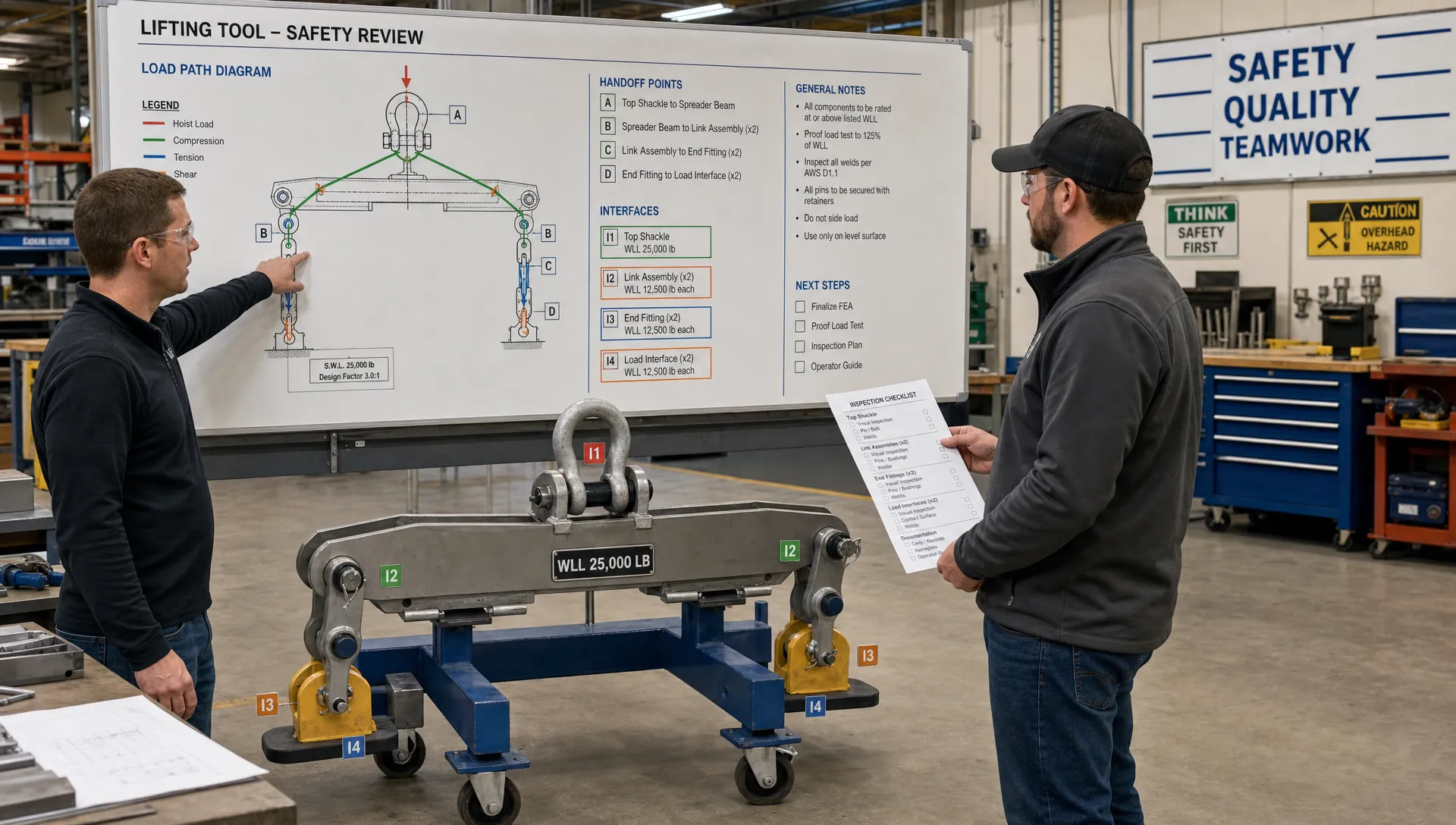
Employee safety is often discussed when a tool is delivered, a machine is commissioned or operators receive work instructions. In reality, many of the most important safety decisions have already been made by then. The geometry, load path, control concept, access points, interfaces, documentation and inspection strategy were defined much earlier, usually at the engineering table.
That is why employee safety should not be treated as a final checklist item. For OEMs, machine builders, high-tech manufacturers and industrial production teams, safe operation starts when requirements are translated into technical choices. A well-engineered tool or module does more than meet a specification. It helps operators perform the task correctly, predictably and with less exposure to unnecessary risk.
In practical terms, the engineering table is where safety, usability, compliance readiness, production efficiency and lifecycle support come together. If those topics are separated, the result is often a technically functional solution that creates avoidable problems during lifting, handling, transport, installation or maintenance.
Safety is designed before the operator touches the equipment
A machine guard, warning label or work instruction can be necessary, but they are not the starting point of employee safety. The preferred approach is to remove or reduce hazards through design wherever reasonably possible. This is consistent with the principle behind NIOSH’s Prevention through Design initiative, which focuses on addressing occupational risks as early as possible in the design process.
For industrial tools and machines, that means asking safety questions before detailed drawings are released. How will the load behave if it is slightly off-center? Where are the operator’s hands during coupling and decoupling? Can the tool be positioned without awkward force? Is the interface self-locating, or does it depend on operator judgment under time pressure? What happens if the tool is used after years of wear?
These questions are not theoretical. They determine whether a lifting tool, handling fixture, industrial module or maintenance aid remains safe and practical in real factory conditions. A solution that looks acceptable in CAD can still create risk if it is difficult to align, hard to inspect or unclear to operate.
What must be decided at the engineering table
The engineering table is where teams convert operational reality into measurable technical requirements. For employee safety, the most valuable discussions are not limited to rated capacity or basic machine guarding. They also include the full sequence of use, the environment, the operator interaction and the long-term condition of the equipment.
| Engineering decision | Why it matters for employee safety | Practical example |
|---|---|---|
| Task definition | Prevents tools from being designed for an idealized process instead of real work | Including actual lifting angles, operator reach and available clearance |
| Load path | Helps control forces from the load through the tool, interfaces and lifting points | Verifying how forces are transferred through a custom hoisting tool |
| Interfaces | Reduces the risk of incorrect connection, instability or unintended movement | Designing clear locating features and secure locking points |
| Ergonomics | Limits unnecessary strain, awkward posture and manual correction | Placing handles, controls and access points where operators can use them safely |
| Controls and movement | Supports predictable operation and reduces unintended activation | Using clear control logic for powered or mechatronic functions |
| Inspection concept | Makes wear, deformation or damage easier to detect over time | Defining inspection points and acceptance criteria during design |
| Documentation | Helps operators and maintenance teams use and service the equipment correctly | Providing manuals, test reports, usage advice and technical files |
The most effective safety discussions involve more than the design engineer. Operations, maintenance, safety, production and procurement teams each see different risks. Operators know where access is limited. Maintenance teams know which parts are difficult to reach. Safety managers understand incident patterns and compliance expectations. Procurement teams need to compare not only price, but also lifecycle risk and support.
When these perspectives are included early, the engineering team can make better trade-offs. For example, a heavier tool may be acceptable if it creates a stable load path and reduces manual alignment. In another case, a standard solution may be sufficient if the task is simple, the environment is predictable and inspection requirements are clear. Safety-led engineering is not the same as always choosing the most complex solution. It is about choosing the right level of engineering for the risk and the application.
Employee safety in high-tech and OEM environments
In high-tech, semiconductor, optical, aerospace and advanced manufacturing environments, lifting and handling tasks often involve valuable equipment, limited clearance and strict process requirements. A small mechanical error can damage sensitive components. A poorly positioned lifting point can create unstable movement. A tool that is difficult to connect can place operators in unsafe positions.
This is where generic equipment selection can fall short. Catalogue specifications may state a rated load, but they rarely describe the complete context of use. The real question is whether the tool fits the product, the workspace, the operator task, the maintenance procedure and the inspection regime.
BKL explores this practical fit in more detail in its article on choosing safety tools that fit real factory use. That perspective is important because employee safety depends on how equipment behaves in the actual production environment, not only on what it is rated for on paper.
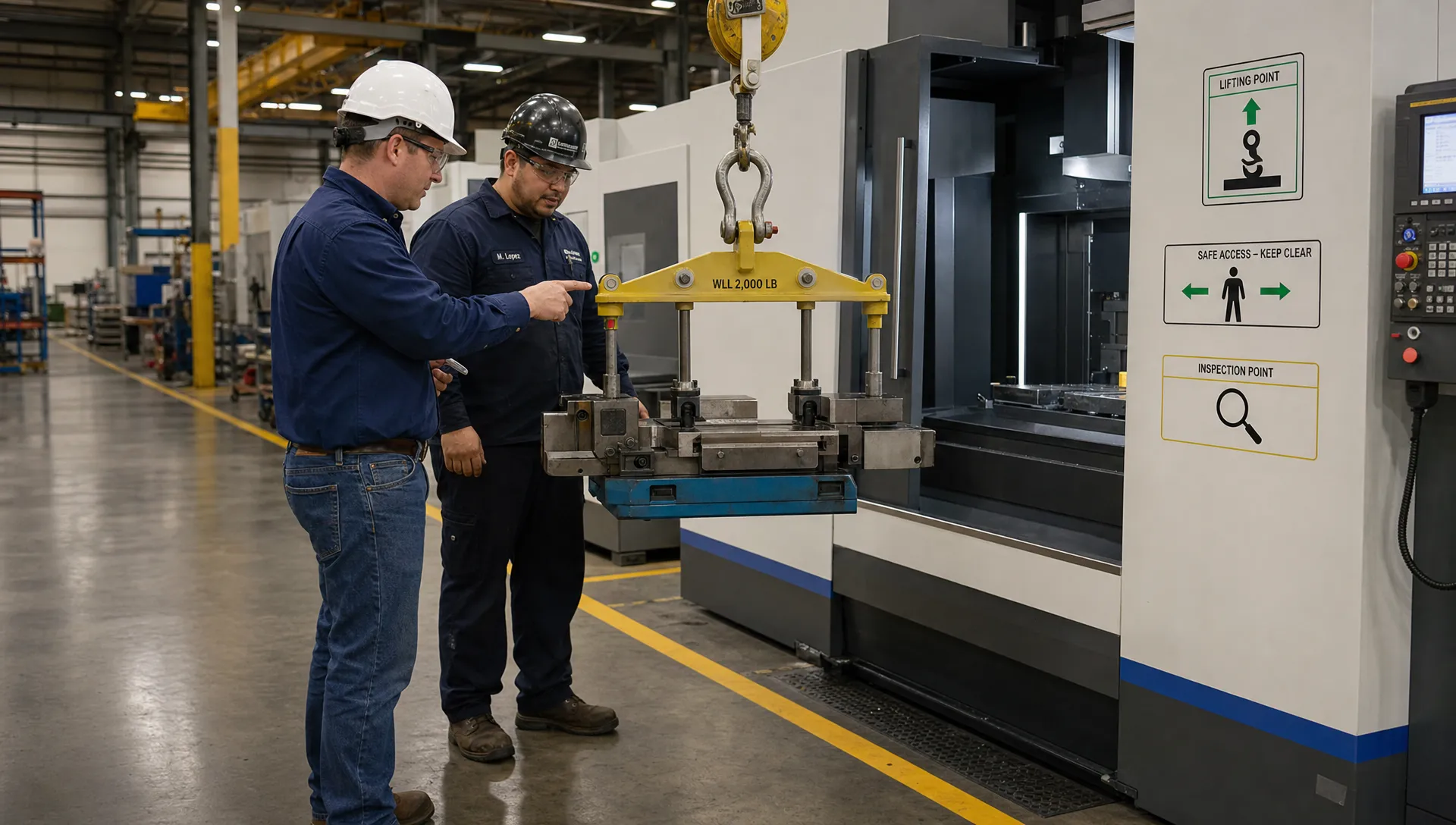
For example, a lifting tool for a high-value module may need to pass close to machine frames, cleanroom structures or sensitive assemblies. The safe design challenge is not just lifting capacity. It also includes controlled movement, clear operator visibility, stable interfaces, predictable handling and documentation that explains the correct use conditions.
Traceability makes safety easier to maintain
Engineering decisions should leave a trace. For machines and lifting tools, this usually means calculations, drawings, risk assessments, test reports, manuals, inspection reports and usage instructions. These documents are not administrative extras. They help future users, inspectors and maintenance teams understand what the equipment was designed to do and under which conditions it should be used.
This is especially important for equipment that remains in service for many years. A tool may appear to function normally, while wear, deformation, cracks or incorrect use slowly increase risk. Without a clear inspection concept and technical baseline, it becomes harder to prove that the tool remains fit for its intended task.
In Europe, manufacturers also need to consider applicable product safety legislation, CE marking obligations and technical documentation requirements. In 2026, many organizations are also preparing for the transition from the Machinery Directive to the EU Machinery Regulation, which becomes applicable in 2027. Engineering teams should not treat this as a paperwork exercise. Compliance readiness starts with clear design assumptions, risk reduction measures, verification and documentation.
BKL supports this broader lifecycle view through engineering, production, inspections and related services. Its article on how safety engineering reduces risk across the lifecycle explains why design, manufacturing, commissioning, inspection and maintenance should be connected instead of managed as isolated phases.
Usability is not optional
A tool can be strong and still be unsafe to use. If operators need to improvise, apply excessive manual force or rely on unclear visual cues, the design has left too much to human correction. Usability is therefore a safety requirement, not just a convenience.
Good usability starts with understanding the task sequence. Operators need to know where to stand, what to connect first, how to confirm correct engagement and how to react if the process does not go as expected. Handles, guiding features, control positions and visual indicators should support the intended behavior.
This is particularly relevant for custom lifting and handling equipment. The operator may use the tool only periodically, for example during maintenance, module replacement or transport. If a tool is rarely used, intuitive operation and clear documentation become even more important. The design should help employees do the right thing without relying on memory alone.
The cost of late safety decisions
When safety is addressed late, teams often have fewer options. A hazard discovered during commissioning may require additional guarding, procedural controls, design rework or production delays. These measures can still be necessary, but they are usually more expensive and less elegant than solving the issue during concept development.
Late safety decisions also create coordination problems. Engineering may need to revise drawings. Production may need to modify parts. Documentation may need to be rewritten. Operators may need additional instructions. Procurement may face new supplier requirements. Maintenance may inherit a design that is technically acceptable but difficult to service.
| If safety is handled early | If safety is handled late |
|---|---|
| Risks can be reduced through geometry, interfaces and control logic | Risks may need to be managed with added procedures or retrofits |
| Operator access can be built into the layout | Access problems may appear during installation or use |
| Inspection points can be designed into the equipment | Inspectors may struggle to assess critical areas |
| Documentation can reflect the real design intent | Manuals and reports may need rework after changes |
| Lifecycle costs are easier to evaluate | Hidden costs appear through downtime, repair or redesign |
This does not mean every possible risk can be eliminated by design. Industrial work will always require trained employees, defined procedures and responsible use. But when engineering reduces unnecessary complexity and makes correct use easier, the organization becomes less dependent on last-minute controls.
Safety belongs in the wider operational context
Employee safety is closely connected to production continuity, maintainability and operational efficiency. A tool that is difficult to inspect may create downtime later. A module that is hard to access may increase maintenance risk. A lifting device that requires too many manual corrections may slow the process and expose employees to avoidable strain.
The same early-stage thinking also applies to other operational constraints around industrial projects. Facility capacity, energy use, compressed air, electrification and sustainability goals can influence technical decisions. For companies in the Arnhem-Nijmegen region, independent energy and sustainability advice can help align operational improvements with practical steps for energy savings, regulation and future facility needs.
For safety-critical equipment, the key point is similar: decisions are easier to improve before they become fixed in hardware, layout and procedures. The earlier teams identify constraints, the more room they have to design a solution that fits the real environment.
Questions to ask before approving a tool or machine
Before approving a lifting tool, handling fixture, industrial module or machine, management and engineering teams should challenge the design from the operator’s perspective. The following questions can help reveal whether employee safety has been considered early enough:
- Has the real task been defined, including environment, clearance, operator position and frequency of use?
- Can the complete load path be explained, calculated and verified?
- Are the interfaces designed to reduce incorrect connection or unstable positioning?
- Are pinch points, crush zones and unintended movement addressed through design where possible?
- Can operators use the tool without awkward posture, excessive force or unclear steps?
- Are inspection points accessible and are acceptance criteria defined?
- Does the documentation explain intended use, limitations, inspection requirements and maintenance guidance?
- Has the design considered what happens after years of use, repair or repeated inspection?
These questions are useful because they connect technical design to everyday work. They also help decision-makers compare suppliers more realistically. The lowest initial cost is not always the lowest risk or the lowest lifecycle cost, especially when tooling availability and production continuity matter.
How BKL supports safety from concept to lifecycle
BKL works at the intersection of mechanics, mechatronics, production, inspection and service. That combination matters because employee safety is not created by one discipline alone. A safe lifting tool or industrial module needs a sound mechanical concept, practical usability, controlled manufacturing, clear documentation and a plan for inspection and maintenance.
Depending on the project, BKL can support a specific step or the complete process. That may include concept development, engineering, manufacturing, conformity assessment support, inspection, overload testing, repair or service. For companies that already have internal engineering capacity, BKL can provide specialist knowledge for safety-critical lifting, handling or machine applications. For teams that need one technical partner, BKL can connect design, production and lifecycle support.
BKL is also accredited according to ISO 17020:2012 for inspections. This supports structured visual inspections, examinations, overload testing, reports and practical usage advice for lifting and hoisting equipment. Combined with engineering and manufacturing knowledge, inspections become more than a periodic obligation. They become part of a feedback loop that helps keep equipment available, understandable and suitable for continued use.
The most valuable safety improvements often start with a simple shift in timing. Instead of asking whether a finished tool is safe enough, ask how the design can make safe use more natural from the start.
FAQ's about employee safety at the engineering table:
Why should employee safety start during engineering? Because many risks are created or reduced by early design decisions. Load paths, interfaces, access, controls, ergonomics and inspection points are much easier to improve before manufacturing and commissioning.
Does every lifting or handling task require a custom-made solution? No. A standard solution can be appropriate when the task, load, environment and safety requirements match the equipment. Custom engineering becomes important when the application has special interfaces, limited clearance, high-value loads or specific operational constraints.
How does documentation support safer use? Documentation records the design intent, correct use, limitations, inspection requirements, test results and maintenance guidance. This helps operators, maintenance teams and inspectors understand how the equipment should be used and assessed over time.
What is the role of inspections after delivery? Inspections help verify whether equipment remains suitable for use after wear, repeated loading, repair or changing operating conditions. They do not replace good design, but they are an important part of lifecycle safety and tooling availability.
How can managers justify investing in safety-led engineering? The value is not only reduced risk exposure. Better engineering can also improve usability, reduce rework, support compliance readiness, simplify maintenance and protect production continuity. These factors should be considered alongside the initial purchase price.
Build safety into the first decision
If your organization is developing, modifying or evaluating lifting tools, handling systems, industrial modules or machines, involve safety from the first engineering discussion. The earlier the task, environment, operator interaction and lifecycle requirements are understood, the stronger the final solution can be.
BKL supports OEMs, machine builders and industrial manufacturers with mechanical and mechatronic engineering, production, inspections and service for safety-critical tools, modules and machines. Start with the engineering table, and make employee safety part of the design from day one.