
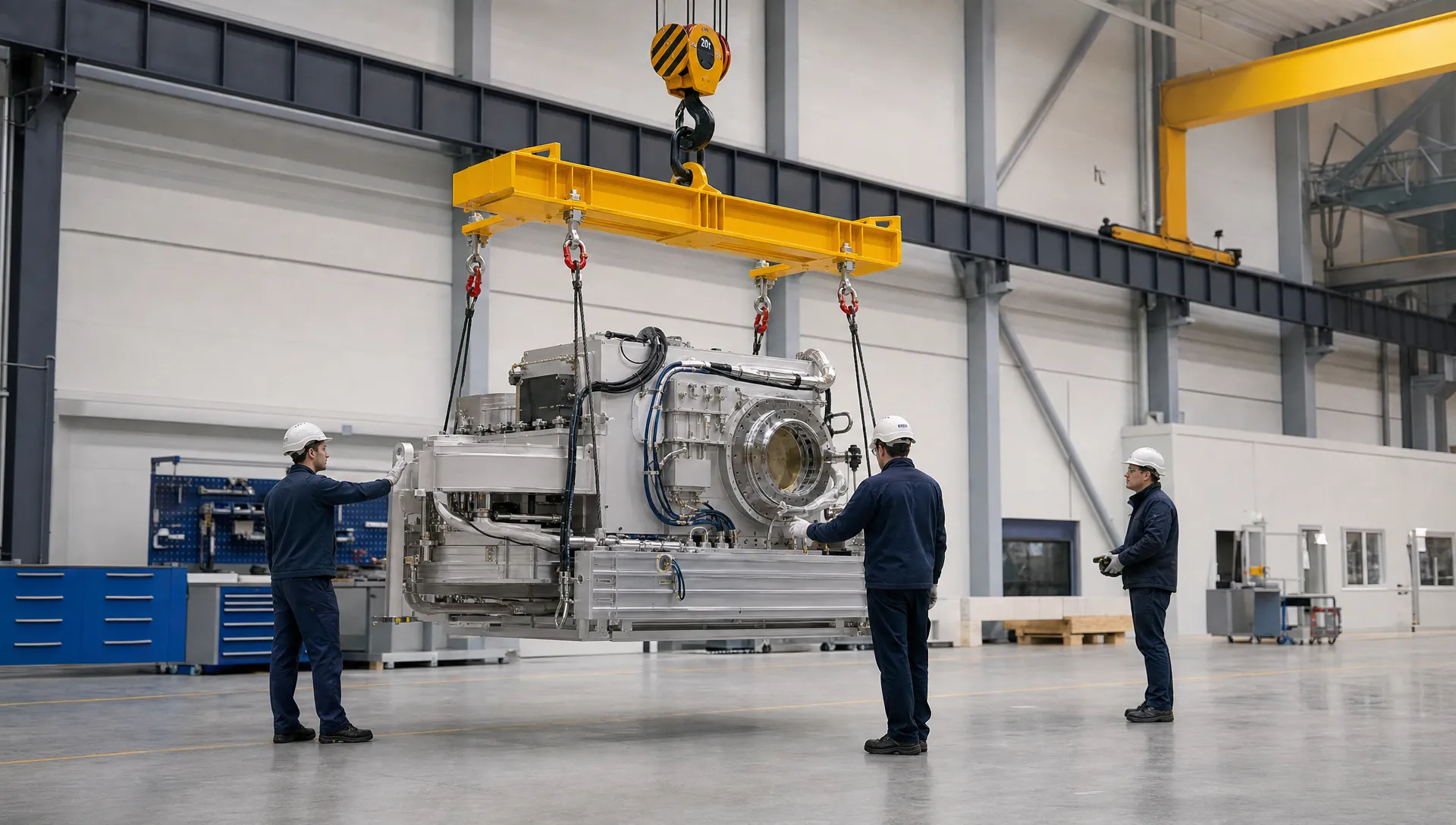
Selecting a four point lifting beam for a complex load is not a catalogue exercise. Rated capacity matters, but it is only one part of the decision. For OEMs, first-tier suppliers and high-tech manufacturers, the real question is whether the beam gives predictable control of the load throughout the complete lifting operation, from connection and take-up to transport, installation and release. A good specification accounts for center of gravity, lifting interfaces, headroom, operator posture, equipment access, documentation and future inspection.
In industries such as semiconductor equipment, aerospace, medical technology, energy, optics and analytical equipment, loads are often expensive, sensitive, asymmetric or difficult to access. The lifting beam must therefore do more than hold weight. It must help operators position the load safely, reduce unwanted rotation, avoid damage to critical surfaces and fit the real working environment.
When a four point lifting beam is the right choice
Een four point lifting beam is typically used when a load needs support at four defined points rather than from a single hook, two-point beam or simple sling set. This can improve stability and reduce local stress on the product, especially when the load is long, wide, flexible or fitted with engineered lifting points.
The choice is most relevant when the load cannot tolerate bending, twisting or uncontrolled tilting. Examples include machine frames, precision modules, cleanroom assemblies, tooling plates, aircraft components and high-value service parts. In these cases, the beam geometry should match the product geometry, not the other way around.
A four-point arrangement can also improve operator confidence during alignment. If the load must be guided into a machine base, test rig, transport frame or installation envelope, the lifting system needs to behave predictably at low speeds and during small corrections.
| Situation | Why four points may help | Key engineering check |
|---|---|---|
| Wide or flexible load | Reduces sagging and local stress | Deflection of beam and load |
| Offset center of gravity | Allows engineered pick-up geometry | Load share per point |
| Sensitive equipment | Limits uncontrolled motion | Stability during take-up |
| Repeatable production lift | Supports consistent procedures | Fixed or controlled settings |
| Limited access | Positions hooks and slings away from obstacles | Headroom and operator reach |
Start with the lifting task, not the beam capacity
The first specification step is to describe the lift in operational terms. What is being lifted, where is it lifted from, where does it need to go and what happens if alignment is not perfect? A four point lifting beam can only be selected correctly when the full task is understood.
Capacity alone can be misleading. A beam with adequate working load limit may still be unsuitable if the hook height is too high, the lifting points are not compatible with the load, the sling angles create excessive forces or the operator cannot connect the tooling ergonomically.
Document the following before choosing a design: load mass, center of gravity, lifting points, allowable interface loads, environmental constraints, crane or hoist data, movement path, available headroom, required orientation and any restrictions from the product manufacturer. If the load is not rigid, also consider how it deforms during lifting.
For a broader procurement view, BKL has also explained how to select lifting and hoisting equipment based on the real task rather than by rated capacity alone.
The center of gravity must be treated as a design input
Complex loads rarely have a convenient center of gravity directly below the crane hook. Cabinets may contain heavy assemblies on one side. Aerospace structures may have irregular geometry. Semiconductor modules may include sensitive subsystems that cannot be used as reaction points.
Een four point lifting beam should be designed so the resultant lifting force passes through, or is deliberately controlled around, the actual center of gravity. If that is not possible, the design needs a defined method to manage tilt, such as adjusted connection lengths, alternative lifting holes, an engineered adapter or a controlled balancing procedure.
Guesswork is not acceptable for safety-critical lifting. If the center of gravity is uncertain, it should be calculated, measured or validated through a controlled test process before routine use.
Four lifting points do not automatically share the load equally
One of the most common mistakes is assuming that four connection points each carry 25 percent of the load. In practice, small height differences, manufacturing tolerances, sling length variations, product flexibility and beam deflection can shift load from one point to another.
This matters because a lifting lug, threaded insert or adapter may be overloaded even when the total load is within the beam rating. A four point lifting beam may therefore need load balancing features, adjustable connection points or a design that intentionally limits sensitivity to small differences in height.
The engineer should verify the worst credible load distribution, not only the ideal case. For high-value equipment, this verification can be just as important as the beam strength calculation.
Choose the beam geometry for control and usability
Specifying a four point lifting beam means choosing a geometry that supports both the load and the people using it. A technically strong beam can still create risk if it is awkward to connect, difficult to inspect or easy to set incorrectly.
The main geometry decisions are fixed versus adjustable, single product versus multi-product use, top suspension arrangement, lower connection layout and available headroom. Adjustable designs can be useful when one beam must serve several load variants, but each adjustment introduces a setup step. For repeatable production lifting, a fixed design may reduce operator decisions and improve consistency.
BKL has covered this trade-off in more detail in its article on when a fixed lifting beam is safer than an adjustable design.
| Geometry choice | Advantage | Risk to manage |
|---|---|---|
| Fixed lifting points | Simple use and repeatability | Limited flexibility for product variants |
| Adjustable lifting points | Can serve multiple load geometries | Incorrect setup or unclear markings |
| Low-headroom design | Useful in restricted spaces | Higher structural demands in compact layouts |
| Integrated adapters | Better fit to the load | Requires accurate product interface data |
| Removable accessories | Easier storage and service | Missing parts or wrong configuration |
Clear markings, positive locking, logical handling points and visible inspection areas all improve usability. These details may seem small during engineering, but they have a direct effect on safe daily operation.
Check every interface between beam, load, hoist and operator
For a four point lifting beam, the critical interfaces are often where practical problems appear. The lower interfaces must match the product lifting points without forcing operators to improvise with shackles, slings or temporary adapters. The top interface must fit the crane hook, hoist or lifting system with adequate clearance and correct load transfer.
Each connection should be assessed for strength, accessibility, wear, rotation, pin retention and misuse risk. If the beam is used in a cleanroom or high-tech assembly area, the interface design may also need to address surface protection, particle control, cleanability and material compatibility.
Operator interface is equally important. Can the user connect the lifting tool without reaching into a pinch point? Are handles located where they help guide the beam without placing hands under suspended parts? Are labels readable from the normal working position? Can the tool be stored safely without damaging lifting points or control features?
The same thinking applies to medical technology supply chains. Lifting and handling equipment may be used to build or service devices that ultimately support clinical environments such as Integrated Dental Care in Pakenham, where reliable equipment and safe service access support day-to-day care.
Include compliance, documentation and risk reduction from the start
The design file for a four point lifting beam should not be an afterthought. Documentation is part of the safety concept, especially when the lifting equipment will be used by multiple shifts, maintained over several years or transferred between production, installation and service teams.
Within the EU, lifting attachments may fall under machinery legislation depending on the product scope and intended use. The Machinery Directive 2006/42/EC remains relevant until the Machinery Regulation (EU) 2023/1230 applies from 20 January 2027. Standards such as EN 13155 are commonly considered for non-fixed load lifting attachments, but the exact route depends on the application, risk assessment and conformity assessment strategy.
The documentation package should typically address design assumptions, rated capacity, intended use, limitations, risk assessment, calculations, drawings, material and production records where relevant, inspection requirements, user instructions and marking. If load testing or certification is applicable, the test method and results should be recorded clearly.
Good documentation also supports procurement and maintenance. It helps teams understand why a solution was chosen, what must not be modified and when the equipment requires inspection or service.
Decide whether standard equipment is enough
Not every complex lifting task requires a custom-engineered solution. In some cases, a standard spreader beam, lifting frame or below-the-hook device may be adequate if it matches the load, environment, documentation requirements and inspection regime. A standard option can be sensible when the load is simple, the center of gravity is known, the lifting points are designed for the task and the operating environment is not restrictive.
Custom engineering becomes more relevant when the load is sensitive, high-value, asymmetric, difficult to access or part of a repeatable production process where small inefficiencies multiply. A four point lifting beam may also need to be custom-designed when standard equipment creates poor ergonomics, excessive headroom, unsafe sling angles or unclear setup steps.
The decision should compare total lifecycle value, not only purchase price. Consider engineering time, operator training, connection time, inspection access, downtime risk, repairability, spare parts, documentation and the cost of an incident or damaged component.
| Decision factor | Standard solution may be enough when | Custom solution may be needed when |
|---|---|---|
| Load geometry | Simple and symmetrical | Asymmetric, fragile or flexible |
| Center of gravity | Known and central | Offset or variable |
| Lifting points | Standard and accessible | Special adapters are required |
| Use frequency | Occasional and low complexity | Repeated production or service task |
| Environment | Open space and normal access | Cleanroom, limited headroom or tight machine access |
| Documentation | Basic instructions are sufficient | Full technical file and defined procedures are required |
For a deeper view of this decision, see BKL's article on what custom lifting solutions solve better than standard gear.
Plan inspection, maintenance and lifecycle support
Een four point lifting beam remains safety-critical after delivery. Wear, deformation, damaged markings, missing locking elements, corrosion, overload events and uncontrolled modifications can all reduce safety or make correct use harder to verify.
A practical lifecycle plan defines inspection intervals, inspection criteria, storage conditions, service responsibilities and actions after abnormal events. For custom lifting tools, the inspection team should understand both general lifting equipment requirements and the specific engineering intent behind the tool.
BKL is accredited according to ISO 17020:2012 for inspections and can support visual inspections, overload testing, examinations, reports, certification where applicable and practical usage advice. This is particularly valuable for custom tools because inspection is not only about checking whether steel is present and intact. It is also about checking whether the tool still matches its intended use, configuration and operating environment.
Maintenance planning also supports uptime. When lifting equipment is unavailable, production, installation or service work may stop. A good lifecycle strategy reduces uncertainty by making condition, documentation and service status visible before the next critical lift.
Questions to answer before requesting a quotation
Before contacting a supplier or engineering partner, prepare a concise lifting specification. It does not need to be perfect, but it should make the real application visible. The better the input, the easier it is to compare concepts, costs and risks.
Useful questions include:
- What is the maximum load mass, including adapters, packaging or service parts?
- Where is the center of gravity and how much can it vary?
- Which lifting points may be used and what are their allowable loads?
- How much headroom is available between crane hook, beam and load?
- Does the load need to remain level, tilt in a controlled way or rotate?
- What environment will the beam be used in, such as cleanroom, workshop, aircraft hangar or field service area?
- Who will operate the tool and what ergonomic constraints apply?
- Which documents, markings, inspections, tests or certificates are required?
- How often will the lift be performed and what downtime is acceptable?
These questions help determine whether a catalogue device, modified standard beam or engineered four point lifting beam is the most practical option.
How BKL supports complex lifting applications
When BKL supports a four point lifting beam project, the work can cover one process step or the complete chain. Depending on the customer need, this may include concept development, engineering, manufacturing, assembly, installation, inspection, maintenance and lifecycle support.
The value of this integrated approach is that safety is considered before the tool is built, not only during final inspection. Mechanical strength, mechatronic integration where relevant, operator usability, documentation, production feasibility and service access can be assessed together. This reduces the coordination burden for OEMs and first-tier suppliers that would otherwise need separate partners for design, production, testing and maintenance.
BKL also understands that high-tech customers must balance Quality, Logistics, Technology, Cost and Sustainability. A lifting solution should be robust enough for safety-critical use, practical enough for operators, manufacturable at the required scale and maintainable over its working life.
For complex loads, the best outcome is usually not the heaviest beam or the most adjustable tool. It is the solution that gives controlled load behavior, clear operation, reliable documentation and a lifecycle plan that keeps the equipment safe and available.
FAQ's about four-point lifting beams:
What is a four-point lifting beam used for? A four-point lifting beam is used to support a load at four defined locations, usually to improve stability, distribute forces or control the orientation of a complex load. It is common for wide, sensitive, asymmetric or high-value equipment.
Is a four point lifting beam safer than a two-point beam? It can be safer when the load needs four-point support, but safety depends on the complete design. Load distribution, center of gravity, lifting point strength, sling angles, operator access, inspection and documentation all matter.
Do all four lifting points carry the same load? Not necessarily. Tolerances, sling length differences, product flexibility and beam deflection can create unequal load sharing. This is why engineering verification is needed, especially for sensitive or high-value loads.
Should a lifting beam be fixed or adjustable? A fixed beam can be safer for repeatable lifts because it reduces setup choices. An adjustable beam may be useful for multiple products, but it needs clear markings, locking features and instructions to reduce the risk of incorrect configuration.
What information is needed to design or select a four point lifting beam? Key inputs include load mass, center of gravity, lifting point locations, allowable interface loads, required orientation, crane or hoist data, headroom, working environment, frequency of use, documentation requirements and inspection expectations.
How often should a lifting beam be inspected? Inspection intervals depend on legislation, company procedures, use intensity, environment and the tool design. The plan should be defined in the documentation and reviewed if the lifting task, load or operating conditions change.
Discuss your lifting application with BKL
If you are selecting a four point lifting beam for a complex industrial load, involve engineering, safety, operations, maintenance and procurement early. The right decision depends on how the tool will be used, inspected and maintained over its full lifecycle.
BKL can help you assess whether a standard solution is sufficient, whether an existing tool can be inspected or improved or whether a custom lifting solution is required. To discuss a specific application, contact BKL to schedule an appointment or request a quotation for engineering, production, installation, inspection, maintenance or related lifecycle support.