
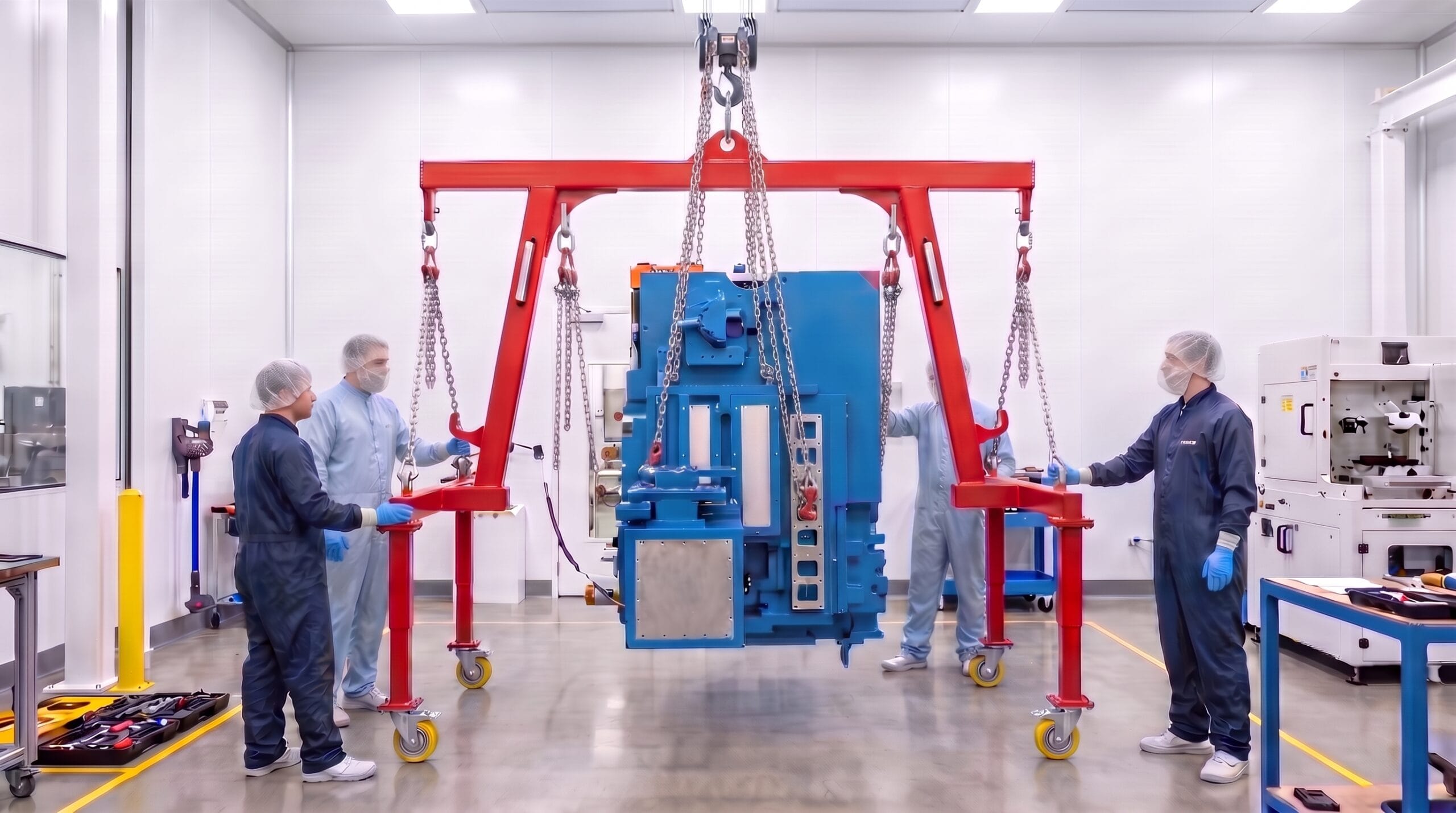
Adjustable lifting equipment has its place, especially when one tool must serve multiple loads. But in many repeatable high-tech handling tasks, a fixed lifting beam can be the safer engineering choice because it removes setup variables, controls the load path and reduces the chance of operator error during a critical lift.
For OEMs, first-tier suppliers and industrial manufacturers, the question is not whether fixed or adjustable is always better. The real question is whether the lifting task is predictable enough to justify a purpose-designed beam, or variable enough to require controlled adjustment. That decision affects safety, ergonomics, downtime, documentation and lifecycle costs.
What a fixed lifting beam changes in the lifting process
A lifting beam transfers load forces between the hoist hook and the lifting points on the object being handled. An adjustable beam allows lifting points, hook positions or attachment locations to be modified for different loads. A fixed lifting beam has a defined geometry for a defined application, with lifting points, interfaces and load distribution engineered for a specific use case.
That difference matters in daily operation. With an adjustable design, safety depends not only on the beam strength but also on the operator selecting the right configuration, locking all adjustable parts correctly and verifying the setup before every lift. With a fixed design, many of those decisions are already engineered into the tool.
This does not make fixed designs automatically superior. It simply shifts risk away from repeated manual setup and toward upfront engineering, validation, documentation and inspection. For high-value modules, fragile assemblies or tight installation spaces, that shift can be a strong advantage.
When a fixed lifting beam is safer than adjustability
A fixed design becomes attractive when the lift is repeated often, the load shape is stable and the consequences of a wrong setup are high. In those situations, a fixed lifting beam can support safer handling because operators have fewer configuration choices to make under time pressure.
This is especially relevant in semiconductor equipment, medical technology, aerospace, optical systems and analytical instruments. These loads may be expensive, sensitive to deformation or difficult to replace quickly. A small handling error can create damage, production delay or unsafe working conditions around the load.
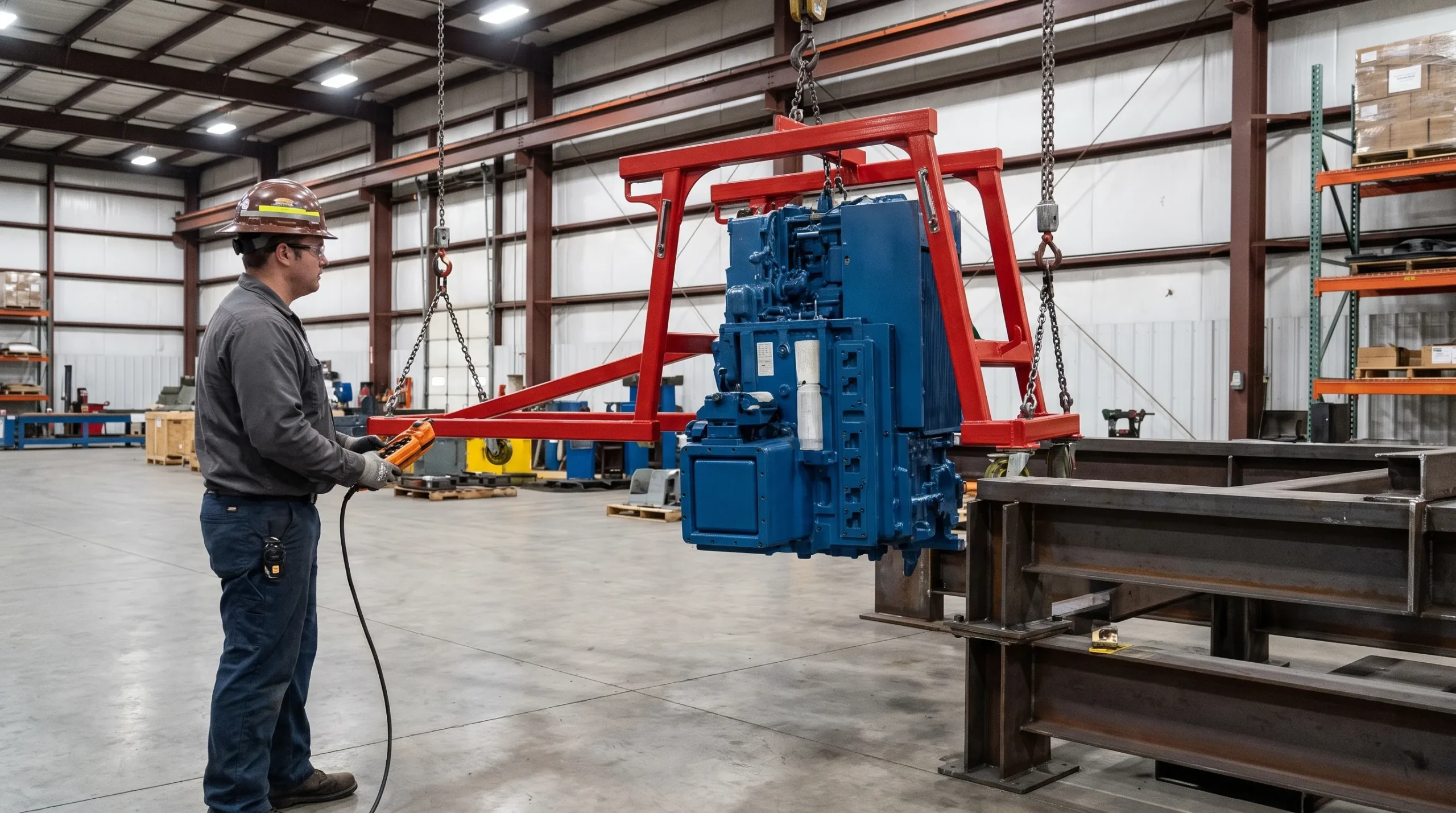
Fixed geometry also helps when headroom is limited. If a beam is designed around the exact hook height, sling angles, attachment points and center of gravity, the lift can be more predictable than a generic adjustable arrangement. That predictability supports better planning for clearance, access and operator positioning.
In projects where control of complex loads is the priority, it is worth comparing the fixed approach with broader principles for custom lifting beams that improve control for complex loads. The more sensitive the load path, the more important the engineering assumptions become.
Safety advantages that are easy to underestimate
The main safety advantage is not only strength. A beam can be strong enough and still be unsafe in practice if it is hard to set up correctly. A fixed lifting beam reduces the number of operational decisions before each lift, which can reduce variation between shifts, operators and production locations.
Common advantages include fewer loose or movable components, clearer attachment points, less need for configuration checks and a more repeatable center of gravity relationship. The operator still needs training and the beam still needs inspection, but the tool itself can guide correct use more effectively.
| Safety factor | Fixed design advantage | Adjustable design risk if unmanaged |
|---|---|---|
| Setup | Defined geometry for one task | Wrong hole pattern, slider position or pin location |
| Load path | Predictable force distribution | Load path changes with every configuration |
| Operator workload | Fewer choices during preparation | More checks required before each lift |
| Documentation | Instructions can be specific | Instructions must cover multiple configurations |
| Inspectie | Wear points are easier to localize | More moving parts and locking features to inspect |
A fixed beam may also improve ergonomics. If the operator does not need to reposition sliders, measure spacing or interpret a complex setup chart, preparation becomes simpler. That matters when the lift is performed in cleanrooms, restricted spaces or production environments where time pressure can influence behavior.
When an adjustable beam is still the better choice
A fixed solution is not always the safest or most economical answer. If the same lifting device must handle multiple products, changing load widths or several centers of gravity, an adjustable design may be necessary. In those cases, safety depends on making adjustment controlled, visible and difficult to misuse.
An adjustable beam can be appropriate when load families are well defined, the adjustment points are mechanically robust and operators can verify the correct configuration quickly. Clear markings, captive pins, positive locking, setup instructions and inspection access become important design features.
A fixed lifting beam may be excessive if the task is rare, the load is low risk, a compliant standard tool fits the application and there is no operational benefit from custom geometry. In that situation, a standard beam or a controlled adjustable lifting tool can be a practical choice.
The decision should include engineering, safety, production and maintenance input. Procurement cost alone is too narrow. The better comparison includes setup time, risk of incorrect use, inspection effort, training needs, repairability and the cost of downtime if a lift cannot be performed.
Many engineering investments also need clear internal justification. Commercial or management teams may use general digital resources such as AI-driven marketing tools and business guides to improve how they communicate value, but the lifting equipment decision itself should remain based on load data, risk assessment, usability and lifecycle requirements.
Warning signs that fixed geometry may be safer
There are practical signs that an adjustable beam may be introducing more risk than value. A fixed lifting beam deserves serious consideration when operators repeatedly use the same configuration and adjustment features are present mainly because the original design was generic.
Look for these warning signs during a lifting review:
- The beam is always set to the same width or hook position.
- Operators need informal notes, photos or memory to choose the correct setup.
- The load is high value, fragile or sensitive to tilting.
- The lift takes place in a tight machine frame, cleanroom or restricted work area.
- Incorrect setup could damage lifting points, covers, cables or precision interfaces.
- Setup checks are skipped because the task feels routine.
- Maintenance finds wear on adjustable holes, pins, sliders or locking elements.
These signals do not prove that the current tool is unsafe, but they justify a closer look. The review should examine real use, not only the original specification. Tools often change role over time as production processes, product variants or maintenance routines evolve.
Engineering inputs for a safe fixed design
Designing a safe beam starts with the lifting task, not with the steel profile. The engineering team needs reliable information about the load mass, center of gravity, lifting points, permitted forces, required orientation, available headroom and surrounding obstacles. For a fixed lifting beam, inaccurate assumptions can be built into the tool, so verification at the start is critical.
The working environment also matters. A beam for a cleanroom or precision assembly area may need different surface finishes, contamination control, access clearances or operator interfaces than a beam used in a general manufacturing hall. The design should reflect how people actually connect, lift, guide, transport, lower and store the tool.
Compliance must be considered early. Depending on the scope and market, requirements may relate to the Machinery Directive 2006/42/EC, the transition toward Machinery Regulation (EU) 2023/1230 and relevant standards such as EN 13155 for non-fixed load lifting attachments. The exact route depends on the equipment, its intended use and the responsibilities of the parties involved.
Good documentation is part of the engineering output. Calculations, drawings, load limits, inspection points, instructions and test records help operators and maintenance teams understand how the beam should be used and when it should be removed from service.
Lifecycle value: inspection, maintenance and availability
The value of a fixed lifting beam is strongest when it remains safe and available throughout its service life. A robust design can still become unsafe if it is overloaded, damaged, modified, corroded or used outside its intended scope.
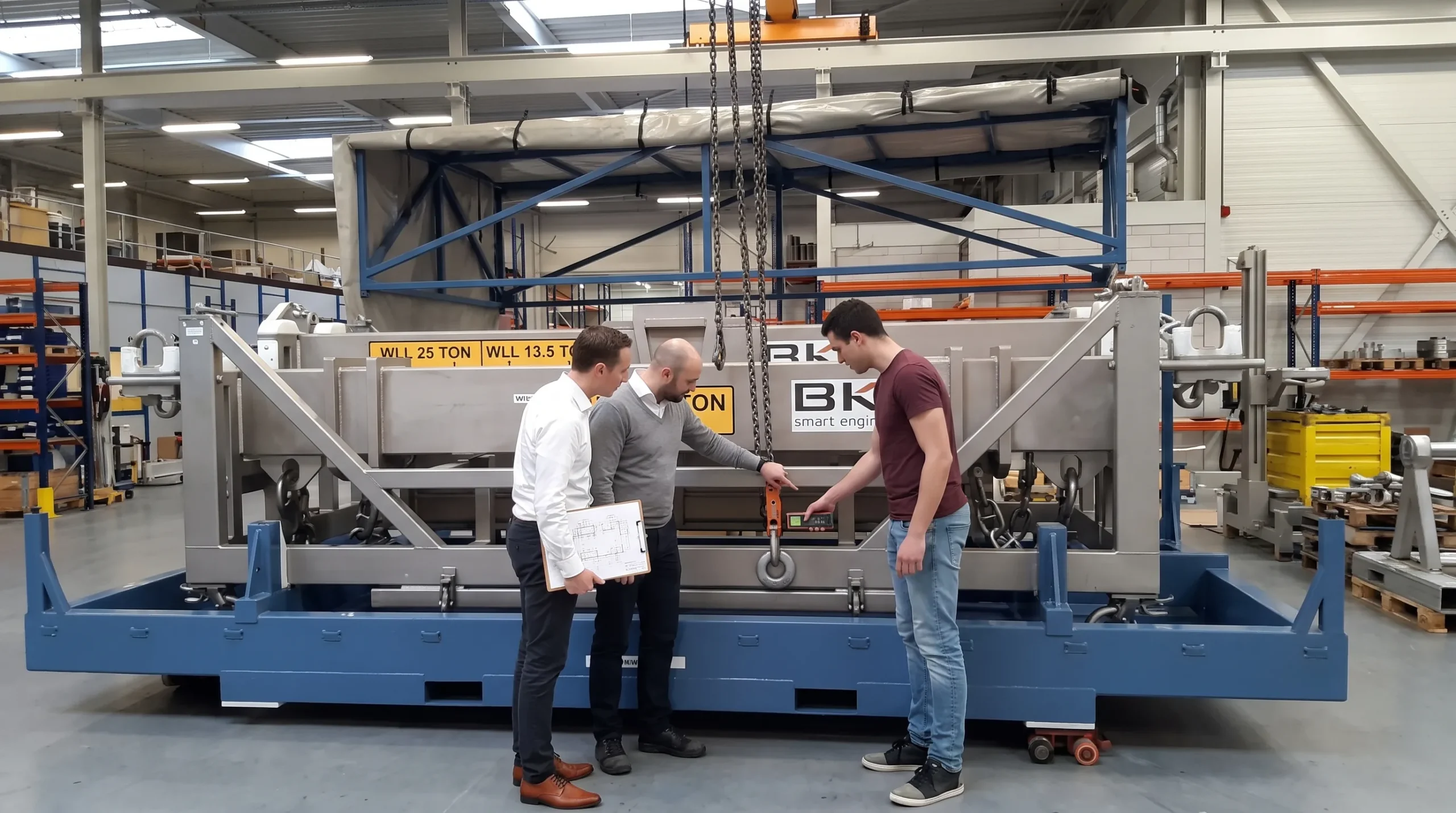
Periodic inspection should check visible deformation, cracks, weld condition, lifting eyes, attachment interfaces, markings and any wear points. If a beam has been dropped, overloaded, repaired or used for a changed application, the inspection plan should be reviewed rather than waiting for the next routine interval. BKL explains these triggers in more detail in its article on when lifting equipment inspections should not be delayed.
Maintenance also affects production continuity. If a dedicated beam is essential for installing a module or servicing a machine, downtime of that tool can stop more than one operation. Spare parts, repair procedures, inspection records and clear usage advice help reduce uncertainty when a tool is needed urgently.
For safety managers and maintenance teams, the lifecycle question is simple: can you prove that the lifting tool is still suitable for the task it performs today? If not, the issue may be documentation, inspection frequency, changed use or the original design concept.
How BKL approaches fixed and adjustable lifting tools
BKL supports customers with mechanical and mechatronic engineering, production, assembly, installation, inspection, certification where applicable, maintenance and service. That broad scope is valuable because the safest solution is rarely defined by engineering calculations alone. It also depends on fabrication quality, operator usability, installation conditions, documentation and lifecycle support.
For some applications, BKL may help improve or inspect existing equipment. For others, a new custom tool may be needed. A fixed lifting beam can be engineered as part of a complete lifting or handling solution when standard equipment does not provide enough control, ergonomics or certainty for the application.
BKL’s work is especially relevant for OEMs and first-tier suppliers in high-tech environments where loads are valuable, tolerances are tight and safety-critical tools must remain reliable over time. The same practical mindset applies whether the challenge is a lifting adapter, handling frame, mobile lift, scissor lift table, cleanroom handling tool or working-at-height solution.
If your team is reviewing a fixed versus adjustable beam, it can help to define the lift, identify the failure modes and check how operators perform the task in reality. BKL’s guidance on working safely with custom lifting equipment is a useful starting point for that discussion.
Practical decision framework
A fixed solution is usually worth exploring when the lift is repeatable, the load is valuable, the environment is constrained and the risk of incorrect adjustment is higher than the benefit of flexibility. An adjustable solution remains useful when variation is real, controlled and properly documented.
Use the following decision factors during concept selection:
- Repeatability of the load, lifting points and center of gravity
- Consequence of incorrect setup, including injury risk, damage and downtime
- Available headroom, access and operator visibility
- Number of operators, shifts and production locations using the tool
- Required documentation, inspection method and test approach
- Total lifecycle costs, including setup time, maintenance and availability
The best answer may also be a hybrid. Some tools use limited adjustment with mechanical stops, dedicated adapters or clearly defined positions. This can preserve flexibility while reducing the risk of free configuration.
FAQ's about fixed lifting beams:
What is a fixed lifting beam? A fixed lifting beam is a lifting device with defined lifting points and geometry for a specific load or task. Unlike an adjustable beam, it is not intended to be reconfigured for multiple load widths or centers of gravity during normal use.
Is a fixed lifting beam always safer than an adjustable beam? No. It is safer when the lift is repeatable and adjustment would mainly add setup risk. If the load varies significantly, a well-engineered adjustable beam may be safer and more practical.
When should an existing adjustable beam be reviewed? Review it when it is always used in the same setting, when operators rely on informal setup methods, when wear appears on adjustable components or when the load, environment or lifting procedure has changed.
What documentation should be available for a lifting beam? Relevant documentation may include drawings, calculations, load limits, user instructions, inspection points, test records, certificates where applicable and maintenance history. The required documentation depends on the product, application and regulatory context.
Can BKL help only with inspection, or also with engineering and production? BKL can support individual process steps or a complete chain, including engineering, production, assembly, installation, inspection, certification where applicable, maintenance and service for custom lifting, hoisting and handling solutions.
Discuss the safest beam concept for your application
If your current lifting beam is adjustable but always used in the same configuration, or if setup errors would create unacceptable risk, it may be time to review the concept. The outcome may be a fixed beam, an improved adjustable design, an inspection plan or a practical modification to an existing tool.
Bring the real lifting task into the conversation: load data, center of gravity, lifting points, available headroom, operator access, environmental constraints, inspection history and required documentation. With that information, BKL can help assess whether a fixed design, adjustable design or custom lifting solution is the most suitable route for safe and efficient operation.