
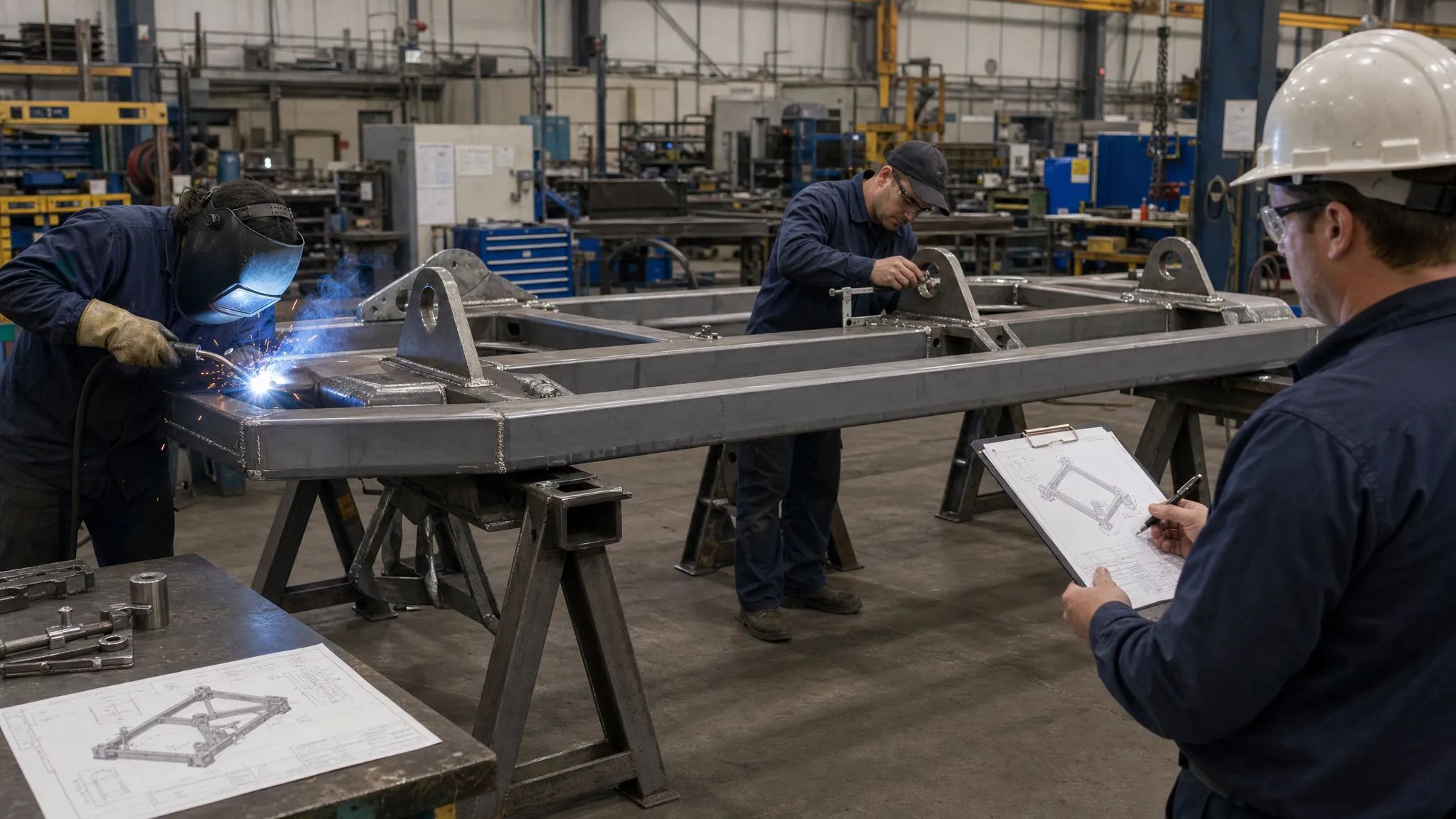
For OEMs, machine builders and high-tech manufacturers, complex industrial tooling is often too important to treat as ordinary fabrication. A lifting tool, transport frame, assembly fixture or maintenance module may support valuable equipment, protect operators, determine process stability and influence production uptime.
That is why the delivery model matters. In some projects, the best route is full engineering support from concept to commissioning. In others, the customer already has a mature design and needs a capable partner to manufacture, inspect and document the tool exactly as specified. That is where built-to-print can be the right fit.
Built-to-print is not simply “make this part from a drawing.” For complex industrial tooling, it works best when the engineering definition is stable, the risks are understood and the manufacturing partner can translate documentation into a safe, reliable and usable physical product. The model can reduce lead time and protect design intent, but only if both customer and supplier understand where responsibility, quality control and change management begin and end.
What built-to-print means in industrial tooling
Built-to-print means the customer provides the released technical definition, such as drawings, 3D models, bills of materials, specifications, tolerances and inspection requirements. The supplier then manufactures, assembles, inspects and delivers according to that defined package.
In a simple component project, this may be mainly a production task. In complex tooling, it is broader. The supplier may need to manage machining, welding, mechanical assembly, purchased components, surface treatment, load testing, documentation and serviceability considerations. The tooling may also include mechanical or mechatronic functions, operator interfaces, guarding, positioning features, lifting points or safety-related details.
The important distinction is this: built-to-print does not remove the need for engineering judgement. It changes where that judgement is applied. The customer remains responsible for the released design intent, while the supplier must have enough technical understanding to identify manufacturability concerns, ambiguous specifications, inspection gaps and practical risks before production starts.
When built-to-print works best
Built-to-print is most effective when the project has a clear technical baseline. The more mature the design package is, the more value the model can deliver in speed, repeatability and cost control.
It is especially suitable when the customer has already completed concept engineering, risk evaluation and interface definition, but needs a specialist partner for reliable manufacturing, inspection and lifecycle support. This is common in high-tech, semicon, optical, aerospace and industrial manufacturing environments where internal engineering teams own the product or process architecture, but prefer to outsource the realization of supporting tools and modules.
| Built-to-print works well when | Risk if this is missing |
|---|---|
| The design is released, reviewed and stable | Uncontrolled design changes can delay production and create rework |
| Load cases, interfaces and operating conditions are known | The tool may not match the real use case or working environment |
| Critical tolerances and acceptance criteria are defined | Inspection becomes subjective or incomplete |
| Documentation requirements are agreed upfront | Technical files, manuals or test reports may be incomplete at handover |
| The supplier can manufacture and inspect complex assemblies | Quality issues may only appear during commissioning or operation |
| Change control is formal and traceable | Safety, cost and planning risks become harder to manage |
For repeat tools, spare tools or small complex series, built-to-print can be particularly strong. Once a design is proven, the priority often shifts to consistent production quality, availability and traceability. A technically capable partner can then reproduce the tool while maintaining documentation, inspection records and practical service knowledge.
Why complex tooling needs more than drawing compliance
In safety-critical industrial environments, a drawing is necessary, but it is rarely enough on its own. Complex tooling must work in a real context: operators need to handle it safely, maintenance teams need to inspect it, production teams need predictable availability and safety managers need evidence that the equipment is suitable for use.
A custom lifting tool, for example, is not defined only by its geometry. Its safe use depends on the load path, centre of gravity, lifting points, allowable angles, locking mechanisms, deformation behaviour, operator access and inspection points. If the tool is used in a tight cleanroom or around high-value equipment, clearance, visibility and handling sequence become just as important as the welds and machined features.
This is why built-to-print suppliers for complex tooling need practical engineering capability, even when they are not redesigning the product. They must understand what the documentation is trying to achieve. If a tolerance is unrealistic, a lifting point conflicts with assembly access or an inspection requirement cannot verify a critical feature, the supplier should raise the issue before manufacturing continues.
For tooling that directly affects operator safety, it is also useful to connect built-to-print work with the broader principles of occupational safety in machine and tooling design. Safety is not a final box to tick after production. It is influenced by the design package, production method, inspection plan, user information and maintenance approach.
The technical data package should be complete before release
A strong built-to-print project starts with a complete and controlled technical data package. This does not mean every project needs unnecessary bureaucracy. It means the supplier receives enough information to manufacture, inspect and document the tool without guessing.
A typical package for complex industrial tooling may include:
- Released 2D drawings and 3D models with revision status clearly identified
- Bill of materials with material grades, purchased parts and approved alternatives
- Critical dimensions, tolerances, fits and interface control points
- Welding, machining, assembly, surface treatment and cleanliness requirements
- Rated loads, load cases, lifting configurations and test requirements where applicable
- Inspection criteria, measurement methods and acceptance limits
- Required certificates, test reports, manuals, markings and technical documentation
- Packaging, transport, installation and handover requirements
- Change control rules for deviations, substitutions and design clarifications
Digital workflows can help teams manage CAD data, documentation, supplier communication and approvals. For general orientation on digital platforms and practical software guides, resources such as Online Tool Guides can be useful. For complex industrial tooling, however, the decisive factor is not the tool used to store the data. It is whether the released information is technically complete, controlled and understood by the people manufacturing and inspecting the equipment.
Where supplier expertise makes or breaks the outcome
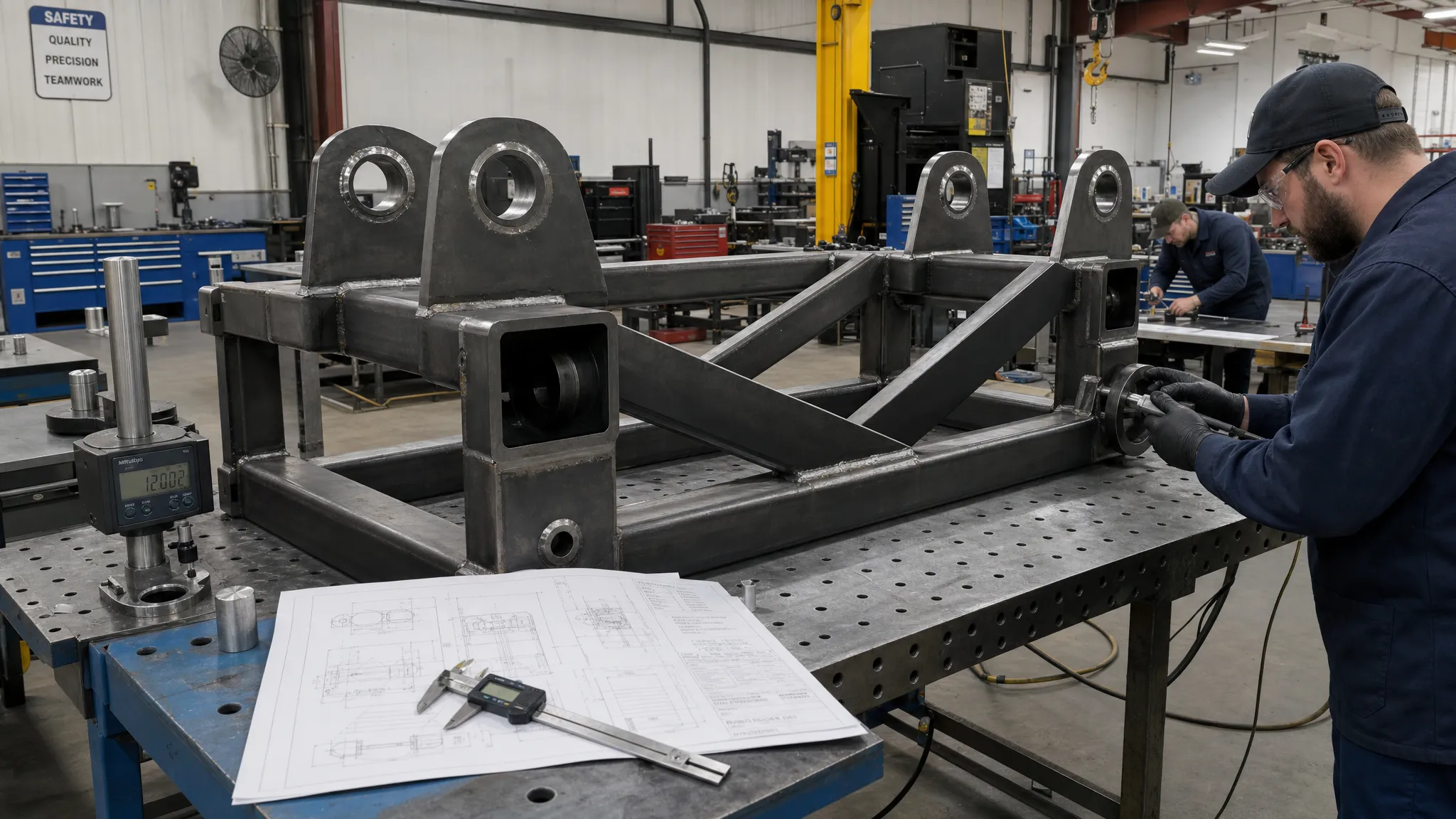
A built-to-print supplier for complex industrial tooling should do more than process drawings. The right partner brings production capability, inspection discipline and practical engineering awareness together.
For decision-makers, the question is not only “Can this supplier build it?” A better question is “Can this supplier build it consistently, document it clearly, identify technical risks early and support the tool after delivery?”
Key capabilities to evaluate include:
- Mechanical and mechatronic understanding, especially when tooling includes moving parts, sensors, actuators or controlled handling functions
- Manufacturing capability for complex assemblies, including machining, welding, fitting, alignment and assembly sequencing
- Inspection competence, including the ability to verify critical characteristics and provide clear reports
- Experience with lifting and handling tools, particularly where load testing, usage advice and operator safety are relevant
- Controlled deviation management, so no technical change is made informally or without approval
- Documentation quality, including test evidence, manuals, markings and traceable revision records
- Lifecycle support, so repairs, inspections and improvements remain connected to the original technical intent
This is where BKL’s broader role as a technical service provider is relevant. For customers with mature designs, BKL can support manufacturing, inspection and service. For projects where gaps appear in the design package, BKL can also support specific engineering steps rather than forcing a full redesign process. That flexibility is important when internal teams want to retain ownership of the design but need specialist capacity for safety-critical realization.
Built-to-print and compliance: keep responsibilities clear
Compliance is one of the areas where built-to-print projects need careful alignment. Industrial tooling may be subject to EU machinery legislation, internal safety standards, customer specifications or sector-specific requirements. CE marking, conformity assessment and technical documentation cannot be treated as an afterthought.
In a built-to-print model, the customer may already have defined the compliance strategy. The supplier may be asked to deliver manufacturing evidence, material certificates, inspection reports, load test results, operating instructions or other documentation needed for the technical file. The exact scope should be agreed before production starts.
The key is to avoid assumptions. A supplier should not silently interpret missing safety requirements, and a customer should not assume that manufacturing to drawing automatically resolves all conformity obligations. If the tool is new, modified or used in a new context, engineering, safety and compliance stakeholders should clarify what evidence is required and who is responsible for each part.
For custom lifting equipment, the documentation should also support safe daily use. Clear markings, allowable configurations, inspection points and practical usage advice help operators and maintenance teams understand the limits of the tool. BKL addresses this broader lifecycle perspective in guidance on how to work safe with custom lifting equipment.
When built-to-print is not the right starting point
Built-to-print is not the best model when the design is still uncertain. If the customer only has a functional need, a rough concept or an incomplete set of interfaces, a design-to-requirement or co-engineering approach is usually safer and more efficient.
Built-to-print may be premature when:
- The operating environment is not fully understood
- The centre of gravity, load cases or handling sequence are still unknown
- Operators have not validated access, visibility or ergonomics
- Safety functions or guarding requirements are not defined
- Critical tolerances are missing or not linked to function
- The tool must integrate with equipment that is still changing
- Documentation requirements are unclear or disputed
In these situations, forcing the project into built-to-print can create false certainty. The drawing may look complete, but the real risks remain unresolved. A short engineering review, risk assessment, prototype iteration or manufacturability study may prevent costly rework later.
This does not mean every project needs a custom engineering phase from scratch. Sometimes a targeted review, a design clarification or an inspection of existing tooling is enough. The best approach depends on the maturity of the information, the safety impact of the tool and the consequences of failure or downtime.
A practical workflow for built-to-print tooling
A structured workflow helps keep built-to-print projects controlled without making them unnecessarily slow. For complex industrial tooling, the following sequence is often effective:
- Technical intake: Customer and supplier review drawings, models, specifications, load data, interfaces, documentation requirements and delivery expectations.
- Manufacturability and risk review: The supplier checks whether the design can be produced, assembled, inspected and tested as specified, then raises questions before work starts.
- Scope and responsibility alignment: Both parties agree who owns design decisions, deviations, compliance documentation, testing, markings, manuals and acceptance criteria.
- Controlled production preparation: Materials, purchased parts, production methods, inspection points and planning are defined with revision control.
- Manufacturing and assembly: The tool is produced according to the released package, with deviations handled through formal approval instead of informal workshop decisions.
- Inspection and testing: Critical features are verified, required tests are performed and findings are documented in a way that supports acceptance and future inspections.
- Handover and lifecycle planning: The customer receives the tool, documentation and usage information, while inspection intervals, maintenance needs and repair routes are clarified.
This workflow is especially important for tools used in production, transport, installation and maintenance. These tools often remain in service for years. If documentation and inspection logic are weak at delivery, it becomes harder to prove safe condition later in the lifecycle.
Built-to-print can improve availability when lifecycle support is included
Many built-to-print decisions are made because engineering teams need extra capacity or because procurement wants a reliable external production route. Those are valid reasons, but they do not capture the full value.
For industrial tooling, availability is a major performance factor. A tool that is delivered on time but difficult to inspect, repair or reproduce can still create operational risk later. If a lifting frame, handling fixture or service module is unavailable, production and maintenance schedules may be affected.
A supplier that understands the full lifecycle can support better availability by maintaining technical knowledge of the tool, performing periodic inspections, identifying wear or damage, advising on safe use and supporting repairs or replacements. This connects built-to-print manufacturing with long-term operational continuity. BKL discusses this broader operational topic in its article on how to increase your tooling availability.
For OEMs and high-tech manufacturers, this is often where the business case becomes strongest. The lowest initial manufacturing price is not always the lowest lifecycle cost. Documentation quality, inspection reliability, repairability and supplier knowledge can reduce coordination effort and support safer, more predictable operations.
How to decide if built-to-print is right for your project
Before choosing built-to-print, engineering, operations, safety and procurement teams should evaluate the maturity and risk profile of the project together. A useful decision question is: “Can we release this package to production without expecting the supplier to solve undefined engineering problems?”
If the answer is yes, built-to-print may be efficient and appropriate. If the answer is no, the project may need an engineering review, risk assessment, design support or a clearer compliance plan before production begins.
| Decision area | Questions to ask before choosing built-to-print |
|---|---|
| Design maturity | Are drawings, models, revisions and interfaces fully released? |
| Veiligheid | Are load cases, operator actions, hazards and usage limits defined? |
| Manufacturing | Can the design be produced and assembled without undocumented interpretation? |
| Inspectie | Are critical characteristics and acceptance criteria measurable? |
| Documentation | Are reports, manuals, markings and certificates specified upfront? |
| Lifecycle | Can the tool be inspected, maintained, repaired and reproduced later? |
When these questions are answered clearly, built-to-print can be a strong model for complex industrial tooling. It allows internal teams to retain control over the design while using external specialist capacity for production, inspection and service. When the answers are unclear, a more collaborative engineering route may protect safety, planning and total cost.
FAQ's about built-to-print for complex industrial tooling:
What does built-to-print mean for industrial tooling? Built-to-print means the customer provides a released design package, and the supplier manufactures, assembles, inspects and documents the tooling according to that package. For complex tooling, this often includes more than fabrication, such as assembly control, testing, traceability and handover documentation.
When is built-to-print better than full engineering support? Built-to-print is usually better when the design is mature, interfaces are known, load cases are defined and the customer wants a specialist partner for controlled realization. If the concept, safety functions or operating conditions are still unclear, engineering support before production is usually more appropriate.
Can built-to-print be used for lifting and handling tools? Yes, but only when the technical package clearly defines the load cases, lifting configurations, safety factors, inspection requirements, markings and usage limitations. The supplier should also understand lifting tool production, testing and documentation requirements.
Who is responsible for CE documentation in a built-to-print project? Responsibility depends on the agreed scope and the legal role of each party. This should be clarified before production starts. The supplier may provide manufacturing records, inspection reports, test evidence and technical documentation, but the overall conformity responsibility must be explicitly assigned.
What should procurement look for in a built-to-print supplier? Procurement should look beyond price and lead time. Important factors include technical understanding, production capability, inspection competence, documentation quality, deviation control and lifecycle support. These factors have a direct impact on safety, availability and total cost of ownership.
Need a built-to-print partner for complex tooling?
Built-to-print works best when the design is clear and the realization partner understands the safety, production and lifecycle context behind the drawings. For complex industrial tooling, that means controlled manufacturing, practical engineering judgement, reliable inspection and documentation that remains useful after delivery.
BKL supports OEMs, machine builders and high-tech manufacturers with mechanics and mechatronics, hoisting and lifting tools, industrial modules, machines, inspections, manufacturing and service. Whether you need support for one process step or a complete route from engineering to lifecycle support, BKL can help turn technical requirements into safe, reliable and user-friendly equipment.
If you are evaluating a built-to-print project for complex tooling, contact BKL to discuss the design package, production requirements, inspection scope and lifecycle needs before manufacturing begins.