
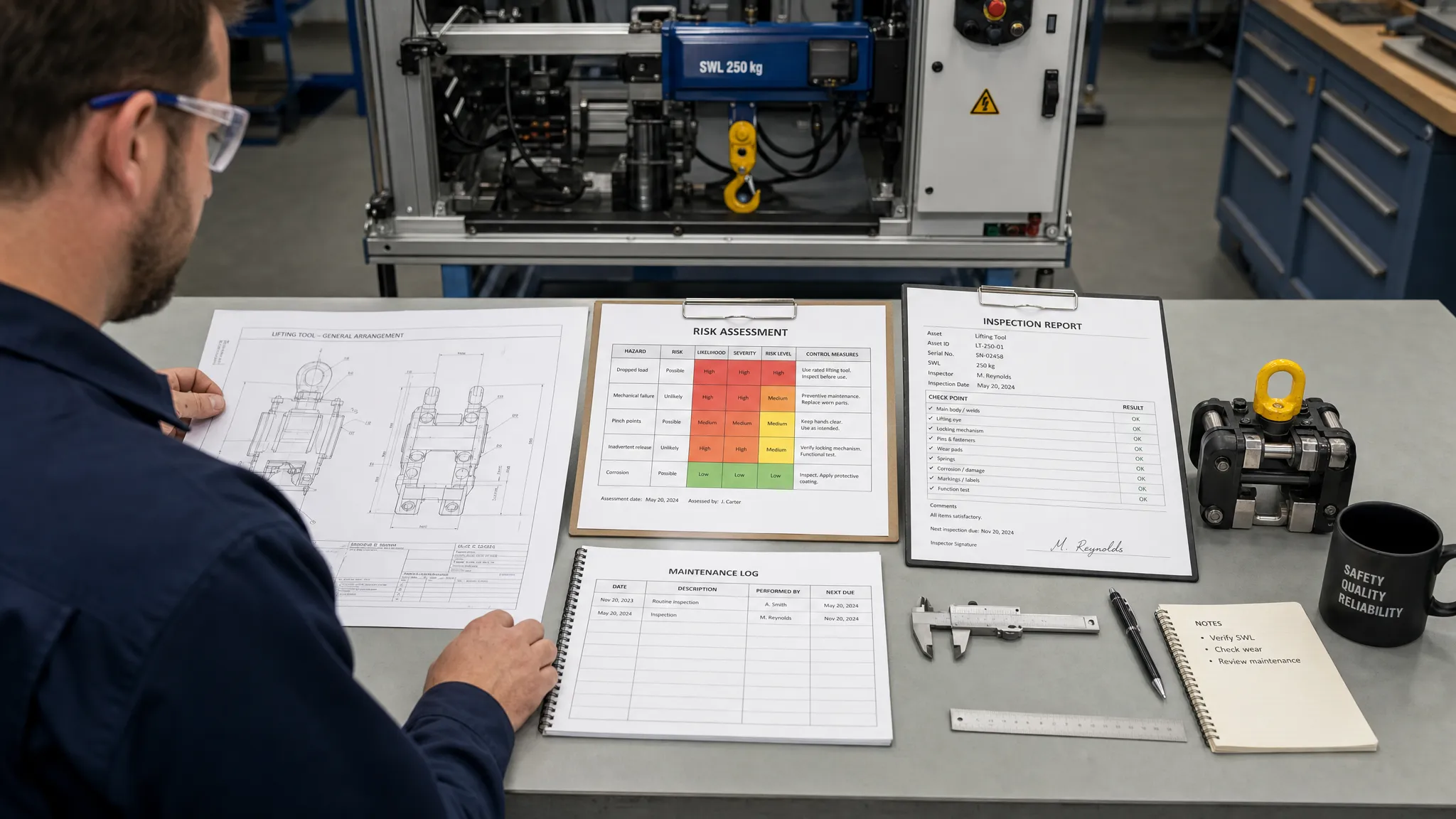
In industrial environments, risk is rarely created by one isolated decision. It builds up across the lifecycle of a tool, machine or module: during early concept choices, detailed engineering, production, commissioning, daily operation, inspection, maintenance, modification and eventual replacement.
That is why effective safety engineering is not a final checklist before delivery. It is a structured way of making risk visible, reducing it where practical, and keeping safety performance under control as equipment is used in the real world.
For OEMs, high-tech manufacturers, semiconductor equipment companies, aerospace suppliers and industrial production teams, this lifecycle view matters. A lifting tool that is technically strong enough may still create risk if it is difficult to position. A machine module may meet the functional brief but cause maintenance teams to work in awkward positions. A custom handling device may be safe at delivery but become uncertain after years of wear, repairs or changed use.
Safety engineering reduces these risks by connecting design decisions, technical calculations, practical usability, documentation, inspections and service support into one coherent process.
What safety engineering means across the lifecycle
Safety engineering is the discipline of identifying hazards, assessing risks and implementing technical and organizational measures to reduce those risks to an acceptable level. In industrial equipment, it combines mechanical engineering, mechatronics, ergonomics, control systems, testing, documentation and practical knowledge of how operators and maintenance teams actually work.
A lifecycle approach means safety is considered at each phase, not only at the point of certification or commissioning. The goal is not to make every tool more complex. The goal is to make the right risks visible early enough that they can be addressed efficiently.
In practice, that can include:
- Defining the real lifting, handling, production or maintenance task before engineering begins.
- Designing the load path, supports, interfaces and controls with foreseeable use in mind.
- Selecting materials, components and manufacturing methods that suit the duty cycle and working environment.
- Verifying assumptions through calculations, inspections, overload tests or functional tests where appropriate.
- Providing documentation, manuals, technical files and usage advice that support safe operation.
- Keeping tools and machines in a safe condition through periodic inspection, maintenance and repair.
This is especially important for custom lifting tools, handling systems and industrial modules. These are often used with high-value equipment, limited clearances, strict cleanliness requirements or demanding production schedules. In such environments, a small design oversight can lead to operator frustration, downtime, product damage or unsafe workarounds.
Phase 1: Concept development and task definition
The earliest phase often has the greatest influence on lifecycle risk. Before a solution is designed, engineering teams need a clear understanding of the task, the load, the environment and the people who will use the equipment.
A technically correct design can still be unsuitable if the original task definition is incomplete. For example, a lifting tool may be designed for a component’s nominal weight but not for its shifting center of gravity, fragile connection points, limited access from one side or required rotation during installation. A maintenance platform may provide access but still force technicians into unsafe postures if tool clearance is ignored.
At concept level, safety engineering helps teams ask practical questions:
- What needs to be lifted, handled, transported, positioned or maintained?
- What is the full range of weights, dimensions and centers of gravity?
- Which interfaces are allowed, and which surfaces or components may not be loaded?
- Who operates the tool, and what visibility, reach and control do they need?
- What happens during abnormal but foreseeable situations, such as misalignment or partial obstruction?
- What are the inspection, maintenance and storage requirements over time?
This early clarity prevents costly redesign later. It also supports procurement and management teams, because the business case can include more than the purchase price. It can account for operator safety, tooling availability, production continuity and lifecycle support.
Phase 2: Design that reduces risk before controls are added
The strongest safety measures are usually built into the design itself. Guards, procedures and warnings may be necessary, but they should not compensate for avoidable design weaknesses.
For machines, tooling and industrial modules, risk reduction often starts with mechanical choices. These include stable geometry, controlled movements, suitable safety factors, reliable load transfer, accessible lifting points, secure locking mechanisms and predictable positioning. In mechatronic systems, risk reduction also involves sensing, control logic, motion limits, emergency functions and safe interaction between operator and machine.
This is where practical engineering experience is important. Operators may work under time pressure. Maintenance teams may need to access parts in cramped spaces. Production staff may repeat the same handling task many times per shift. If the tool is hard to align, heavy to manipulate or unclear to operate, the likelihood of shortcuts increases.
For a deeper view on integrating safety into the earliest design choices, BKL’s article on occupational safety in machine and tooling design explains why safety should be treated as a design requirement rather than a final review item.
Good safety engineering does not make equipment difficult to use. In many cases, it makes operation simpler. Clear interfaces, intuitive control positions, stable movement and logical access can reduce both risk and cycle time.
Phase 3: Engineering verification, documentation and CE readiness
Once the design direction is defined, safety engineering becomes more evidence-based. Assumptions must be checked. Load cases must be calculated. Risks must be documented. The intended use and limitations must be clear.
For equipment within the European market, manufacturers and suppliers also need to consider relevant EU requirements, including machinery safety obligations and CE-related documentation where applicable. This does not mean every project follows the same route. A custom lifting tool, a machine module and a complete machine can have different conformity responsibilities depending on the scope, integration level and intended use.
A structured technical file or project dossier often includes elements such as risk assessments, design calculations, drawings, material information, test results, inspection reports, manuals and declarations where relevant. These documents are not just administrative. They help future users, maintenance teams and inspectors understand how the equipment was designed, what limits apply and how safe use should be maintained.
Clear documentation also reduces risk when equipment changes hands internally. Years after delivery, a maintenance manager or safety officer may need to confirm whether a tool can still be used, whether a repair is acceptable or whether a load test is needed. Without reliable records, decisions become slower and less certain.
The same principle applies in many quality-critical supply chains outside engineering. Whether a company is managing industrial tooling or sourcing premium products from a specialist supplier such as Beef Boutique, confidence depends on defined specifications, controlled handling and traceable quality expectations.
Phase 4: Manufacturing quality and assembly control
A safe design still needs to be manufactured correctly. Deviations in welding, machining, assembly, surface treatment or component selection can affect performance. For safety-critical tools and modules, production quality is therefore part of safety engineering, not a separate afterthought.
Manufacturing control helps ensure that the delivered product matches the engineered intent. This can include dimensional checks, material verification, weld quality assessment, assembly inspection, functional testing and controlled handling during production. For small-scale or complex series, this is particularly important because standard production routines may not fully apply.
For machine builders and OEMs, working with a partner that combines engineering and production can reduce coordination issues. Design engineers can consider manufacturability early, while production feedback can identify practical improvements before issues reach the customer site.
This is one of the reasons lifecycle thinking is valuable. It connects engineering decisions to workshop reality, operator use and future inspection requirements.
| Lifecycle phase | Typical risk if safety is treated too late | How safety engineering reduces the risk |
|---|---|---|
| Concept | Wrong task assumptions or missing constraints | Defines the real use case, environment and load conditions early |
| Design | Equipment is strong but difficult or unsafe to operate | Integrates stability, ergonomics, controls and predictable movement |
| Verification | Unclear proof of design assumptions | Uses calculations, tests, reports and technical documentation |
| Manufacturing | Product deviates from engineered intent | Applies production checks, assembly control and quality review |
| Operation | Operators create workarounds due to poor usability | Supports intuitive use, clear instructions and suitable interfaces |
| Maintenance | Wear, damage or modification remains unnoticed | Uses inspections, servicing, repair advice and lifecycle records |
Phase 5: Commissioning and operator usability
Commissioning is where the engineered solution meets the real production environment. Even a well-designed tool can reveal issues when it is used around existing equipment, floor layouts, crane availability, access restrictions or operator routines.
Safety engineering during commissioning focuses on confirming that the equipment works as intended in context. This may involve checking fit, movement, clearance, control positions, lifting points, stability and interaction with nearby machines or structures. It also includes verifying that operators understand how the tool should be used and what limitations apply.
Usability is a major risk factor. If equipment requires excessive force, unclear alignment or awkward access, operators may develop informal methods that were not part of the intended process. These workarounds may seem efficient in the short term but can increase risk over time.
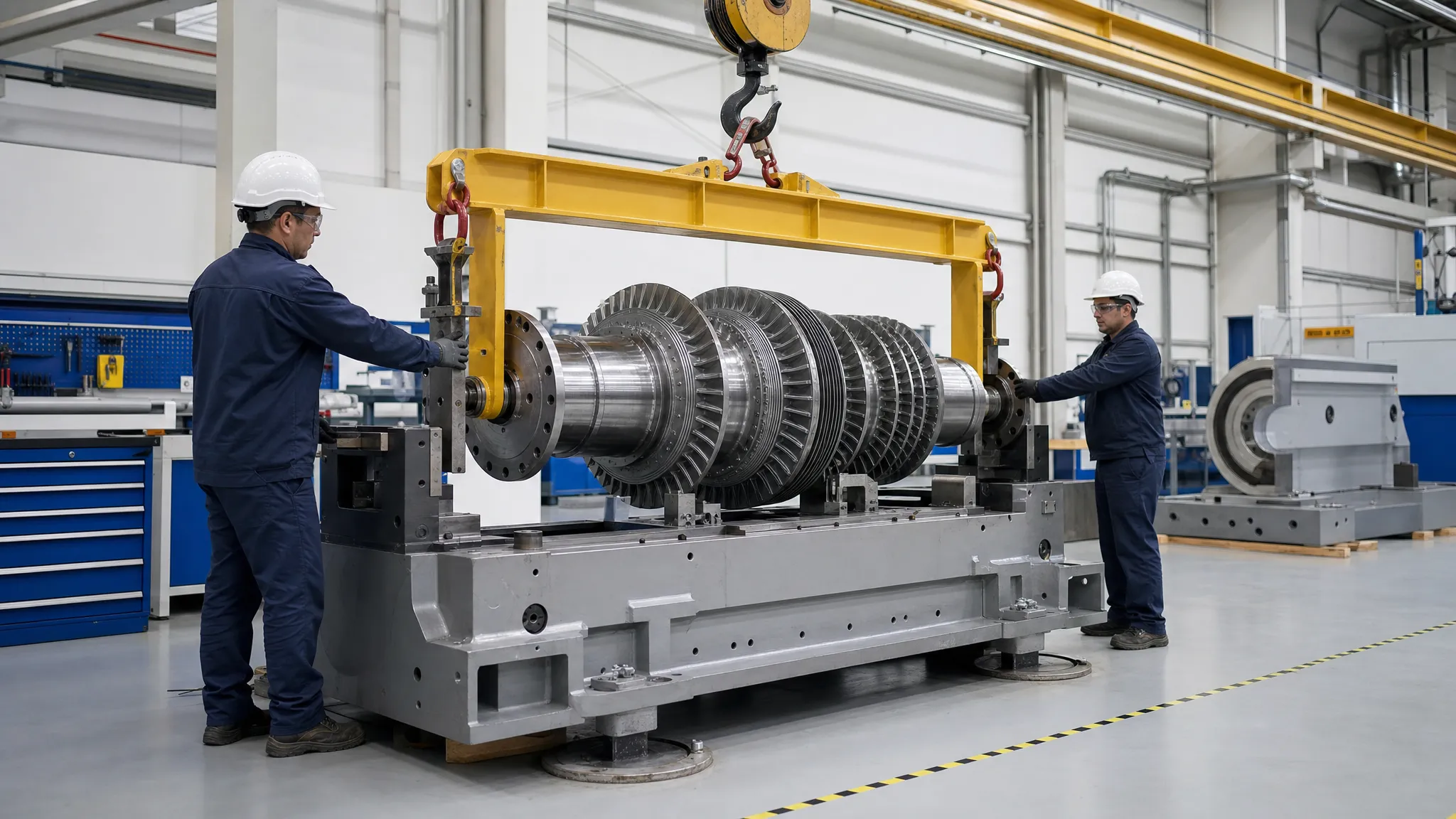
For lifting and hoisting applications, BKL’s article on how to improve lifting and hoisting safety in OEM operations covers the importance of designing around the task, the load path and real operator behavior.
Phase 6: Inspection, load testing and safe continued use
Risk does not stop at delivery. Tools and machines are exposed to repeated loads, impacts, wear, contamination, storage conditions and occasional misuse. Even equipment that appears functional can develop defects that are difficult to see without a structured inspection.
Periodic inspections help companies determine whether equipment remains suitable for use. Depending on the tool or machine, this may involve visual inspection, measurement, examination of critical areas, overload testing, functional checks and review of documentation. The outcome should be more than a pass-or-fail label. Clear reporting and practical usage advice help maintenance, operations and safety teams make informed decisions.
This is particularly important for custom lifting equipment. Standard inspection routines may not be enough if the tool has a specific load path, special interfaces or unique failure modes. Inspectors need to understand both the design intent and the way the equipment is used.
BKL is accredited according to ISO 17020:2012 for inspections, which supports structured and independent inspection work. Combined with engineering and production knowledge, this helps create a more complete view of equipment condition, repair options and safe continued use.
Phase 7: Maintenance, repair and lifecycle decisions
Every safety-critical tool or module eventually needs maintenance, repair, modification or replacement. Lifecycle risk increases when these decisions are made without engineering context.
For example, a damaged lifting beam may look repairable, but the repair method can affect strength, geometry or inspection requirements. A machine module may need a component replacement, but a different part could change movement behavior or load capacity. A handling tool may still function, but wear in a guide, bearing or locking point may reduce reliability.
Safety engineering supports lifecycle decisions by combining inspection results with engineering judgment. The question is not only, “Can it still be used today?” It is also, “Under what conditions, with which limitations, after which repair, and with what inspection interval?”
This helps companies balance safety, availability and cost. Not every issue requires a full redesign or new tool. Sometimes a repair, updated instruction, additional inspection, local reinforcement or modified interface is the most practical step. In other cases, replacement is the safer and more efficient decision because the tool no longer matches the process or current requirements.
Why lifecycle safety engineering improves operational efficiency
Safety and efficiency are sometimes treated as competing goals. In well-engineered systems, they often support each other.
A tool that is stable, easy to position and clear to operate can reduce handling time. A machine that provides safe maintenance access can reduce service delays. A lifting device with documented load limits and inspection history can be released for use with more confidence. A module designed for assembly and service can reduce rework and downtime.
For decision-makers, the value is not only in reducing incidents. It is also in reducing uncertainty. When engineering, production, documentation, inspection and service are connected, teams spend less time interpreting unclear equipment status or coordinating between multiple suppliers.
The lifecycle approach is especially relevant when equipment is used for high-value products, complex assemblies or critical production steps. In these cases, downtime, damage and unsafe work can have consequences far beyond the cost of the tool itself.
How BKL supports safety engineering across the lifecycle
BKL develops technical solutions in mechanics and mechatronics for companies that need safe, reliable and user-friendly tools, machines and industrial modules. The work can cover individual process steps or complete end-to-end support, depending on the client’s needs.
That means BKL can help during concept development, engineering, production, inspection, documentation, service and maintenance. This broader involvement is valuable for safety-critical applications because design choices, manufacturing quality and lifecycle support are connected.
For companies working with hoisting and lifting tools, industrial modules or custom handling equipment, BKL’s role is not limited to building a product or performing an inspection. The focus is on helping clients create solutions that fit the real working environment, support safe use and remain manageable throughout their service life.
This includes practical attention to:
- Safe and efficient operation for employees.
- Compliance-related engineering and documentation support.
- Load testing, inspection reporting and usage advice.
- Small-scale and complex production where standard suppliers may not fit.
- Lifecycle service to support tooling availability and reliability.
For applications involving custom lifting equipment, the article on how to work safe with custom lifting equipment offers additional guidance on task definition, load-path design and safe use.
Practical questions to ask before the next project
A lifecycle safety approach starts with better questions. Before specifying, purchasing or modifying a tool, machine or module, engineering and operations teams should align on the full context.
Useful questions include:
- Is the intended use fully defined, including abnormal but foreseeable situations?
- Are the operators, maintenance teams and inspectors involved early enough?
- Is the load path or movement path clearly engineered and documented?
- Are the interfaces suitable for the real component, workspace and handling method?
- Can the equipment be inspected, maintained and repaired without creating new risks?
- Are documentation, test reports, manuals and technical files complete enough for future decisions?
- Is the lowest initial cost being weighed against lifecycle risk, downtime and availability?
These questions help move safety from a compliance exercise to an engineering discipline. They also help different stakeholders, including procurement, safety, maintenance and management, evaluate technical decisions with a shared view of risk.
FAQ's about safety engineering across the lifecycle:
What is lifecycle safety engineering? Lifecycle safety engineering is the practice of managing risk from the first concept of a tool, machine or module through design, production, commissioning, operation, inspection, maintenance and replacement. It helps ensure that safety is considered continuously, not only at delivery.
Why is safety engineering important for lifting and handling tools? Lifting and handling tools often interact with heavy, high-value or sensitive equipment. Safety engineering helps define the task, control the load path, improve usability, support documentation and maintain safe continued use through inspections and service.
Does every safety issue require a custom-made solution? No. Some situations can be improved through inspection, repair, updated instructions, practical modifications or better maintenance planning. Custom engineering is most relevant when the task, load, environment or interface cannot be addressed safely and efficiently with a standard solution.
How does documentation reduce lifecycle risk? Documentation records the design assumptions, load limits, test results, inspection findings, manuals and maintenance guidance. This helps future teams understand how equipment should be used, when it needs inspection and what decisions are appropriate after wear, damage or modification.
When should safety engineering start in a project? It should start during task definition and concept development. Early attention to hazards, usability, load cases and maintenance access is usually more effective and less costly than correcting problems after manufacturing or commissioning.
Build safety into every stage of your equipment lifecycle
Safety-critical tools, machines and industrial modules require more than a strong design on paper. They need practical engineering, controlled manufacturing, clear documentation, reliable inspection and lifecycle support.
If your organization needs support with hoisting and lifting tools, mechanical or mechatronic modules, inspections, production or service, BKL can help you assess the technical challenge and determine the right next step. Visit BKL to explore how engineering, production and inspection expertise can support safer and more efficient industrial operations.