
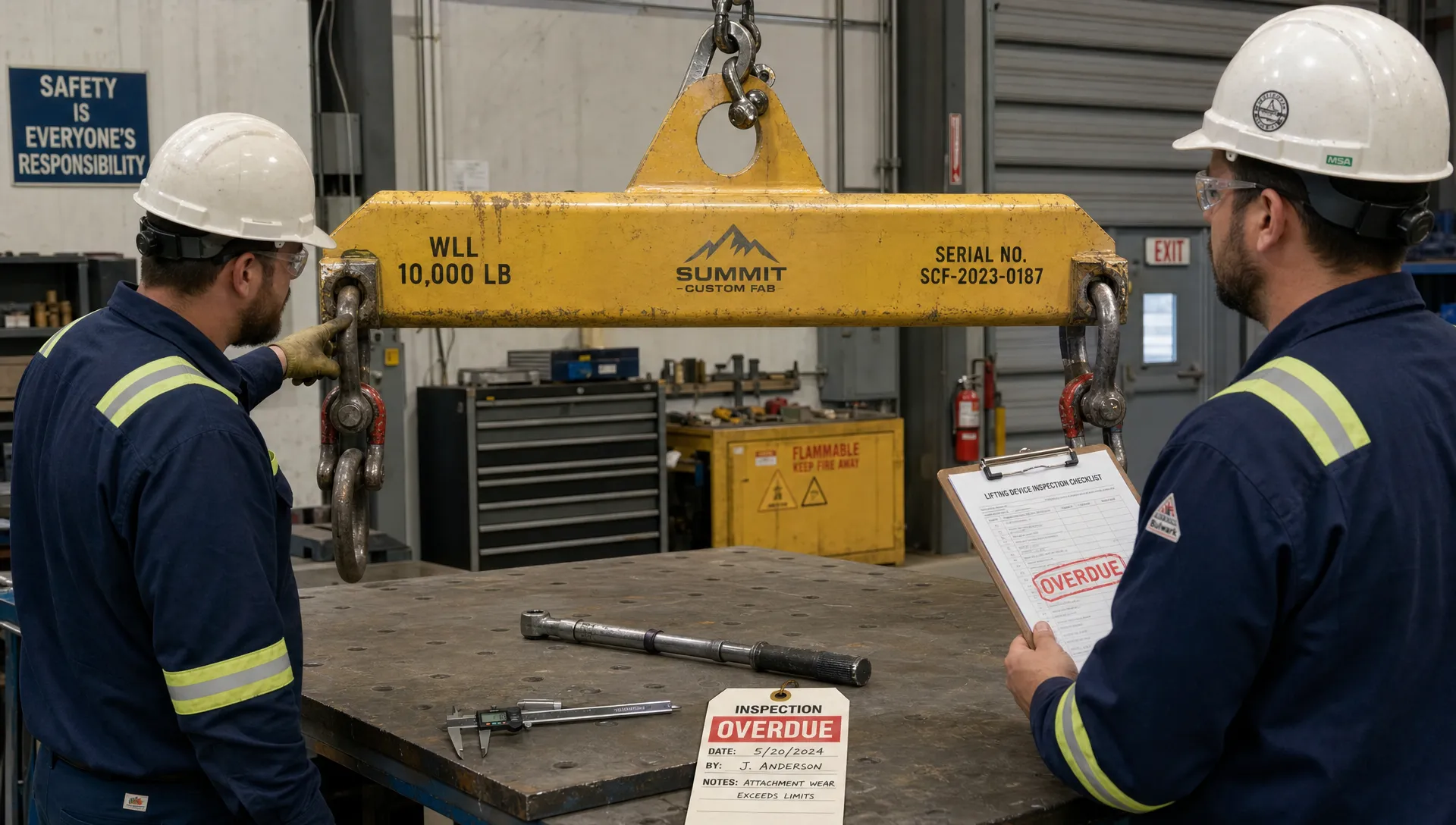
In safety-critical industrial environments, inspection timing is not an administrative detail. A lifting beam, hoist attachment, transport frame or custom handling tool may still look functional from a distance, while wear, deformation, corrosion or documentation gaps quietly increase the risk profile of the next lift.
For OEMs, high-tech manufacturers, aerospace companies and semiconductor equipment builders, the stakes are rarely limited to the lifting equipment itself. A delayed inspection can affect employee safety, production continuity, high-value assets, installation planning and compliance evidence. The practical question is not only “When is the next inspection due?” It is also “Has anything changed that makes the next inspection urgent?”
Below are the situations in which lifting equipment inspections should not be delayed, even if the planned interval has not yet expired.
Inspection intervals are a baseline, not a safety strategy
Periodic inspections are essential, but they are only the minimum framework. They help confirm that equipment remains suitable for use over time, based on its design, condition, operating environment and documented history. In Europe, employers must also consider the broader duty to keep work equipment safe for use. The EU Work Equipment Directive sets general requirements around suitable work equipment, maintenance and safe use, while national rules and standards may add more specific obligations.
In practice, an inspection interval should be reviewed whenever the risk changes. A lifting tool used daily in a clean, controlled production area does not face the same conditions as equipment used outdoors, near chemicals, in tight installation spaces or under frequent dynamic loading. The same applies when lifting equipment handles expensive, delicate or difficult-to-replace modules.
A planned annual inspection may be appropriate for one application, while another tool needs earlier attention because of use intensity, environment, handling history or observed defects. Treat the inspection plan as a living part of the equipment lifecycle, not a fixed date that can be ignored until the calendar says otherwise.
Do not delay after visible damage, deformation or abnormal wear
Any visible defect should trigger a stop-and-assess mindset. This does not mean every mark automatically makes equipment unusable, but it does mean the condition must be evaluated by competent people before the next critical lift.
Common warning signs include bent plates, elongated holes, damaged welds, cracked paint near stressed areas, corrosion, worn lifting points, distorted hooks, damaged threads, missing retaining components or illegible load markings. On custom lifting and handling tools, small changes can matter because the load path is often engineered for a specific geometry, center of gravity and working method.
Visual indicators may also point to deeper issues. Cracked coating near a weld can indicate flexing. A worn pin can change load distribution. A deformed contact surface can reduce stability during positioning. These findings are exactly why inspections should be performed with knowledge of both the tool and the application. For a deeper look at early warning signs, BKL has also explained what safety inspections reveal before failures escalate.
The key principle is simple: if operators, maintenance technicians or supervisors notice damage, the inspection should not wait for the next planned date.
Do not delay after an overload, shock load or abnormal event
Lifting equipment can be affected by events that leave little obvious external evidence. An overload, impact, sudden stop, collision, dropped component, uncontrolled rotation or side loading can introduce stresses that were not part of the intended design case.
This is particularly important for custom lifting tools, spreader beams, frames, interfaces and fixtures used in precision manufacturing. Even if the equipment appears straight and still fits its mating points, an abnormal event may have changed the structural integrity, alignment or load-bearing performance.
Examples of events that should trigger immediate review include:
- A load was heavier than expected or the actual weight was uncertain.
- The lifting tool was used at an angle or configuration outside the instructions.
- A hoist, crane or transport system stopped suddenly while the load was suspended.
- The tool struck a machine frame, floor, pallet, transport cart or building structure.
- A load shifted unexpectedly during lifting, turning or positioning.
- An operator reported unusual movement, noise, vibration or resistance.
In these situations, postponing inspection creates uncertainty. The next lift may rely on equipment that has already experienced stress outside the documented use case. A technical assessment, and where appropriate a load test or further examination, helps determine whether the tool can return to service, needs repair or requires engineering review.
Do not delay when the application or load has changed
Lifting equipment is often designed around a specific task: a defined load, center of gravity, connection interface, movement path, operating environment and user sequence. When one of those factors changes, the original safety assumptions may no longer apply.
This is common in OEM and high-tech environments where products evolve, modules change and production layouts are updated. A lifting tool that was suitable for one machine generation may not automatically be suitable for the next. Even small dimensional changes can alter clearances, lifting angles, stability, operator access or the location of forces in the structure.
Inspection should not be delayed when equipment is used for a new product variant, modified component, different lifting point, changed center of gravity, new installation route or different lifting device. In many cases, the correct action is not only inspection, but also an engineering check against the new use case.
This is where mechanics, mechatronics and practical operator knowledge must come together. A tool can be structurally strong and still be unsuitable if it creates awkward handling, unclear positioning or unsafe access. When the lifting task involves high-value equipment or constrained environments, the planning approach described in safe lifting for high-value equipment and tight spaces becomes especially relevant.
Do not delay when documentation is missing, outdated or unclear
Documentation is part of safe use. If operators cannot confirm the permitted load, correct configuration, inspection status or operating instructions, the risk increases before the lift even starts.
Missing or outdated documentation is often treated as a paperwork issue, but it can point to a deeper lifecycle problem. For example, a lifting tool may have been modified without updated drawings. A load rating may no longer be legible. A manual may describe an earlier version of the tool. Test reports may not match the serial number on the equipment. Inspection records may be incomplete after internal relocation or supplier changes.
The following table shows common documentation triggers and why they matter.
| Documentation issue | Why inspection or review should not wait |
|---|---|
| Missing inspection report | There is no reliable evidence of current condition or previous findings. |
| Illegible load marking | Operators may select or use the equipment incorrectly. |
| Unknown modification history | Original calculations, drawings and risk assumptions may no longer apply. |
| Manual does not match the tool | The operating sequence may be incorrect for the actual equipment. |
| Missing serial number or identification | Traceability, inspection planning and technical file management become unreliable. |
| No record after repair | It is unclear whether the repair restored the intended function and strength. |
If documentation gaps are discovered, the safest response is to verify the equipment, its configuration and its records before continued use. This is also valuable for audits, maintenance planning and future engineering decisions.
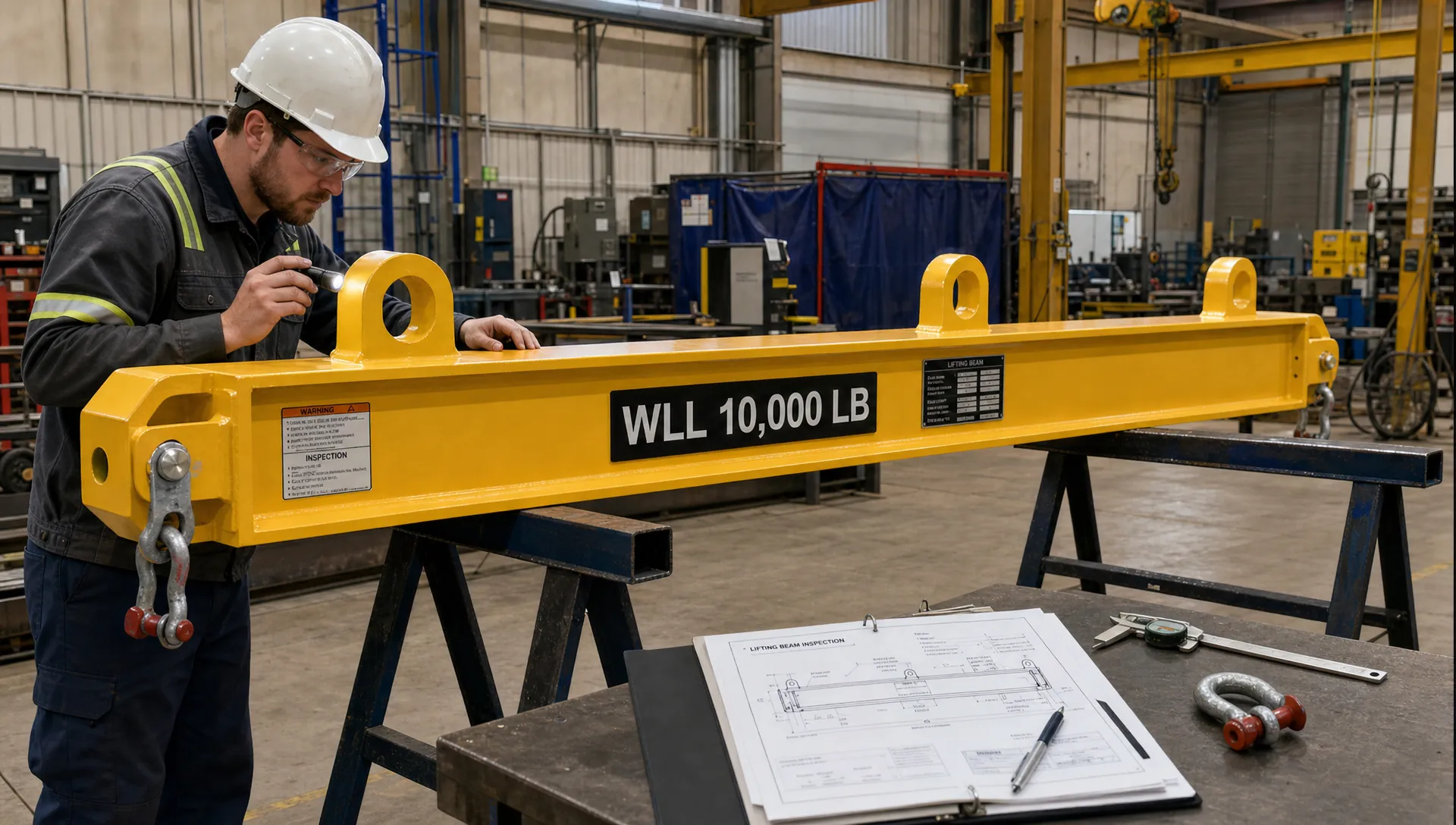
Do not delay after repair, modification or long storage
A repaired or modified lifting tool should not simply return to production because it “looks ready.” Welding, machining, replacement of pins, replacement of lifting eyes, altered interfaces or changes to support points can affect structural performance and safe operation. Even repairs that appear minor may influence the load path or introduce new inspection requirements.
The same applies to equipment returning from long storage. Storage conditions can introduce corrosion, contamination, seized moving parts, degraded labels, missing components or outdated documentation. A lifting frame stored for two years may not be ready for immediate use in a high-value production lift, especially if the environment was humid, uncontrolled or poorly documented.
Before returning equipment to service, review the condition, identification, load rating, instructions and inspection history. If the equipment was modified, the review may also need calculations, drawings, risk assessment updates or test evidence. The goal is not to create unnecessary delay, but to avoid reintroducing uncertainty into a safety-critical process.
Do not delay when equipment is used intensively or in harsh conditions
Inspection urgency increases when lifting equipment is exposed to demanding use. Repetition, contamination, vibration, temperature changes, moisture, chemicals, abrasive particles and outdoor storage all accelerate degradation. In semiconductor, optical and high-tech production environments, the environment may be clean, but the equipment may still be used with high precision, tight tolerances and expensive loads. The risk is different, but not lower by default.
A standard inspection interval may become insufficient when actual use exceeds the assumptions made at the time of delivery. This is why lifecycle support should include feedback from operators and maintenance teams. They know how often the equipment is used, where it is stored, what small problems keep recurring and whether the tool still fits the real working environment.
In some cases, the result may be a shorter inspection interval. In others, a practical design improvement, clearer instruction, better storage method or replacement of wear components may reduce recurring issues. Inspection is most valuable when it leads to decisions that improve safety and availability over time, not only a pass or fail result.
Do not delay before critical lifts or planned shutdown work
Some lifts carry a higher operational consequence than others. Before a major installation, maintenance shutdown, factory acceptance test, relocation or customer delivery, it is worth confirming that lifting and handling equipment is ready for the task.
A defect discovered during the lift plan can usually be managed. A defect discovered when the crane is booked, the machine is open, the production line is stopped and the customer asset is suspended is much harder to manage. Delayed inspection can shift the problem from maintenance planning to operational crisis.
For critical lifts, inspection should be considered part of preparation. Verify the tool condition, rated capacity, configuration, documentation, operator instructions and any required test evidence early enough to act on findings. This gives engineering, safety, production and procurement teams time to arrange repair, replacement, additional checks or an alternative method.
Clear communication also matters. Inspection findings, operating limits and correct use must be understandable for the people involved in the lift. Photos, marked-up documents and short instruction videos can help transfer practical knowledge, especially when multiple shifts or external contractors are involved. For companies that need professional visual material for training, internal briefings or stakeholder communication, a specialist in business video production can help turn technical information into clearer visual content.
Do not delay when operators raise concerns
Operators often notice early changes before they appear in formal records. A tool that feels unstable, a pin that is harder to insert, a fixture that no longer aligns smoothly or a lifting point that makes unusual noise should not be dismissed as inconvenience.
Operator feedback is valuable because it comes from real use. Engineering calculations and manuals define the intended method, but daily operation reveals whether the equipment remains practical, ergonomic and consistent. If a tool encourages workarounds, requires excessive force, creates poor visibility or makes positioning unpredictable, inspection and review should happen before habits normalize around the problem.
This does not always mean the equipment is structurally unsafe. It may mean that maintenance is needed, instructions are unclear, a component is worn or the working environment has changed. However, delaying the review can allow a manageable usability issue to become a safety or downtime issue.
The cost of delaying is rarely limited to the inspection itself
A delayed inspection may save a small amount of time today, but it can increase cost and complexity later. The longer a defect remains undiscovered, the more likely it is to affect planning, spare parts, production availability and operator confidence.
The business case for timely inspection is strongest when companies look beyond the inspection fee. Consider the value of the lifted asset, crane availability, production downtime, repair lead time, customer commitments, internal safety procedures and the effort required to reconstruct missing documentation after the fact.
This is why inspection services should be seen as part of risk management and lifecycle support. They help organizations make better decisions about continued use, repair, modification, replacement and future design improvements. BKL has discussed this broader value in more detail in its article on when safety inspection services add value beyond compliance.
How to decide whether an inspection should happen now
A practical decision does not need to be complicated. If any of the following questions raise doubt, postponement should be challenged.
- Has the equipment experienced damage, overload, impact or abnormal loading?
- Has the load, lifting configuration, center of gravity or working environment changed?
- Are inspection records, markings, manuals or test reports missing or unclear?
- Has the tool been repaired, modified, relocated or stored for a long period?
- Are operators reporting unusual behavior, poor usability or recurring issues?
- Is the next lift critical for safety, production continuity or a high-value asset?
- Is the equipment used more intensively or under harsher conditions than originally planned?
If the answer is yes, the next step is to involve the right technical competence. That may be an inspection, a load test, a repair assessment, an engineering review or a combination of these. The right response depends on the equipment, the finding and the intended use.
What a good inspection process should deliver
A useful lifting equipment inspection should produce more than a checkbox. It should help the organization understand the condition of the equipment, the relevance of any findings and the actions needed for safe continued use.
For safety-critical applications, look for clear identification of the equipment, visual inspection findings, measurement or test results where relevant, load test evidence if applicable, practical usage advice and traceable reporting. When custom lifting tools are involved, inspectors should understand the intended load path, connection interfaces, design assumptions and operating sequence.
BKL supports clients with engineering, production, inspections and lifecycle services for hoisting and lifting tools, industrial modules and machines. Because safety is considered from design through use, inspection findings can also feed back into practical improvements, repairs, documentation updates or new tooling decisions. BKL is accredited according to ISO 17020:2012 for inspections, and can support visual inspections, overload testing, examinations, reports and usage advice.
The value for OEMs, high-tech manufacturers and industrial companies is not only that equipment is checked. It is that safety, usability, compliance evidence and operational availability are treated as connected lifecycle topics.
FAQ's about delayed lifting equipment inspections:
How often should lifting equipment be inspected? Inspection frequency depends on the equipment type, application, use intensity, environment, risk level and applicable regulations or standards. A fixed interval is only a baseline. Inspections may be needed earlier after damage, overload, modification, repair, changed use or operator concerns.
Can lifting equipment be used if the inspection date has passed but it looks fine? Appearance alone is not enough to confirm safe condition. If the inspection is overdue, the equipment should be reviewed according to the company’s safety procedures and applicable requirements before further use, especially for critical or high-value lifts.
What should happen after lifting equipment has been overloaded? The equipment should be taken out of normal use until a competent assessment determines its condition. Depending on the situation, this may include visual inspection, measurement, engineering review, non-destructive examination or load testing.
Is a load test always required after repair or modification? Not always, but repair or modification should trigger a technical review. The required checks depend on the type of repair, the load-bearing function, the original design, the applicable standards and the intended use.
Why is documentation important for lifting equipment safety? Documentation supports traceability, correct use, inspection planning and compliance evidence. Missing load ratings, unclear manuals or incomplete inspection records can lead to incorrect use or poor decision-making during maintenance and audits.
Who should decide whether an inspection can be delayed? The decision should involve competent technical and safety stakeholders, not only planning or procurement. Engineering, operations, maintenance and safety teams should consider the equipment condition, task risk, documentation and operational consequences.
Need confidence before the next lift?
If your lifting equipment has visible damage, unclear documentation, changed use conditions or an upcoming critical lift, delaying inspection can create unnecessary uncertainty. BKL can support your team with inspections, overload testing, engineering review, manufacturing, repair coordination and lifecycle advice for safety-critical lifting and handling tools.
To discuss whether your equipment should be inspected, improved or reviewed before the next operation, contact BKL and involve a technical partner that understands both engineering quality and practical industrial use.