
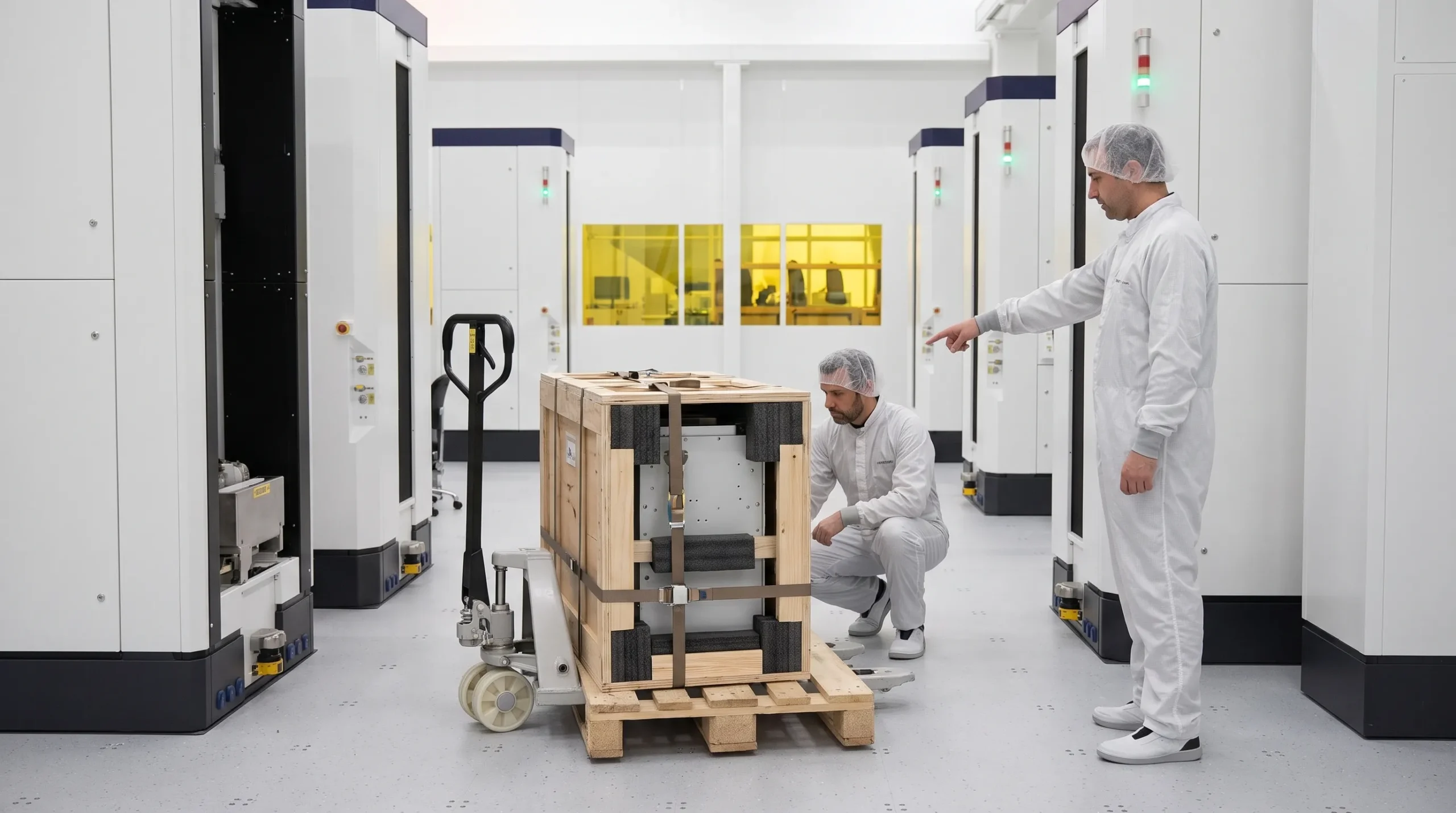
A manual pallet lifter is simple, familiar and cost-effective. In the right environment, it is a practical tool for moving palletized goods across a level floor. That is exactly why it is often the first option considered when a team needs to move a machine part, module, tool or packed component from one workstation to another.
But familiarity can hide risk. In high-tech manufacturing, aerospace, medical technology, energy, optical and analytical equipment environments, the load is often not just heavy. It may be unstable, sensitive, expensive, difficult to grip, difficult to position or used in an area where access is limited. In those situations, a manual pallet lifter can create more risk than many teams expect.
The question is not whether manual pallet lifters are safe or unsafe in general. The real question is whether the lifter, the load, the route, the operator and the working environment match each other. When they do not, the safer choice may be a different standard lifting device, a modified handling process or a custom-engineered lifting and handling solution.
What a manual pallet lifter is designed to do
A manual pallet lifter, also known as a hand pallet truck or pallet jack, is primarily designed to move palletized loads over short distances on suitable floors. It is strongest in relatively simple logistics tasks where the load is stable, the route is predictable and the operator can move the equipment without excessive force.
Typical suitable conditions include a load that is properly supported on a pallet, a reasonably low center of gravity, a smooth and level floor, clear aisles, sufficient turning space and a route without steep ramps, thresholds or tight interfaces. In those conditions, a manual pallet lifter may be perfectly adequate.
Problems start when the tool is used outside that intended context. This often happens gradually. A team first uses the pallet lifter for normal goods movement. Later, it is used for a fixture, then a production module, then a valuable assembly that is not truly palletized. Because the lifter is available and operators know how to use it, it becomes the default solution. That default can become unsafe when the task changes but the handling method stays the same.
Warning signs that a manual pallet lifter may not be safe enough
A manual pallet lifter should not be selected only because the rated capacity appears sufficient. Capacity is only one part of the safety equation. The stability of the load, the operator's control, the route and the final positioning task matter just as much.
The following signs indicate that a more controlled lifting or handling solution should be considered.
| Warning sign | Why it increases risk | Possible safer direction |
|---|---|---|
| The load has a high or offset center of gravity | The load can become unstable during turning, braking or floor transitions | Use a lifting frame, handling cart or custom support that controls the center of gravity |
| The item is not properly palletized | Fork support may be uneven, creating bending, sliding or tipping risk | Design a dedicated carrier, adapter or lifting interface |
| The route includes slopes, thresholds or uneven flooring | Manual push and pull forces rise, while stability decreases | Reassess the route, improve the floor interface or use powered handling equipment |
| Operators have limited visibility | Collision, trapping and product damage risks increase | Improve load orientation, operator position, guidance or controlled movement |
| The task requires accurate positioning | Manual pallet lifters are not ideal for fine alignment during installation | Use a scissor lift table, mobile lift, hoist or custom positioning tool |
| The load is high-value or safety-critical | A small handling error can cause major operational, financial or safety impact | Engineer the full load path and define inspection and maintenance requirements |
| The work is repeated frequently | Fatigue and ergonomic strain accumulate over time | Consider powered motion, better handles, lower forces or assisted lifting |
| The environment is cleanroom, aerospace or high-tech assembly | Standard equipment may not match cleanliness, access or quality requirements | Specify cleanroom-compatible or application-specific handling equipment |
If several of these conditions apply at the same time, the issue is rarely solved by choosing a stronger manual pallet lifter. The handling concept itself may need to change.
Why rated capacity is not the same as a safe lifting solution
One of the most common misunderstandings in lifting and handling is the idea that rated capacity defines safety. It does not. Rated capacity indicates what the equipment is designed to carry under defined conditions. It does not prove that the equipment is suitable for every load shape, every route or every operator interaction.
For example, a 500 kg module with a low and centered center of gravity behaves very differently from a 500 kg module with a high center of gravity and sensitive protruding components. Both may fall within a lifter's rated capacity, but only one may be practically safe to move with a manual pallet lifter.
The load path should be considered from the moment the item is picked up until it is placed, installed or transferred. That includes fork insertion, support points, stability during movement, braking, turning radius, visibility, lowering, final alignment and removal of the lifter. If the lifter only works in the middle of the route but creates risk during pick-up or final positioning, it is not a safe overall solution.
This is why equipment selection should start with the actual task. BKL discusses this broader decision process in more detail in its article on how lift and hoist choices affect safety and uptime. The same principle applies to manual pallet lifters: the right choice protects people, products and production continuity.
Manual handling force and ergonomics are often underestimated
A manual pallet lifter reduces direct lifting by the operator, but it does not eliminate physical strain. Operators still need to pull, push, steer, stop and position the load. The heavier the load, the poorer the floor condition and the tighter the space, the higher those forces become.
This matters for safety and productivity. High push and pull forces can lead to shoulder, back and wrist strain. Sudden stops or direction changes can cause operators to lose control. In busy production areas, a slow and physically demanding movement can also increase interaction with people, tools, machines and sensitive products.
Ergonomics should therefore be treated as an engineering requirement, not as an afterthought. A safer solution may include powered movement, improved handle design, a lower rolling resistance, better wheel selection, controlled lifting height, guided positioning or a different handling route. In repetitive tasks, even small ergonomic improvements can have a meaningful effect on operator comfort and process reliability.
High-value equipment changes the risk calculation
For OEMs and first-tier suppliers, the object being moved is often far more valuable than the handling equipment. A production module, optical assembly, analytical instrument component or aerospace part may represent significant cost, long lead times and strict quality requirements. Damage during internal transport can interrupt production and create complex investigation, repair and documentation work.
In these situations, the lowest initial-cost handling method is not always the most economical. A manual pallet lifter may look inexpensive compared with a custom lifting tool or mobile lift, but the real comparison should include product damage risk, downtime, operator injury risk, maintenance, inspection, repeatability and lifecycle support.
The same applies when handling tools are used for installation or maintenance. If a module must be positioned accurately inside a machine, a pallet lifter may provide movement but not control. The safer concept may require a defined interface, mechanical stops, controlled vertical adjustment, fine positioning and clear operating instructions.
Where standard equipment cannot control these factors, a custom solution may be more appropriate. BKL's article on what custom lifting solutions solve better than standard gear explains several situations where engineered lifting and handling tools can reduce practical risk.
Tight spaces and restricted access make manual pallet lifters less predictable
Many industrial handling tasks take place in spaces that were not designed around a pallet lifter. Cleanrooms, machine fronts, test cells, service areas, aircraft maintenance environments and high-tech assembly lines often have restricted access, limited turning space and sensitive surroundings.
A manual pallet lifter needs enough room for approach, turning, pumping, lowering and retreat. When that space is not available, operators may compensate by using awkward body positions, making repeated corrections or working close to pinch points. The load may also need to be approached from an angle that does not properly support the item.
In restricted spaces, engineering the route is just as important as engineering the lift. The solution may involve a narrower mobile lift, a dedicated handling cart, a lifting adapter, an overhead hoist with a spreader beam or a tool that interfaces directly with the product. For sensitive equipment in tight areas, BKL has also written about safe lifting for high-value equipment and tight spaces, which is closely related to the limitations of manual pallet handling.
When standard alternatives may be sufficient
Not every application needs a custom lifting tool. A standard alternative may be the right choice when the task is common, the load is stable and the working environment is suitable. The goal is to choose the simplest solution that controls the real risks, not to over-engineer every movement.
Possible alternatives include powered pallet trucks for longer routes or heavier loads, electric stackers for controlled vertical movement, scissor lift tables for ergonomic working height, mobile lifts for flexible positioning, overhead hoists for vertical handling and dedicated transport carts for repeatable movement between workstations.
The important step is to assess whether the alternative actually solves the risk. A powered pallet truck may reduce operator force, but it may not solve load instability. A scissor lift table may improve working height, but it may not provide the right product interface. An overhead hoist may provide vertical lifting, but it still needs the right lifting beam, lifting adapter or attachment points.
A safe handling concept is therefore built around the load and the task, not around a preferred equipment category.
When a custom-engineered lifting or handling solution is justified
A custom solution becomes relevant when standard equipment cannot provide the required stability, control, ergonomics, safety margins or integration with the process. This is common in high-tech manufacturing where loads have unusual geometry, sensitive surfaces, strict cleanliness requirements or limited allowable contact points.
A custom lifting or handling solution may be justified when the equipment must interface with defined lifting points, prevent incorrect use, fit a restricted route, support repeatable positioning, reduce operator forces, control tilting or rotation, or integrate with a machine, test setup or installation procedure.
Good custom engineering should also consider the full lifecycle. That includes manufacturing quality, assembly, load testing, user instructions, technical documentation, inspection access, wear points, maintenance tasks and future modifications. A tool that is easy to inspect and maintain is often safer and more available than a tool that only looks good at delivery.
This is where combining mechanics, mechatronics and practical production experience becomes valuable. BKL can support engineering, manufacturing, assembly, installation, inspections, maintenance and related lifecycle services for lifting, hoisting, handling and working-at-height solutions. Depending on the need, that support can cover one process step or the complete chain.
Inspection, documentation and maintenance should not be left until later
A manual pallet lifter may appear to function normally even when wear, deformation or poor wheel condition increases risk. The same applies to custom tools, lifting beams, mobile lifts and handling equipment. Visual condition, test results, maintenance history and operator feedback all help determine whether equipment remains suitable for use.
For safety-critical equipment, documentation is not paperwork for its own sake. It supports traceability and decision-making. Useful documentation may include design assumptions, calculations, operating instructions, inspection reports, overload test results where applicable, maintenance records and clear usage advice.
BKL is accredited according to ISO 17020:2012 for inspections and can support visual inspections, examinations, overload testing, reports, certification where applicable and practical advice on safe use. The value is not only in checking the equipment. It is also in understanding how the tool is used in the real working environment.
Digital systems can further strengthen this process when inspection records, maintenance actions and operator reports are connected instead of scattered across spreadsheets and emails. For broader digitalization, automation or AI-supported workflow initiatives, companies may also work with specialists in custom IT and AI solutions to improve how technical data supports productivity and decision-making. However, digital data should complement, not replace, sound engineering judgement and competent inspection.
A practical decision framework for engineering and safety teams
Before approving a manual pallet lifter for a critical handling task, engineering, operations, safety and maintenance teams should align on a few practical questions.
- What is the real load, including weight, center of gravity, geometry, fragility and allowable contact points?
- Is the item genuinely palletized, or is the pallet lifter being used as a convenient workaround?
- Can the operator move, stop, steer and position the load without excessive force or awkward posture?
- Does the complete route include slopes, thresholds, tight turns, poor visibility or shared pedestrian zones?
- Is final placement a simple transport task or a precision installation task?
- What happens if the load shifts, the floor is imperfect or an operator must stop unexpectedly?
- Are inspection, maintenance, documentation and user instructions adequate for the level of risk?
These questions often reveal whether the issue is a simple equipment selection matter or an engineering problem. They also help procurement teams compare options more fairly. The cheapest tool may be acceptable for low-risk logistics. For safety-critical, high-value or repetitive tasks, lifecycle value is usually a better decision basis.
How BKL approaches safer lifting and handling decisions
BKL's approach starts with understanding the application. That means looking at the load, the operator, the working environment, the intended use, the route, the required accuracy and the lifecycle of the equipment. Safety is considered from the first design steps, not treated as a final check after the tool has been built.
For some customers, the answer may be a practical improvement to an existing process. For others, it may be a custom lifting adapter, lifting beam, mobile lift, cleanroom handling tool, scissor lift table integration, working-at-height solution or dedicated industrial module. BKL can also support inspection, service and maintenance to help keep important tooling available and in a safe condition.
This combination is especially relevant for OEMs and first-tier suppliers in semiconductor, medical technology, defence, aerospace, energy, optical technology and analytical equipment markets. These environments often require robust and user-friendly tools that fit strict quality, safety, cleanliness and operational requirements.
A manual pallet lifter is not a bad tool. It is simply the wrong tool when the task requires more stability, control, ergonomics, documentation or lifecycle support than it can provide. Recognizing that point early can prevent unsafe workarounds, reduce operator strain and protect valuable equipment.
FAQ's about manual pallet lifter safety:
When is a manual pallet lifter appropriate? A manual pallet lifter is usually appropriate for stable palletized loads, short transport distances, level floors, clear routes and tasks that do not require precision positioning. The load, route and operator effort should still be assessed.
Is rated capacity enough to decide whether a manual pallet lifter is safe? No. Rated capacity is only one factor. Stability, center of gravity, floor condition, visibility, operator force, turning space, final placement and inspection condition all influence whether the handling method is safe enough.
What are the main risks of using a manual pallet lifter for high-value equipment? The main risks include tipping, load movement, collision, poor support, operator strain, inaccurate positioning and product damage. These risks increase when the item is not designed for pallet handling or when the route is restricted.
When should we consider a custom lifting or handling solution? Consider a custom solution when standard equipment cannot safely control the load, fit the workspace, reduce operator strain, provide repeatable positioning or meet the required documentation, inspection and lifecycle needs.
Can BKL inspect existing manual or custom lifting equipment? BKL can support inspections of lifting equipment and is accredited according to ISO 17020:2012 for inspections. Depending on the equipment and application, this may include visual inspection, testing, reporting, certification where applicable and practical usage advice.
Discuss your lifting and handling application with BKL
If a manual pallet lifter is being used for a task that involves high-value equipment, restricted access, repeated operator strain or precision placement, it is worth reviewing the handling concept before a problem occurs.
BKL can help assess whether a standard solution is sufficient, whether an existing tool needs inspection or improvement, or whether a custom lifting and handling solution is justified. Contact BKL by phone or email to discuss your application, plan an appointment or request a quotation for engineering, production, installation, inspection, maintenance or lifecycle support.