
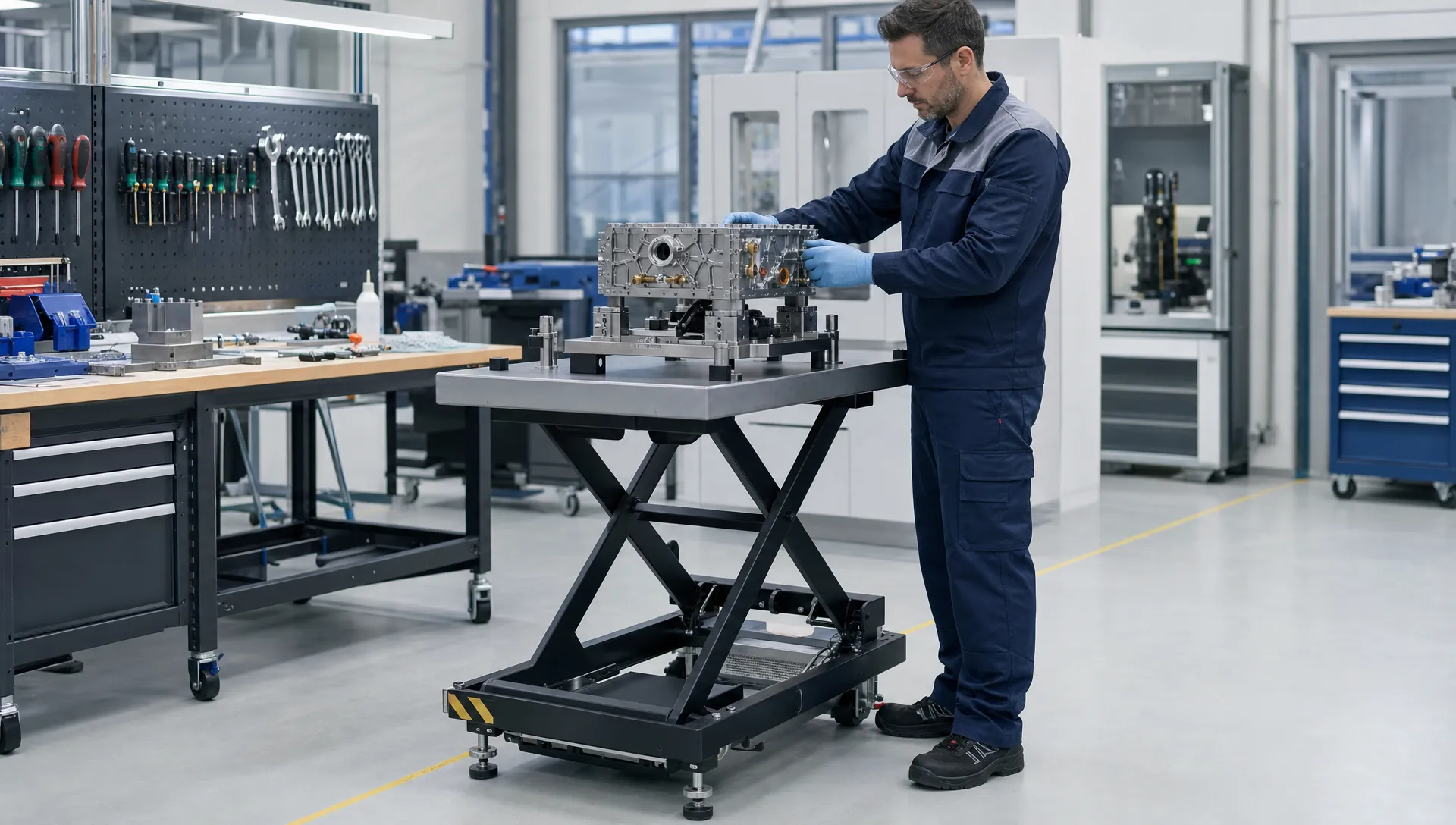
In precision assembly, table lifters are not just a convenient way to raise a component. Used correctly, they control working height, reduce manual handling and help operators position valuable equipment without improvised movements. For OEMs and first-tier suppliers in semiconductor, medical technology, aerospace, defence, energy, optical and analytical equipment, that combination directly affects safety, repeatability and production continuity.
A lift that looks simple from the outside can become a critical part of the assembly process. The real value is not only vertical travel. It is the ability to bring a product, submodule or tooling interface to the correct height, orientation and access position, while keeping the load stable and the operator in control.
Why table lifters matter in precision assembly
Precision assembly often combines heavy or awkward loads with tight tolerances, sensitive components and limited access. Operators may need to install fasteners, connect cables, align modules or perform inspections while the product is at a specific height. If the workpiece is too low, too high or unstable, the operator compensates with posture, force or improvised supports.
Well-engineered table lifters reduce those compensations. They can keep work within an ergonomic reach zone, support controlled movement and create a repeatable interface between the product and the workstation. That matters when a process is performed many times per shift or when a single handling error could damage a high-value module.
For a more focused discussion of working height and fixture stability, BKL has also written about lift tables that improve ergonomics in precision assembly. This article takes a broader engineering view, with safety, usability, compliance and lifecycle support included in the decision.
Safe lifting starts with the load path
A lifting solution is only as safe as its load path. That path includes the load, fixture, platform, drive system, frame, wheels or floor interface, controls and the way the operator interacts with the equipment. If one element is not defined properly, the entire task can become less predictable.
For high-tech OEMs, table lifters are often used close to fragile parts, clean surfaces, measuring equipment or partially assembled machines. The load may not be symmetrical. The center of gravity may shift during assembly. Operators may need access from several sides, which can introduce pushing forces, leaning forces or local impact loads that are not visible in a basic capacity rating.
That is why engineering should start with the task, not with a catalogue model. Key questions include load mass, center of gravity, lifting range, access points, floor conditions, required stability, emergency lowering needs and the consequences of a loss of power. The goal is not to make the device unnecessarily complex. The goal is to make the lifting movement predictable under real operating conditions.
Ergonomics is more than adjustable height
Adjustable height is useful, but ergonomics also depends on reach, visibility, posture, force and repetition. A table at the right height can still create strain if operators need to lean over a large frame, twist to reach connectors or hold a component by hand during alignment.
In precision assembly, table lifters should be considered together with fixtures, work instructions and operator access. A well-designed fixture can locate the product repeatably, protect sensitive surfaces and prevent uncontrolled movement. Handles, control positions and foot clearance also affect whether operators can work naturally or have to adapt their body to the machine.
Ergonomic design also supports process quality. When operators can see the interface, reach the work zone and use both hands safely, assembly steps become more consistent. This is especially relevant in small-series production where manual skill remains important, but the work still requires industrial repeatability.
Precision depends on stability, alignment and control
A lift table used for precision work must do more than move up and down. It must hold position, resist unwanted movement and maintain a stable interface while the operator performs the task. Excessive play, platform deflection or poor wheel locking can turn a controlled assembly step into a difficult manual adjustment.
This is where table lifters differ from general material handling equipment. In many assembly environments, the vertical position is part of the process. The platform may need to stop at defined heights, align with another machine or support fine positioning of a submodule. In cleanroom or high-tech environments, surface finish, particle control, lubrication choices and cleanability may also influence the design.
When the lift is mobile, stability becomes even more important. A movable lift must balance maneuverability with safe positioning. Brakes, steering, floor quality and travel path all affect control. For work near expensive equipment or in restricted production spaces, these details deserve engineering attention before the equipment is introduced on the shop floor.
Standard or custom: choose based on risk and task fit
A standard lift table can be the right choice when the load is simple, the environment is forgiving and the process does not require special interfaces. There is no value in over-engineering a basic handling task. The first decision should always be whether existing equipment can safely and efficiently meet the need.
Standard table lifters become less suitable when the product is valuable, unstable, off-center, difficult to access or sensitive to contamination, vibration or impact. They may also fall short when operators need a special fixture, a compact footprint, a defined stopping position or integration with other tooling.
The same practical logic applies across different manufacturing sectors. Even where the product is less fragile than a semiconductor module, for example in OEM textile manufacturing, lifting aids still need to fit real production flow, operator reach and quality inspection. The difference in high-tech assembly is that the tolerance for handling errors, downtime and product damage is often much lower.
When a standard solution does not fit, BKL's article on what custom lifting solutions solve better than standard gear explains the types of problems that are often better addressed through engineered lifting and handling equipment.
Design inputs that should be defined before engineering
Before specifying table lifters, engineering, safety, operations and maintenance teams should agree on the real use case. This avoids a common problem: buying a lifting device based on nominal capacity, then discovering that the operating environment requires features the original equipment was not designed to provide.
| Design input | What to define | Why it matters |
|---|---|---|
| Load data | Mass, dimensions, center of gravity and lifting interface | Supports stable design and reduces the risk of unexpected movement |
| Process steps | Assembly sequence, access points and required working heights | Helps match the lift to the operator's real task |
| Environment | Cleanroom needs, floor quality, space limits and surrounding equipment | Prevents poor fit with production conditions |
| Controls | Control position, speed, emergency functions and user feedback | Improves safe and intuitive operation |
| Lifecycle | Inspection needs, spare parts, maintenance access and expected use intensity | Supports availability and long-term safe use |
These inputs do not need to make the project slow. In practice, a clear task definition can shorten development time because it reduces redesign, supplier discussions and late-stage safety concerns.
Compliance, documentation and inspection are part of the lifecycle
For table lifters that become part of a machine, workstation or lifting operation, compliance cannot be treated as an afterthought. Depending on the scope, relevant considerations may include risk assessment, CE marking obligations, technical documentation, user instructions, load testing, inspection intervals and maintenance instructions.
In the EU, the Machinery Directive 2006/42/EC remains a key framework until the Machinery Regulation 2023/1230 becomes applicable in 2027. Standards such as ISO 12100 for risk assessment and EN 1570-1 for lifting tables may be relevant, depending on the equipment and application. The exact conformity route depends on the role of the equipment, the intended use and the party placing it on the market or putting it into service.
BKL can support manufacturers with product safety, risk assessment and technical documentation as part of the engineering process. BKL is also accredited according to ISO 17020:2012 for inspections. For existing lifting equipment, inspection, testing where applicable, clear reporting and practical usage advice help companies understand whether a tool remains suitable for safe use after years of operation.
How table lifters support uptime and lifecycle value
Downtime in precision assembly is rarely caused by one factor alone. A tool may still function, but if operators do not trust it, maintenance cannot repair it quickly or inspection history is unclear, the equipment becomes a production risk. This is why lifecycle thinking matters when selecting or engineering lifting equipment.
Good table lifters are maintainable, inspectable and understandable. Wear points should be accessible. Critical components should be documented. Operators should know the intended use and the limits of the tool. Maintenance teams should not have to reverse-engineer the equipment years after installation.
Lifecycle value also includes ergonomics and retention of practical knowledge. If a lifting aid makes work easier, safer and more repeatable, experienced operators spend less time compensating for poor equipment. That supports stable output and reduces hidden costs related to rework, delays, physical strain and improvised handling.
BKL's engineering approach for safety-critical handling
BKL develops technical solutions in mechanics and mechatronics for safer, smarter industrial work. For lifting, hoisting, handling and working-at-height applications, the team can support individual process steps or the complete chain from concept development and engineering to production, assembly, installation, inspection, maintenance and service.
In practice, this means the lifting device is not viewed as a separate object. It is assessed in relation to the product, operator, environment, process and lifecycle. For restricted areas and valuable loads, the same principle applies as in safe lifting for high-value equipment and tight spaces: define the task clearly before choosing the tool.
For OEMs and first-tier suppliers, this integrated approach reduces coordination between separate engineering, manufacturing, inspection and service suppliers. It also supports QLTCS performance: Quality, Logistics, Technology, Cost and Sustainability. The result should be a practical solution that fits the work, supports the operator and remains manageable during its service life.
FAQ's about table lifters:
When is a standard lift table sufficient for precision assembly? A standard lift table may be sufficient when the load is stable, access is simple, the working environment is not restrictive and no special fixture or control function is needed. The decision should be based on task risk, not only on load capacity.
When should an OEM consider a custom-engineered lifting solution? A custom solution is often worth considering when the load is high-value, off-center, sensitive, difficult to access or used in a cleanroom or tight production area. Custom engineering can also help when operator reach, repeatability or lifecycle inspection requirements are not met by standard equipment.
Do table lifters need CE marking? It depends on the equipment, intended use, integration and the party responsible for placing it on the market or putting it into service. For machinery-related applications in the EU, risk assessment, technical documentation and CE requirements should be reviewed early in the project.
How often should lifting equipment be inspected? Inspection frequency depends on the type of equipment, usage intensity, environment, applicable requirements and internal safety policy. Visual inspections, load testing where applicable and documented findings help determine whether equipment remains suitable for use.
Can a lift table improve both safety and productivity? Yes, when it is matched to the task. Better working height, stable positioning, clear controls and good access can reduce physical strain and make assembly steps more repeatable. Productivity gains should never rely on bypassing safety measures.
Discuss your precision assembly application with BKL
If your assembly process involves valuable equipment, difficult access, operator strain or handling steps that depend on stable positioning, table lifters may be part of the solution. The right answer might be a standard lift table, a modified device, a custom fixture or a fully engineered lifting and handling system.
BKL can help review the task definition, load data, operating environment, safety requirements and lifecycle needs before a solution is selected or engineered. To discuss a current application, request support with engineering, production, installation, inspection or maintenance, contact BKL by phone or email and schedule a practical technical review.