
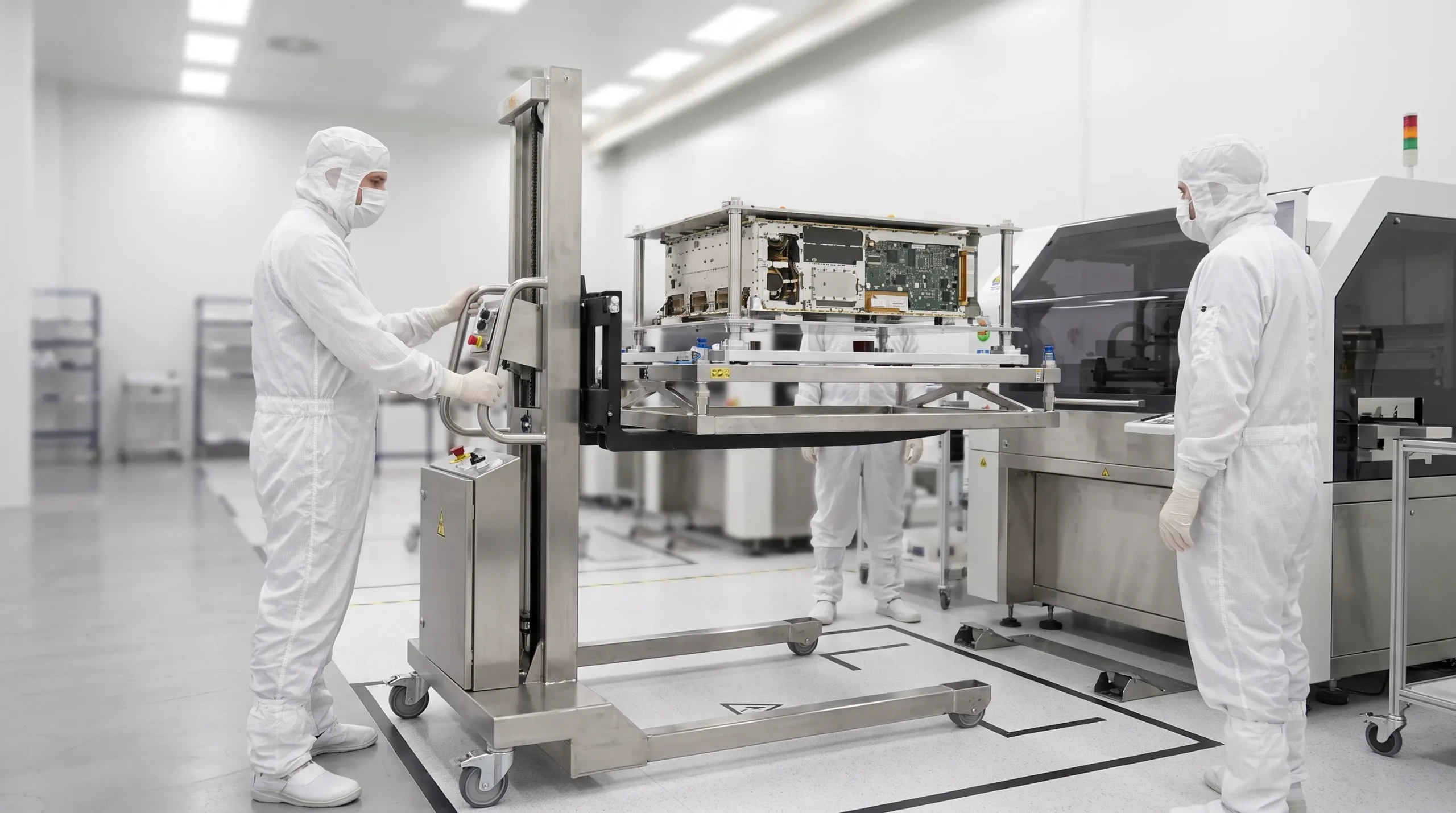
Sensitive products are often at their highest risk when they are being moved, positioned, docked or installed. In semiconductor, medical technology, aerospace, optical and analytical equipment manufacturing, a cleanroom can control particles very well, yet still leave room for scratches, impact damage, electrostatic discharge, misalignment, operator strain and process variation.
That is where cleanroom handling equipment becomes more than a transport aid. A well engineered lift, handling frame, lifting adapter, mobile lift or cleanroom assembly tool controls how a product is supported, how it moves, where forces enter the structure and how operators interact with it. The result is a more predictable process with fewer opportunities for damage.
For OEMs and first-tier suppliers, this is not only a quality topic. It affects safety, uptime, rework, ergonomics, documentation and lifecycle cost.
Damage in a cleanroom is not only a contamination issue
Cleanroom planning often starts with particle control, airflow, gowning and cleaning procedures. Those are essential, but they do not cover every failure mode. A precision module can remain visibly clean and still be damaged by a poor lifting point, a tilted transfer, a cable snag, an uncontrolled rotation or a small contact mark on a critical interface.
In high-tech assembly, damage may be found late. A scratch on a sealing surface, a bent connector pin or a small deformation in a mounting frame might only appear during metrology, calibration, leak testing or final acceptance. By then, the cost is no longer limited to the part. Engineering time, cleanroom capacity, delivery planning and customer confidence may also be affected.
BKL has covered the quality side of this topic in more detail in its article on how cleanroom assembly improves quality in precision builds. Handling equipment adds a practical layer to that principle by controlling the physical interaction between people, tools and sensitive products.
| Damage risk | Typical cause | Handling equipment design response |
|---|---|---|
| Scratches and contact marks | Manual guiding, undefined support points or contact with surrounding tooling | Defined interfaces, protective supports, no-touch zones and controlled approach paths |
| Misalignment | Uncontrolled rotation, poor visibility or operator-dependent positioning | Guided movement, fine adjustment, mechanical stops and repeatable docking features |
| Shock or vibration | Sudden lowering, unstable transport or poor wheel selection | Controlled lifting speed, stable frames, suitable castors, brakes and damping where required |
| ESD damage | Incompatible materials or insufficient grounding strategy | ESD-aware material selection, controlled discharge paths and cleanroom-compatible design choices |
| FOD risk | Loose parts, open mechanisms or poorly managed accessories | Captive fasteners, covered mechanisms, tool retention and clear storage positions |
| Operator strain | Overreaching, twisting, team lifting or poor handle position | Ergonomic working height, balanced movement, intuitive controls and reduced manual force |
Where cleanroom handling equipment reduces risk
Cleanroom damage prevention is rarely achieved by one feature. It comes from a combination of mechanical design, mechatronic control, material selection, operator usability and lifecycle support.
Load-specific interfaces prevent accidental force entry
A sensitive module should not be supported wherever it happens to be convenient. The handling interface should match the product geometry, center of gravity, allowable lifting points and fragile areas. This is especially important when the load has optical surfaces, vacuum interfaces, precision machined references, thin covers or delicate cable routing.
A custom lifting adapter or handling frame can distribute load through approved points and prevent operators from touching vulnerable zones. It can also control orientation during lifting, so the load does not swing, rotate or settle into an unsafe position. For heavy or asymmetrical assemblies, this is often the difference between a controlled installation and a process that depends too much on operator judgement.
Predictable motion protects both product and people
Many cleanroom handling tasks require slow, precise movement rather than high speed. A cleanroom lift, scissor lift table or mobile lifting system can be designed to approach the assembly position in a controlled way, with fine height adjustment and stable horizontal movement.
Predictable motion reduces sudden force changes. It also reduces the need for operators to push, pull, hold or manually correct the load while wearing gloves and cleanroom clothing. If the equipment includes brakes, guides, stops or controlled motion, the assembly process becomes less dependent on individual strength and more dependent on a repeatable method.
In mechatronic handling systems, control logic can also support safer use. Depending on the application, this may include speed limitation, interlocks, position feedback or overload protection. These measures need to be specified for the actual operating environment, not added as generic features at the end.
Cleanroom-compatible construction reduces secondary risk
Handling equipment used in a cleanroom must not become a contamination source itself. Material selection, surface finish, fastener choice, lubrication strategy and cleanability all influence risk. Open crevices, exposed wear points and difficult-to-clean mechanisms can introduce particles or make cleaning inconsistent.
Cleanroom-compatible construction does not automatically mean the most complex solution. It means the design choices fit the cleanliness objective, cleaning method, chemical exposure, ESD needs and required durability. For example, a component that is mechanically strong but difficult to wipe down may create problems in routine use. A surface that looks smooth but wears quickly at a sliding interface may generate particles over time.
FOD control is built into the tool design
Foreign object debris is not only an aerospace concern. In semiconductor, medical device and high-tech equipment assembly, a dropped screw, loose cap or damaged cable tie can create serious quality issues. Cleanroom handling equipment should therefore reduce the number of loose items and make accessories easy to manage.
Captive pins, secured covers, defined tool parking positions and clear visual checks help operators confirm that everything is in place before, during and after a lift. These features are simple in principle, but they need to be designed into the equipment early enough to avoid awkward compromises.
Ergonomics reduces handling mistakes
Operator fatigue and awkward posture increase the chance of contact damage, slow reaction times and inconsistent handling. Cleanroom clothing can also limit visibility, tactile feedback and freedom of movement. If a handling task requires overreaching, twisting or team lifting, the process is already carrying unnecessary risk.
Good cleanroom handling equipment brings the work to a safer height, places controls where operators can reach them, reduces manual force and gives clear visibility of the product interface. A practical safety program can also sit alongside broader wellbeing measures, from fatigue management to access to services such as personalised nutrition guidance, because reliable work depends on both a safe tool and a supported operator.
Standard equipment or custom engineering?
Not every cleanroom task requires custom engineering. A standard trolley, lift table or hoist may be sufficient when the load is simple, the risk is low, the product has robust handling points and the operating environment is well understood. Standard equipment can also be the right choice when it meets the cleanliness, safety and documentation requirements without modification.
Custom cleanroom handling equipment becomes relevant when the process, product or safety requirements go beyond what catalog equipment can handle. That may involve an unusual center of gravity, limited access, heavy but fragile modules, tight clearances, sensitive surfaces, strict ESD requirements or the need to integrate with existing machines.
| Decision factor | Standard equipment may be sufficient when | Custom engineering is usually worth evaluating when |
|---|---|---|
| Load geometry | The load is regular and has clear handling points | The load is asymmetric, fragile or has restricted lift points |
| Cleanroom requirements | Materials and surfaces already meet the process needs | Cleanability, particle generation or ESD behavior must be engineered specifically |
| Positioning accuracy | Approximate positioning is acceptable | Fine alignment, docking or repeatable installation is required |
| Operator interaction | The task is simple and ergonomic | Operators must reach, guide, rotate or stabilize the load manually |
| Lifecycle support | Basic maintenance is enough | Inspection, load testing, documentation and availability are safety critical |
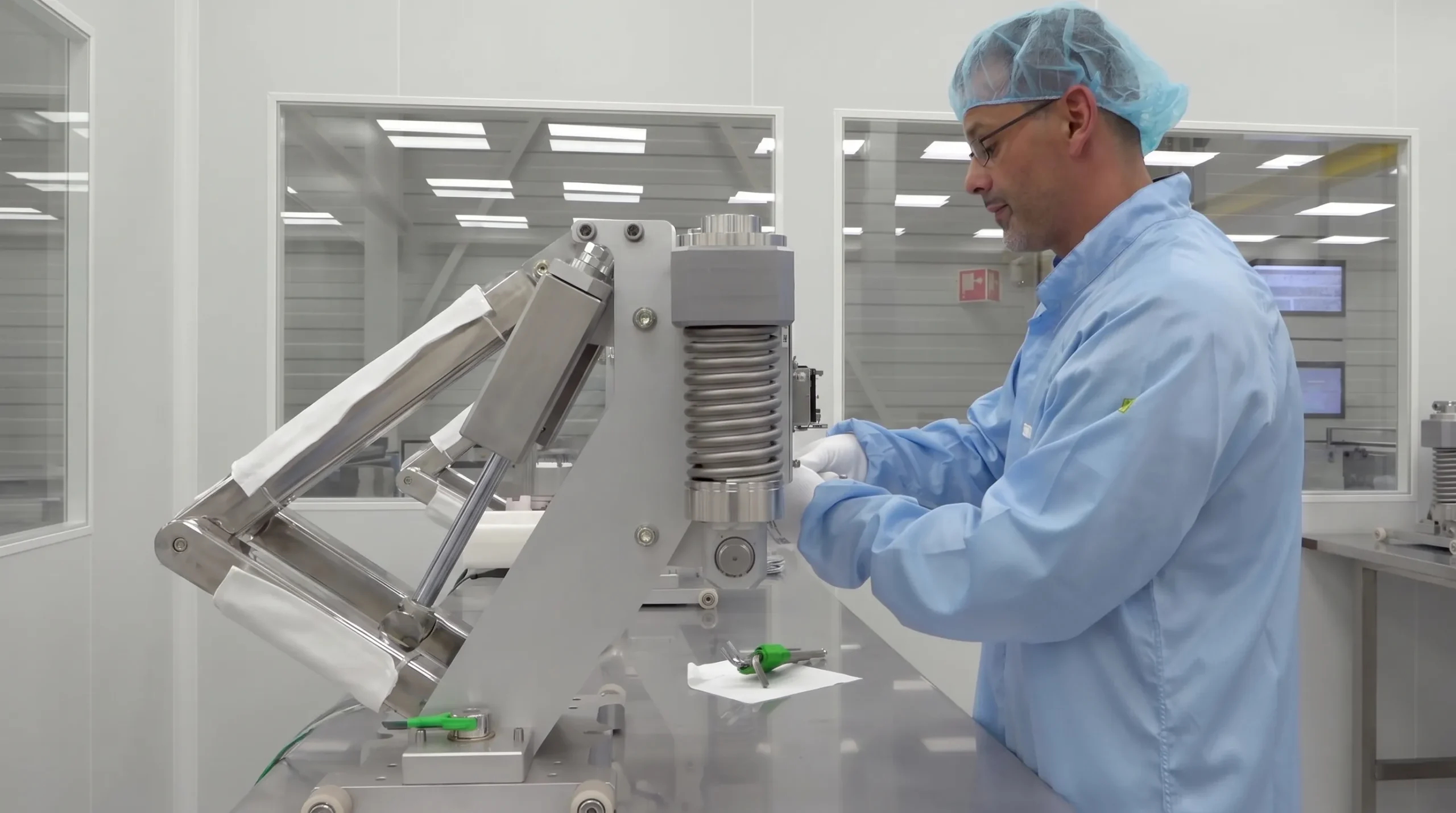
Specification choices that make the biggest difference
Damage prevention starts long before manufacturing. The specification stage should define what the equipment must protect, how it will be used and how safe use will be proven. If those questions are left open, the design may look acceptable on paper but fail in daily operation.
For a deeper specification framework, BKL’s guide on how to specify a cleanroom assembly tool for sensitive equipment is a useful next step. At minimum, engineering teams should align on the following points before choosing or designing equipment:
- Product data: mass, center of gravity, allowable lifting points, fragile zones, no-touch areas and permitted orientation changes.
- Process route: pickup location, transport path, transfer height, docking position, clearances, floor conditions and interaction with surrounding equipment.
- Cleanroom requirements: ISO 14644 class target, cleaning method, compatible materials, particle risk, ESD strategy and lubrication restrictions.
- Safety requirements: foreseeable misuse, load stability, guarding, control functions, emergency access, overload considerations and working-at-height risks where relevant.
- Operator factors: number of operators, PPE, glove use, visibility, reach distances, working height, control position and training needs.
- Lifecycle expectations: inspection intervals, service access, spare parts, load testing, documentation, repair strategy and availability requirements.
These are not administrative details. They directly influence the mechanical layout, control concept, material choices, manufacturing method and maintenance plan.
Engineering, testing and documentation reduce hidden risk
Cleanroom handling equipment should be engineered as part of the production process, not treated as an accessory. The design team needs to understand the load case, the cleanroom environment and the way operators will actually use the equipment.
A structured engineering process helps identify foreseeable risks early. This may include concept development, risk assessment, calculations, interface reviews, prototyping, production, assembly and testing. Depending on the scope, documentation can include drawings, calculation notes, test reports, user instructions, inspection records and technical file support for conformity assessment.
For machinery and lifting-related tools in Europe, CE requirements and applicable safety standards need to be considered from the beginning. That does not mean every tool follows the same route or receives the same type of certification. It means the design process should make safety functions, risk reduction measures, documentation and intended use clear enough for the specific application.
This is where an engineering partner that also understands production, installation and service can reduce coordination risk. Design decisions are easier to validate when the same team understands how the equipment will be manufactured, assembled, installed, inspected and maintained.
Workflow integration matters as much as the tool itself
A strong lifting device can still create risk if it is used in a poorly planned workflow. The cleanroom route may include narrow aisles, airlocks, transfer stations, height differences, temporary storage positions or interface points with other machines. Each transfer creates an opportunity for impact, contamination, unstable handling or operator strain.
Cleanroom handling equipment should therefore be designed around the complete process flow. For semiconductor environments, this is closely connected to layout, material flow and assembly planning. BKL discusses this broader topic in design priorities for a semiconductor clean room workflow.
Good workflow integration answers practical questions. Can the equipment turn safely in the available space? Can the operator see the critical interface during docking? Are brakes and controls accessible when the load is close to the machine? Is there a safe parked position? Can maintenance teams reach inspection points without dismantling half the tool?
These details decide whether equipment remains safe and efficient after the first commissioning.
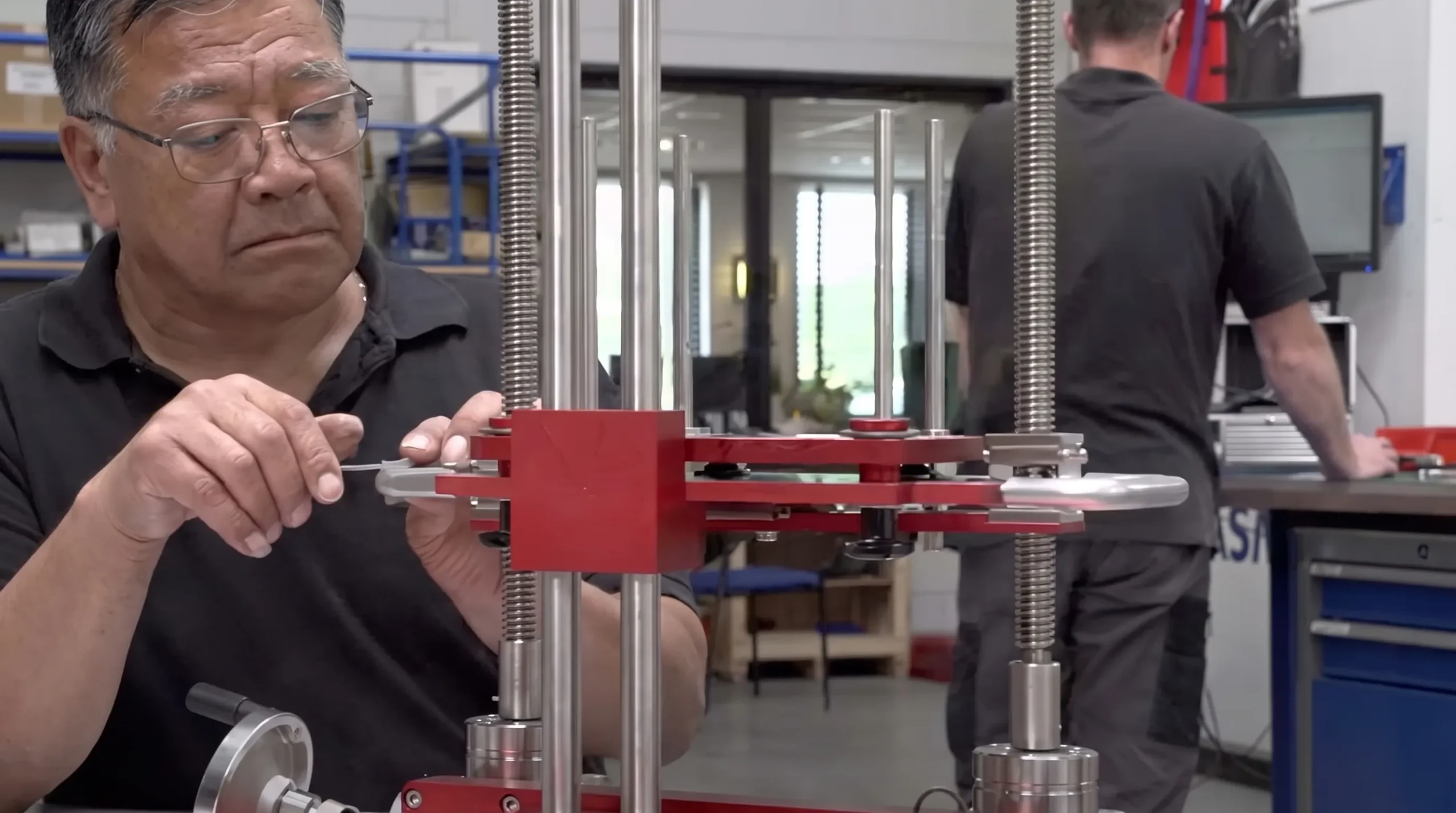
Lifecycle support keeps damage risk under control
Handling equipment changes over time. Wheels wear, guides loosen, lifting points experience repeated loading, surfaces become damaged and operators may adapt the process when production pressure increases. A tool that was safe at delivery can become a risk if inspection and maintenance are not planned.
Periodic inspection helps identify wear, deformation, damage or unsafe use before it becomes a larger problem. For custom lifting and handling tools, inspection quality matters because the inspector must understand the design intent, load path and application. A standard checklist is useful, but it cannot replace technical understanding of the specific tool.
BKL is accredited according to ISO 17020:2012 for inspections and can support visual inspections, overload testing, reports, certification where applicable and practical usage advice within the relevant scope. Combined with maintenance and service support, this helps companies keep important tooling available and in a safe condition.
Lifecycle support also improves the business case. If a handling system reduces damage risk during production but is difficult to inspect, repair or clean, the long-term value is weakened. A better design considers QLTCS from the start: quality, logistics, technology, cost and sustainability. Longer tool life, reduced rework, safer operation and clearer maintenance planning all support that broader value.
The business value of reducing handling damage
Cleanroom handling equipment is often justified by risk reduction, but the benefits reach further than avoiding a damaged part. Better handling can shorten setup time, reduce operator dependency, improve repeatability and support more predictable production planning.
For engineering managers, the value is a more robust process. For safety managers, it is safer lifting, fewer awkward handling tasks and clearer instructions. For operations managers, it is improved availability and fewer unexpected interruptions. For procurement, the decision should not be based only on purchase price, but on the total cost of quality, downtime, maintenance, documentation and lifecycle support.
The practical question is not whether custom equipment is always better. The question is whether the chosen solution controls the real risks of the application. If a standard solution does that, it may be the right answer. If it does not, custom engineering can prevent a low-cost purchase from becoming an expensive process weakness.
FAQ's about cleanroom handling equipment:
What is cleanroom handling equipment? Cleanroom handling equipment includes lifts, hoists, handling frames, lifting adapters, trolleys, scissor lift tables, mobile lifts and assembly tools designed for controlled use in cleanroom or controlled environments. The design should support cleanliness, safe handling, ergonomics and product protection.
How does cleanroom handling equipment reduce damage risk? It reduces damage risk by controlling support points, movement, positioning, operator interaction, cleanability, ESD behavior and FOD risk. The goal is to make handling repeatable and less dependent on manual correction.
When is custom cleanroom handling equipment needed? Custom engineering is worth evaluating when the product is heavy, fragile, asymmetrical, difficult to access or sensitive to contact, vibration, ESD or contamination. It is also relevant when the equipment must integrate with a specific machine, workflow or lifting procedure.
Does cleanroom handling equipment need inspection? Yes, equipment used for lifting, hoisting or safety critical handling should be inspected at appropriate intervals based on use, risk, regulations and internal procedures. Inspections can identify wear, deformation, damage or unsafe use that may not be visible during routine operation.
What information is needed to request a quotation? Useful information includes load data, drawings, center of gravity, lifting points, cleanroom requirements, process route, required positioning accuracy, operator constraints, safety requirements, documentation needs and expected inspection or maintenance requirements.
Discuss your cleanroom handling application with BKL
If your team is planning a new cleanroom process, reviewing an existing lifting tool or dealing with damage risk during assembly, it is worth discussing the application before selecting equipment. The right solution may be a standard tool, a modified system, a custom lifting adapter, a complete handling system or an inspection and maintenance plan for existing equipment.
BKL supports OEMs and first-tier suppliers with engineering, production, assembly, installation, inspection, certification where applicable, maintenance and lifecycle services for safe lifting, hoisting, handling and working at height. Share your load data, process constraints and safety requirements with the team to explore a practical solution or request a quotation for your specific cleanroom handling challenge.