

Precision builds rarely fail because of one obvious mistake. More often, quality issues develop through small uncontrolled variables: particles on a sealing surface, a fiber trapped in an optical path, a fingerprint on a precision interface, a temperature change during measurement, or a handling step that slightly misaligns a sensitive module.
Cleanroom assembly reduces these variables by making the build environment, tools, people and process more predictable. For OEMs, high-tech manufacturers, semiconductor equipment builders and aerospace suppliers, that predictability can be the difference between a module that performs correctly the first time and one that requires costly rework after integration.
The value of cleanroom assembly is not only cleaner air. It is a disciplined way of building precision equipment where contamination control, safe handling, inspection, documentation and operator usability are considered together.
What cleanroom assembly means in precision engineering
Cleanroom assembly is the controlled assembly of components, modules or machines in an environment designed to limit contamination and stabilize critical conditions. Cleanrooms are commonly classified according to ISO 14644-1, which defines air cleanliness by particle concentration. However, the classification alone does not determine build quality.
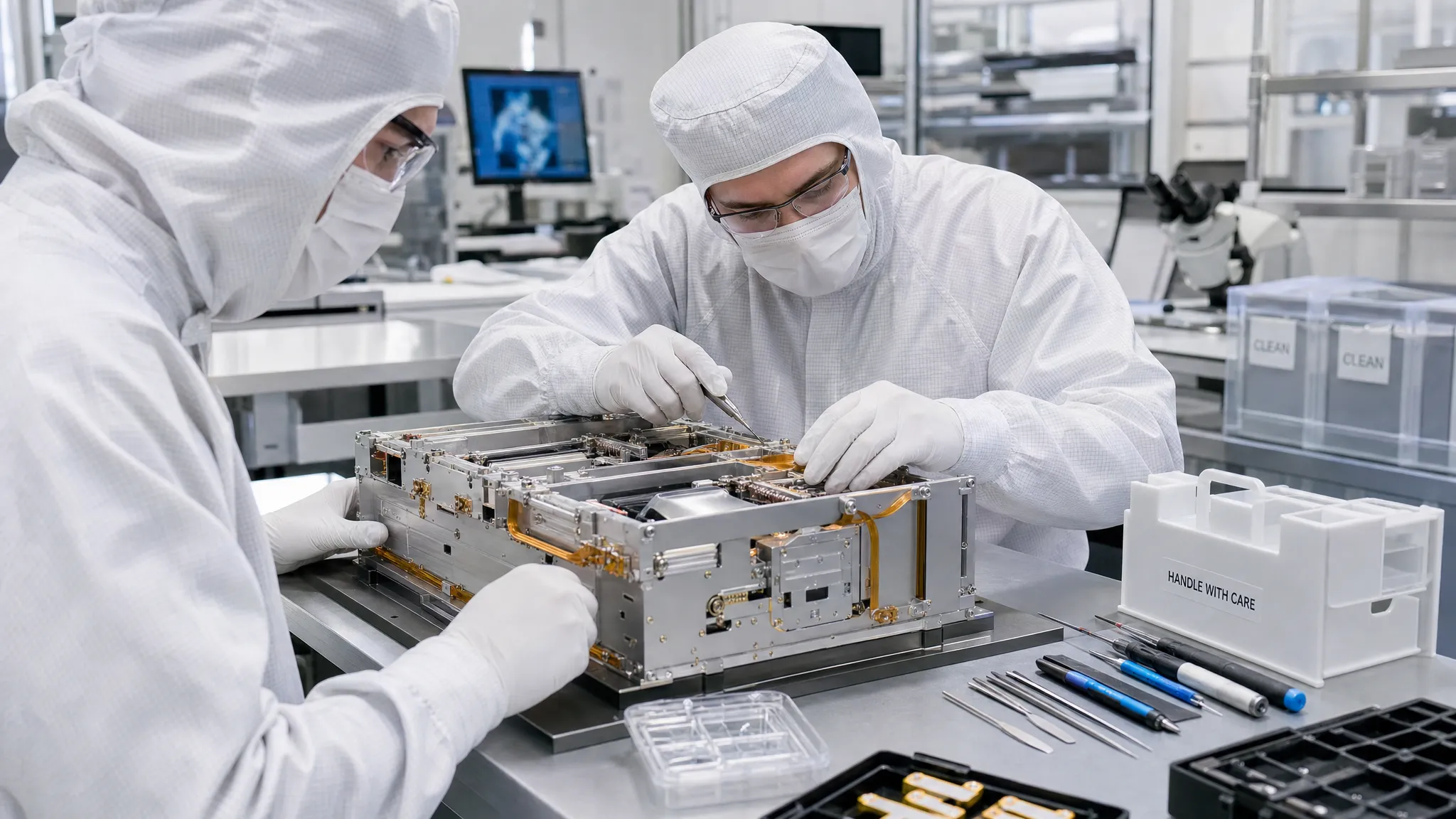
A precision build depends on the complete system around the assembly task. This includes material preparation, cleaning methods, gowning procedures, tooling design, packaging, part flow, inspection points and the way operators handle parts during each step.
For example, a high-value module may enter the cleanroom after machining, welding, coating or external supply. If incoming parts are not cleaned, inspected and handled correctly, the cleanroom cannot compensate for earlier process variation. Likewise, a clean component can be damaged during assembly if the lifting aid, fixture or work instruction does not match the real working environment.
This is why cleanroom assembly should be planned as part of the manufacturing strategy, not added as a final quality measure after the design is complete.
How contamination control protects precision builds
Particles, residues and fibers can create major quality problems in precision equipment. In semiconductor, optical, medical and aerospace-related applications, even small contamination can affect movement, sealing, measurement, alignment or surface performance.
Contamination is not always visible. A part may look clean but still contain microscopic particles, machining residue, oil film or packaging fibers. During operation, those contaminants can move into bearings, linear guides, vacuum interfaces, optical paths or electronic assemblies.
Cleanroom assembly improves quality by reducing these risks at several points in the process:
- Cleaner incoming parts reduce the chance of embedded contamination.
- Controlled clothing and gowning limit fibers, skin particles and other human-generated contamination.
- Clean tools, fixtures and work surfaces prevent recontamination during assembly.
- Defined cleaning steps make the process repeatable instead of dependent on individual habits.
- Controlled packaging protects the assembly after it leaves the cleanroom.
The result is not simply a cleaner product. It is a more stable assembly process with fewer unknowns, fewer late-stage surprises and better confidence during integration.
The same general principle applies outside high-tech manufacturing as well: product quality depends on careful handling, maintenance and storage after production. A specialist sports retailer such as Fabbrica Ski Sises demonstrates this in a consumer context by combining selected equipment with services such as repair and rental support. In precision industrial assembly, that care is formalized through controlled environments, documented processes and validated handling methods.
Where cleanroom assembly improves quality most
Cleanroom assembly is especially valuable when components are difficult to clean after integration, expensive to replace, sensitive to particles or dependent on tight interfaces. The more complex the module, the more important it becomes to control quality before final assembly.
| Quality risk | Possible impact on precision builds | Cleanroom assembly control |
|---|---|---|
| Particles on contact surfaces | Misalignment, wear, sealing issues or functional drift | Cleaning, controlled work surfaces and protected part flow |
| Oil or chemical residues | Adhesion problems, outgassing or surface degradation | Approved cleaning methods and material compatibility checks |
| Fibers in sensitive areas | Optical defects, sensor disturbance or mechanical interference | Gowning, clean packaging and lint-controlled materials |
| Uncontrolled handling | Scratches, deformation or positional errors | Dedicated fixtures, lifting aids and work instructions |
| Inconsistent assembly sequence | Rework, missing checks or documentation gaps | Standardized process steps and inspection hold points |
| Environmental instability | Measurement variation or tolerance issues | Temperature and humidity awareness during critical steps |
The table shows why cleanroom assembly should not be treated as a facility question only. The room supports quality, but the real improvement comes from disciplined engineering around the complete build process.
Repeatability: the hidden quality advantage
In precision builds, repeatability is often more valuable than one perfect assembly. OEMs and machine builders need to know that the tenth module will be assembled with the same care, cleanliness and documentation as the first.
Cleanroom assembly supports repeatability by reducing process variation. Operators work with defined gowning rules, clean tools, approved cleaning agents, controlled part flow and clear inspection moments. This makes it easier to identify deviations because the baseline process is known.
Repeatability also helps engineering teams improve designs over time. If every assembly is performed differently, it is difficult to determine whether a problem comes from the design, the supplied part, the operator method, the tool or the environment. A controlled assembly process makes root cause analysis more reliable.
For complex industrial modules, this can reduce rework loops between engineering, production and quality teams. It also supports more reliable feedback to suppliers, because incoming quality issues can be separated from in-house handling or assembly variables.
Cleanroom assembly starts before the cleanroom
A common mistake is to see the cleanroom as the starting point of quality control. In practice, many quality decisions are made much earlier, during design, purchasing and production preparation.
If a module is difficult to clean, awkward to lift or impossible to inspect once assembled, the cleanroom process becomes more complex and less efficient. Engineering teams can improve cleanroom assembly by considering cleanliness and handling during the design phase.
Important design considerations include:
- Use materials and surface finishes that are suitable for the required cleanliness level.
- Avoid geometries that trap particles, liquids or cleaning residues.
- Define lifting and handling points before production starts.
- Make critical interfaces accessible for inspection and cleaning.
- Select fasteners, lubricants and consumables that fit the cleanroom requirements.
- Plan clean packaging and transport between process steps.
- Document acceptance criteria before assembly begins.
This is where collaboration between engineering, production, quality and safety teams becomes important. Cleanroom assembly is strongest when it is supported by practical design decisions, not when operators must solve avoidable problems at the workbench.
Safe handling is part of clean assembly quality
Precision components often have two conflicting requirements. They must be handled gently because they are sensitive, but they may also be heavy, awkwardly shaped or difficult to access. In a cleanroom, this challenge becomes more demanding because operators may work with gloves, restricted movement, limited visibility or controlled workflow paths.
Poor handling can undo the benefits of clean assembly. A clean part that is scratched, tilted, overloaded or placed under unintended stress can still fail during integration or operation. For high-value components, the cost of one handling error can exceed the cost of designing the right fixture or lifting aid.
Cleanroom-compatible handling tools should support the load path, protect critical surfaces and allow operators to work without unnecessary force or unsafe body positions. They should also be easy to clean, stable during use and suitable for the available space.
This is closely connected to broader lifting and handling safety. When valuable modules must be moved in restricted areas, the engineering challenge is not only lifting capacity. It also includes clearance, visibility, operator access, center of gravity, controlled movement and safe positioning. BKL discusses these factors in more detail in its article on safe lifting for high-value equipment and tight spaces.
Documentation and traceability reduce quality uncertainty
Cleanroom assembly improves quality not only through physical control, but also through documentation. For safety-critical or high-value builds, it is not enough to know that a module was assembled. Teams need evidence of how it was assembled, which checks were performed and which deviations were found.
Useful documentation may include cleaning records, inspection reports, torque logs, measurement results, material certificates, nonconformity records, test reports and packaging instructions. The level of documentation should match the risk and complexity of the application.
Traceability is especially important when modules are part of a larger machine or production line. If an issue appears after installation, good records help engineering and maintenance teams identify whether the cause may relate to incoming material, assembly conditions, handling, testing or field use.
This is also relevant for CE-related processes and technical files. Cleanroom assembly does not automatically create compliance, and no supplier should suggest that it does. However, controlled assembly, risk-based engineering, inspections and clear documentation can support a more robust conformity assessment process. For a broader view of safety from the design stage, BKL has also written about occupational safety in machine and tooling design.
When cleanroom assembly is worth the investment
Not every precision build needs a cleanroom, and not every cleanroom project requires the highest cleanliness class. The correct level depends on the product, risk profile, industry requirements and consequences of contamination or handling damage.
Cleanroom assembly is most valuable when one or more of the following conditions apply: the product has sensitive optical, electronic, vacuum or motion interfaces; the assembly is difficult to clean after integration; rework would require major disassembly; contamination can affect performance or lifetime; or the component value makes handling damage unacceptable.
It can also be useful for prototype and pilot builds. During early development, a controlled environment helps teams separate design issues from contamination or assembly variation. This can make engineering feedback more reliable before scaling production.
For companies operating in semiconductor equipment, optics, high-tech manufacturing and other demanding markets, the cleanroom should be seen as part of a quality strategy. It supports the ability to build consistently, inspect meaningfully and deliver equipment with fewer avoidable risks.
BKL’s overview of its controlled environment cleanroom shows how a clean assembly setting can support demanding work such as assembly, testing and prototyping in technical environments where cleanliness and process control matter.
Practical questions to ask before starting a cleanroom build
Before moving a project into cleanroom assembly, engineering and operations teams should align on the actual risks. This prevents over-specification, under-specification and unclear responsibilities between suppliers, production and quality teams.
A practical discussion should cover the cleanliness requirement, inspection moments, packaging method, handling tools, cleaning agents, accepted materials and documentation deliverables. It should also define who is responsible for each step before, during and after assembly.
Important questions include:
- Which surfaces, interfaces or components are truly contamination-sensitive?
- What cleanliness level is required by the product, customer or application?
- Which parts must be cleaned before entering the cleanroom?
- How will components be lifted, turned, aligned and fixed without damage?
- Which checks must be documented during assembly?
- What packaging is required to preserve cleanliness during transport or storage?
- How will the tool, module or machine be inspected and serviced later in its lifecycle?
These questions help teams avoid treating cleanroom assembly as a standalone production step. They also bring safety, usability and maintenance into the same discussion as cleanliness and quality.
How BKL supports cleanroom assembly for precision builds
BKL works at the intersection of mechanics, mechatronics, production, inspection and service. That combination is important for precision builds because quality issues often cross functional boundaries. A handling problem may be rooted in the mechanical design. A contamination risk may be linked to material selection. A maintenance issue may originate from poor access or unclear documentation.
By considering safety, usability, manufacturability and inspection from the start, BKL helps clients develop tools, modules and machines that fit the real working environment. This can include a partial service, such as engineering support, production, inspection or repair, or a more complete solution from concept through lifecycle support.
For cleanroom-related projects, the practical value lies in combining controlled assembly with the right handling strategy, clear documentation and a long-term view of availability. Precision quality is not finished when the product leaves the cleanroom. It continues through transport, installation, operation, maintenance, inspection and eventual modification or repair.
That lifecycle perspective is especially relevant for OEMs and manufacturers that depend on reliable tooling and modules for business continuity. A clean build reduces risk at delivery, but a well-engineered lifecycle approach helps the equipment remain safe, usable and inspectable over time.
FAQ's about cleanroom assembly:
What is cleanroom assembly? Cleanroom assembly is the process of building components, modules or machines in a controlled environment designed to limit contamination. In precision engineering, it also includes controlled handling, cleaning, inspection, documentation and packaging.
Does every precision build need cleanroom assembly? No. The need depends on the product, cleanliness requirements, sensitivity of components and consequences of contamination or rework. Some projects only need specific cleaning, inspection or handling improvements rather than full cleanroom assembly.
How does cleanroom assembly improve quality? It reduces uncontrolled variables such as particles, residues, inconsistent handling and undocumented process steps. This improves repeatability, lowers the risk of rework and supports more reliable integration of precision modules.
Is cleanroom assembly only relevant for semiconductor equipment? No. Semiconductor applications are a clear example, but cleanroom assembly can also be valuable for optical systems, high-tech industrial modules, medical-related equipment, aerospace components and other precision builds where contamination or handling damage creates risk.
What should be defined before starting cleanroom assembly? Teams should define cleanliness requirements, incoming part preparation, assembly sequence, handling tools, inspection points, documentation needs, packaging requirements and lifecycle service considerations.
Build precision quality into the full process
Cleanroom assembly improves quality when it is treated as part of a complete engineering and production strategy. The room provides control, but the strongest results come from clean design choices, safe handling tools, trained processes, documented inspection and lifecycle support.
For OEMs, machine builders and high-tech manufacturers, this approach helps reduce avoidable rework, protect valuable components and give operators equipment that is safer and easier to use. If your next precision build requires clean assembly, reliable handling or safety-focused engineering support, BKL can help assess the process and develop a practical solution that fits the application.