
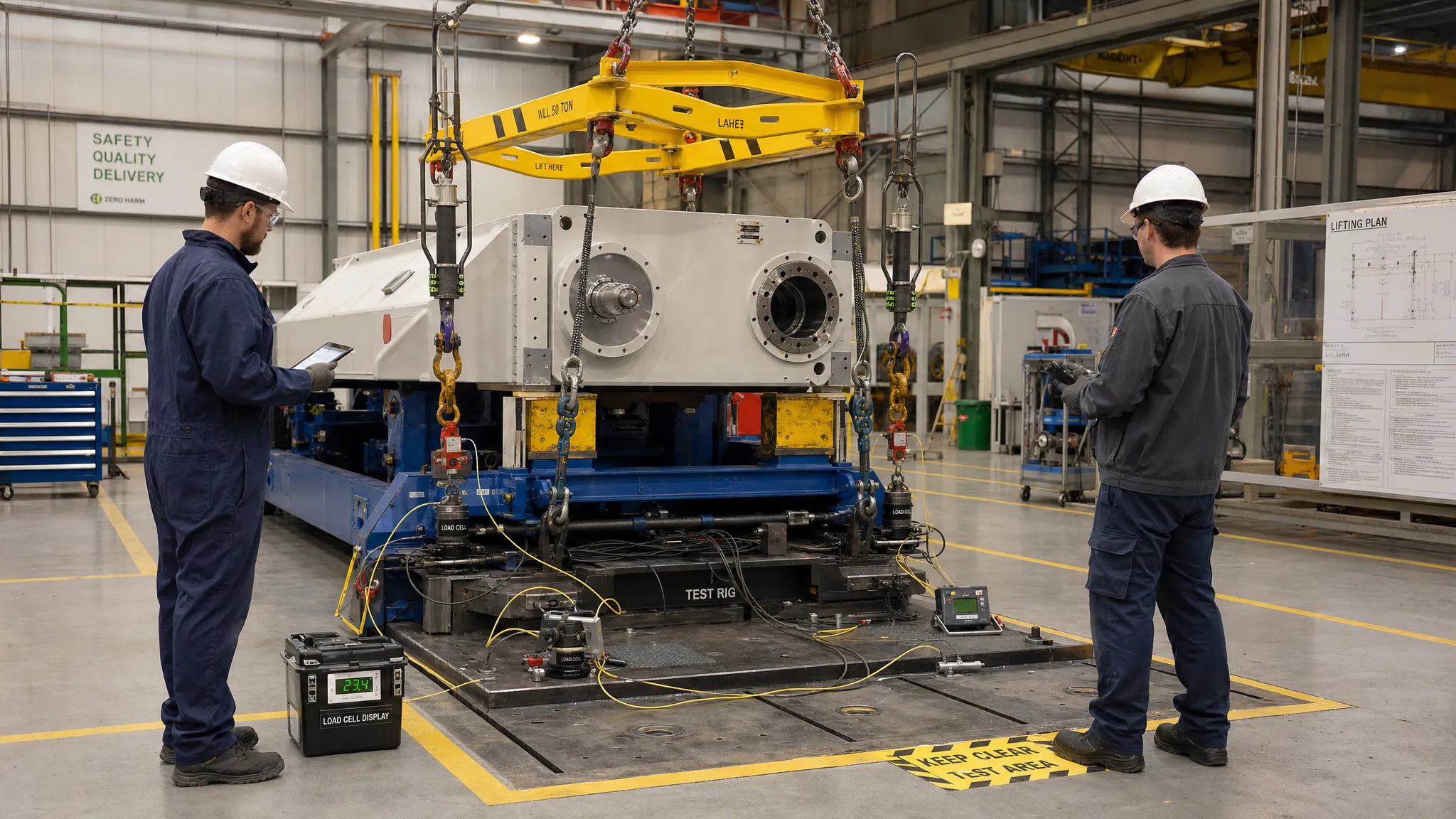
In high-tech manufacturing, aerospace, semiconductor equipment and complex OEM environments, lifting is rarely just a matter of selecting a crane hook and checking the rated load. The real challenge is moving valuable, sometimes fragile equipment through a controlled process without introducing avoidable risk to employees, products or production continuity.
That is where bespoke lifting solutions become valuable. A well-engineered lifting tool, handling frame, adapter, module or support system is designed around the actual load, the working environment, the operator and the complete lifecycle of use. It does not replace disciplined working procedures, inspections or competent operators, but it can make safe execution more practical, repeatable and efficient.
For engineering managers, safety managers, operations teams and procurement, the question is not simply “Can we lift it?” The better question is: “Can we lift, position, transport, install and maintain this equipment safely and consistently, without unnecessary downtime?”
Why standard lifting equipment is not always enough
Standard lifting equipment has an important role in industry. In many applications, certified catalogue products are suitable, cost-effective and readily available. A bespoke solution should not be the default answer for every task.
However, standard equipment often reaches its limits when the load is asymmetrical, access is restricted, interfaces are delicate, the centre of gravity is difficult to control or the lifting operation must be repeated in a specific production or maintenance process. In those cases, a general-purpose lifting accessory may technically carry the load, while still leaving too much uncertainty in the handling task.
This is especially relevant for high-value equipment, optical systems, semiconductor modules, aerospace components and machine assemblies. Damage may not always be visible immediately. A small deformation, uncontrolled tilt or contact with a sensitive interface can lead to rework, delayed commissioning or unplanned production stops.
For applications where valuable equipment must be lifted in restricted areas, the engineering approach overlaps strongly with the principles discussed in safe lifting for high-value equipment and tight spaces: the tool must fit the load, the route, the available clearance and the operator’s real working conditions.
Safety starts with the real lifting task
A safe lifting solution begins before CAD design. It starts with a detailed understanding of the lifting task. That includes the load, but also the way the load is presented, connected, moved, rotated, transported, positioned and released.
In practice, many lifting risks come from assumptions. The tool is designed for an ideal load position, but the operator uses it from the side. The lifting points are accessible in theory, but difficult to reach with gloves. The load is stable in a drawing, but not when a module is partially assembled. A lifting beam has sufficient capacity, but the slinging angle in the real workplace creates forces that were not expected.
A bespoke engineering process should turn these assumptions into verified design inputs.
| Design question | Why it matters for safety | Why it matters for uptime |
|---|---|---|
| Where is the centre of gravity in every relevant configuration? | Helps reduce uncontrolled tilt, rotation or overload on one connection point. | Reduces trial-and-error during lifting and positioning. |
| How will operators connect and disconnect the tool? | Supports safer hand positions, access and posture. | Speeds up routine handling and reduces set-up delays. |
| What are the critical interfaces on the load? | Helps prevent contact with sensitive surfaces, cables, sensors or precision parts. | Reduces the risk of damage, rework and delayed release. |
| Is the lift repeated often or only used occasionally? | Influences ergonomics, markings, instructions and inspection needs. | Helps match the investment to expected use and lifecycle cost. |
| How will the tool be inspected, stored and maintained? | Supports continued safe use after delivery. | Keeps important tooling available when production or service teams need it. |
This focus on context is not unique to factories. In any project environment where people, structures, access routes and equipment interact, the real site conditions determine the quality of the outcome. The same principle can be seen in construction and renovation work, where experienced contractors for home renovation in Dubai must plan around existing spaces before selecting methods or materials.
For industrial lifting, that context-driven approach is even more critical because the consequences of poor fit can include employee injury, damaged assets, failed inspections and production interruptions.
How bespoke lifting solutions reduce risk
A bespoke lifting solution improves safety when it controls the complete load path. That means the engineering team considers how forces move from the crane or hoist, through the lifting tool, into the load interface and back into the surrounding structure or support points.
This requires more than calculating a rated capacity. It includes geometry, connection details, welds, bolts, pins, deflection, stability, load cases and foreseeable misuse. In mechatronic tools, it may also include sensors, actuators, control logic, positioning systems or interlocks, depending on the application.
Good engineering also reduces dependence on operator improvisation. If operators need to add temporary blocks, adjust slings by feel or make manual corrections during every lift, the process is not sufficiently controlled. A well-designed tool makes the intended method clear and repeatable.
Practical safety improvements often include:
- Defined lifting points that match the equipment interface and load case.
- Controlled orientation during lifting, rotation, transport or installation.
- Mechanical features that help prevent incorrect assembly or unsafe positioning.
- Accessible connection points that reduce awkward postures and hand-trap risks.
- Clear markings, manuals, inspection criteria and usage instructions.
These measures do not remove the need for trained operators or safe procedures. Instead, they make safe behaviour easier to execute under real production conditions. That is also why safety should be included from the first design steps, not added as a final checklist item. The same design philosophy is explored in more detail in occupational safety in machine and tooling design.
How bespoke lifting solutions improve uptime
Uptime is often discussed in terms of machine availability, but lifting and handling tools are part of that availability chain. If a critical tool is unavailable, unclear to use, difficult to inspect or repeatedly causes handling delays, production can still be interrupted.
Bespoke lifting solutions support uptime by making routine work more predictable. The value is not only in lifting heavier or more complex loads. It is often in reducing preparation time, avoiding unnecessary handling steps and ensuring the same operation can be repeated by different qualified operators without redesigning the process each time.
In production, a dedicated lifting tool can reduce waiting time around installation, module exchange or maintenance access. In service environments, it can help technicians remove and reinstall components with less disruption. In high-tech or clean manufacturing environments, it can also reduce the risk of product damage caused by uncontrolled movement, contact or poor alignment.
There is another uptime factor that is easy to underestimate: confidence. When operators, maintenance teams and safety managers trust the equipment, documentation and inspection status, fewer decisions need to be escalated at the moment of use. Clear usage advice, load test records and inspection reports help teams act faster without bypassing safety procedures.
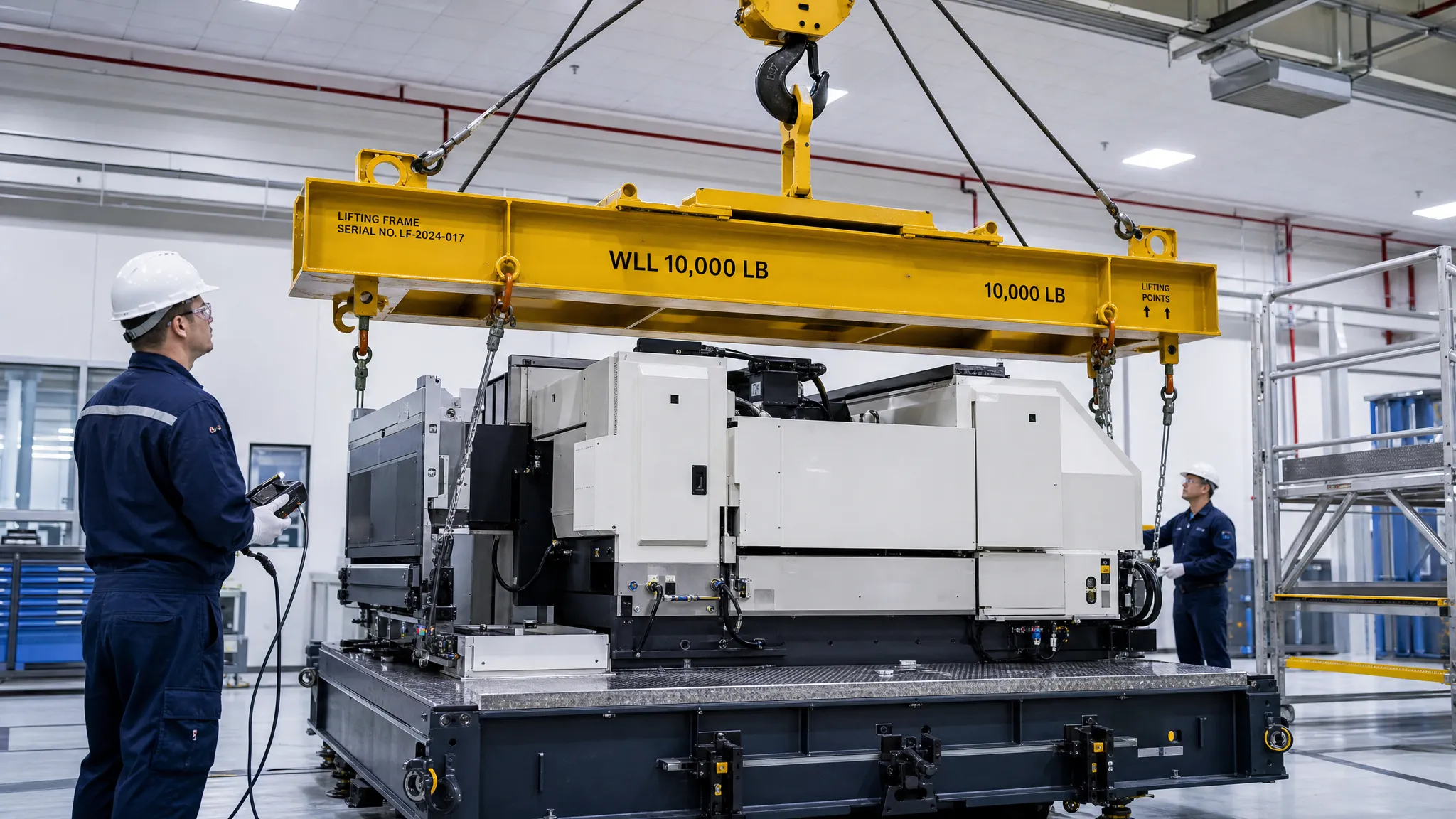
For companies with safety-critical lifting tools already in use, periodic inspection and testing are central to availability. Wear, deformation, corrosion, damaged threads or small cracks can develop over years of intensive use. Visual inspection, overload testing where applicable, clear reporting and practical usage advice help determine whether a tool can remain in service, requires repair or should be taken out of use.
BKL is accredited according to ISO 17020:2012 for inspections and supports clients with visual inspections, overload testing, examinations, reports and usage advice. For operations teams, that means the lifecycle of a tool does not end after delivery. Its safe and reliable use must be supported throughout production, maintenance and future modifications.
Bespoke does not always mean fully custom from scratch
One common concern is that a bespoke approach automatically means a large, expensive engineering project. That is not always the case. Sometimes the best solution is a complete new tool. In other cases, a partial improvement, a custom adapter, an updated interface, a revised instruction set or an inspection and repair plan may be sufficient.
The right scope depends on risk, frequency of use, asset value, operator exposure and the consequences of downtime. For example, a tool used daily in a production line may justify more ergonomic refinement and integrated safety features than a tool used occasionally under tightly controlled conditions. A lifting accessory for a sensitive high-value module may justify more detailed interface engineering than a simple support tool for a robust component.
This is why early technical discussion matters. Engineering, operations, maintenance, safety and procurement should align on the real objective. Is the priority to improve operator safety, reduce handling time, comply with updated requirements, replace obsolete tooling, support a new machine configuration or improve inspection traceability? Each objective can lead to a different design decision.
For teams evaluating whether a custom tool is needed, it helps to compare the actual lifting task with the available standard solutions. If standard equipment can meet the load case, access constraints, ergonomics, documentation and inspection requirements, it may be the most sensible option. If not, bespoke engineering becomes a risk-control measure rather than a luxury.
Engineering, production and inspection should stay connected
A lifting solution is only as strong as the connection between design intent and real use. Calculations, drawings and risk assessments are important, but they must be translated into manufacturing quality, correct assembly, clear documentation and practical inspection criteria.
This is where working with one technical partner can reduce coordination risk. When engineering, manufacturing, inspections and service are disconnected, valuable information can be lost between suppliers. A design detail that looks minor on paper may be essential for safe load transfer. A maintenance finding may indicate that the original operating environment has changed. An inspection report may reveal a pattern that should feed back into a design update.
BKL combines mechanical and mechatronic engineering with production, inspection and service support. For clients, this can be useful when a project requires both technical design capability and practical knowledge of how lifting and handling tools are manufactured, tested, used and maintained.
This integrated view is particularly relevant for OEMs and companies in high-tech, semicon and optical industries, where tools must often be robust, accurate and easy to operate. It also supports clear technical documentation, such as calculations, manuals, test reports and technical files needed for conformity assessment and safe use.
European machinery requirements also continue to place strong emphasis on risk assessment, instructions and technical documentation. The Machinery Directive 2006/42/EC remains relevant for machinery placed on the EU market today, while Regulation (EU) 2023/1230 will become applicable from January 2027. Companies should not treat CE-related work as a label at the end of a project. It is a structured process that must be reflected in design choices, documentation and verification.
For a broader look at safe working practices with custom equipment, the principles in how to work safe with custom lifting equipment provide a useful complement to the engineering and lifecycle perspective discussed here.
Decision criteria for choosing a bespoke lifting partner
When selecting a partner for bespoke lifting solutions, price and delivery time matter, but they should not be evaluated in isolation. A low initial price can become expensive if the tool is difficult to use, hard to inspect, poorly documented or unsuitable for the real working environment.
A stronger evaluation looks at technical capability, safety process, production quality and lifecycle support together.
| Decision factor | What to look for | Practical value |
|---|---|---|
| Engineering capability | Mechanical and, where needed, mechatronic expertise linked to real handling tasks. | Better control of load paths, interfaces and failure modes. |
| Safety-driven design process | Risk assessment and usability considered from the first concept phase. | Safer, more practical operation for employees. |
| Manufacturing knowledge | Ability to produce small-scale or complex series with attention to critical details. | Design intent is more likely to be maintained in the finished tool. |
| Inspection competence | Visual checks, testing, reporting and clear usage advice. | Supports continued safe use and tooling availability. |
| Documentation quality | Calculations, manuals, test reports and technical files where applicable. | Helps engineering, safety and operations teams make informed decisions. |
| Lifecycle support | Service, repair, reassessment and feedback from use. | Reduces uncertainty when tools age, change or need to remain available. |
For C-level and management teams, the business case should include more than the purchase cost. Consider the cost of downtime, damaged assets, operator injuries, delayed commissioning, repeated manual handling and uncertainty during audits or inspections. A bespoke lifting tool that reduces those risks can create value throughout its lifecycle.
Making safety and uptime part of the same design brief
Safety and uptime are sometimes treated as competing goals. In well-engineered lifting solutions, they should support each other. A tool that is stable, intuitive, inspectable and matched to the real task can reduce delays as well as risk. A tool that is difficult to use safely will eventually affect productivity, even if it appears cheaper at the start.
The most effective projects start with a clear brief: what must be lifted, how often, by whom, in which environment and under which constraints? From there, the engineering team can determine whether the answer is a standard solution, a modified tool, a new bespoke lifting solution, an inspection programme or a combination of services.
BKL supports clients with engineering, production, inspections and related services for hoisting and lifting tools, industrial modules and machines. That broad scope helps companies address the complete lifecycle of safety-critical equipment, from concept and design to manufacturing, inspection, service and future improvement.
FAQ's about bespoke lifting solutions:
When should a company consider bespoke lifting solutions? A bespoke solution is worth considering when standard lifting equipment does not adequately fit the load, access constraints, centre of gravity, operator task, documentation needs or risk profile. It is especially relevant for high-value, sensitive or complex industrial equipment.
Do bespoke lifting tools always replace standard lifting equipment? No. Standard equipment is often the right choice when it meets the technical and safety requirements. Bespoke engineering is most valuable when the real application introduces risks or inefficiencies that standard products cannot adequately control.
How do bespoke lifting solutions improve uptime? They can reduce set-up time, make handling steps more repeatable, lower the risk of damage during lifting and support faster decision-making through clear documentation, inspection reports and usage advice.
What role do inspections and load tests play after delivery? Inspections and applicable testing help determine whether lifting equipment remains suitable for use over time. They can identify wear, deformation, damage or other findings that require repair, further examination or removal from service.
Is CE compliance only relevant at the end of the project? No. CE-related requirements and conformity assessment should be considered throughout the design and documentation process. Risk assessment, instructions, technical files and verification activities should reflect the intended use of the machine or tool.
Can BKL support only part of a project? Yes. BKL can support individual process steps as well as complete solutions, including engineering, manufacturing, inspections and service. The right scope depends on the technical challenge, risk level and lifecycle needs.
Improve lifting safety without compromising availability
If your current lifting or handling process depends on improvised steps, unclear tooling status or equipment that no longer fits the real working environment, it may be time to reassess the solution.
BKL helps OEMs, high-tech manufacturers, machine builders and industrial companies develop, manufacture, inspect and maintain safer, smarter lifting and handling tools. By combining mechanical and mechatronic engineering with practical production and inspection expertise, BKL supports solutions that are safe to use, efficient to operate and easier to manage throughout their lifecycle.
Discuss your lifting challenge with BKL and explore whether a bespoke solution, inspection, improvement or lifecycle support plan is the right next step.