
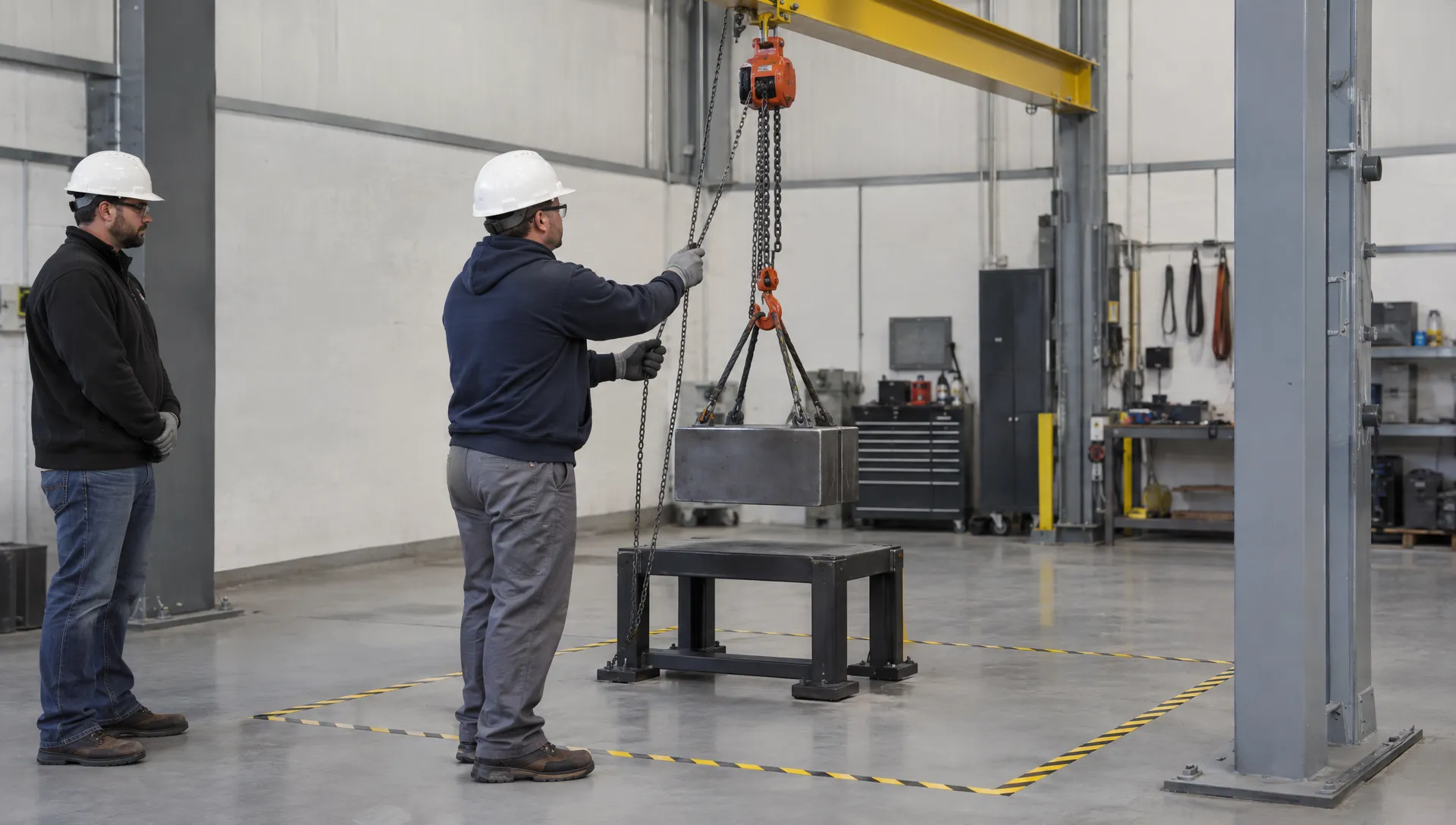
Brake performance in a manual chain hoist cannot be judged simply by whether the equipment raises a load. The brake must hold the suspended load when operation stops and control its descent during lowering. A hoist that lifts normally but creeps downward, lowers unpredictably or requires unusual effort should be removed from service until its condition has been assessed.
For OEMs and high-tech manufacturers, this matters during module installation, maintenance and handling of valuable equipment. A short movement can damage an interface or expose an operator to a trapping hazard, even when the load is well below the hoist’s rated capacity.
A defensible assessment combines manufacturer-defined checks, controlled observations and traceable inspection evidence. It also separates routine operator checks from examinations and load tests that require competent personnel, suitable facilities and an approved procedure.
What a manual chain hoist brake must do
Many hand chain-operated hoists use a mechanical load brake with friction components and a ratchet-and-pawl arrangement. The exact construction varies, so the manufacturer’s instructions must determine how the brake is inspected, maintained and tested.
During operation, the brake must support three distinct functions:
- Holding: The suspended load remains stationary after the operator stops pulling the hand chain.
- Controlled lowering: Descent responds predictably to deliberate hand-chain operation, without uncontrolled acceleration.
- Stopping: When lowering input stops, the brake arrests movement and holds the load as specified by the manufacturer.
These functions need separate attention. Successful lifting does not establish that lowering is controlled, and a satisfactory unloaded check does not demonstrate performance under load.
Some models specify a minimum operating load or particular conditions for brake testing. A very light load is therefore not automatically a suitable test condition. Equally, testing at rated capacity is not something an operator should improvise during a pre-use check.
Establish the assessment conditions first
Before assessing a manual chain hoist, identify its manufacturer, model, serial number, rated capacity and applicable instructions. If identification or essential documentation is missing, resolve that uncertainty before proceeding with a loaded assessment.
The assessment must cover the complete load path, not only the brake. The suspension point, supporting structure, hooks, chains, lifting accessories and load attachment must be suitable for the planned forces and configuration. BKL’s guidance on hoist hook rejection criteria addresses one important part of that wider check.
Establish an exclusion zone and a controlled recovery arrangement before suspending a test load. Nobody should stand beneath the load or enter a trapping zone to observe movement. Use a known test mass or an engineered test arrangement appropriate to the approved procedure, rather than valuable production equipment.
For installation work involving bulky products such as hot tubs and saunas from Hearthside Supply, retail dimensions and shipping weights are only planning inputs. They do not establish approved lifting points or make the product suitable as a brake-test load.
Also check that the hoist is aligned as intended. Side loading, twisted chain or an unsuitable attachment can distort the observations and introduce separate hazards.
Assess holding through a controlled functional check
A pre-use functional check of a manual chain hoist should follow its instructions and the site’s lifting procedure. It is not a substitute for a scheduled examination or a formal load test.
Observe lifting and stopping
Where the manufacturer permits a loaded pre-use check, take up tension and make only the minimal lift needed above a suitable support. Avoid shock loading and keep the load within the planned test conditions.
Stop pulling the hand chain and observe whether the load remains held. Use a fixed reference outside the hazard zone if small movements would otherwise be difficult to identify. An observer must not approach the suspended load to measure movement by hand.
Distinguish continuing downward movement from initial seating of lifting accessories, removal of slack or elastic deflection of the supporting structure. However, do not dismiss unexplained movement as normal settling. If its source cannot be established safely, stop the assessment and refer the equipment for inspection.
The observation period and acceptance criteria must come from the applicable procedure. There is no universal holding time or acceptable creep distance that can be applied to every model.
Observe lowering and stopping
For a manual chain hoist, controlled lowering is as important as static holding. Lower the test load only through the normal operating method described by the manufacturer, within the planned travel and exclusion zone.
Watch for abrupt acceleration, repeated jerking, inconsistent response or movement that continues after hand-chain operation stops. Changes in operating effort can also be relevant, particularly when they differ from the documented behavior of a serviceable unit.
Noise alone is not a reliable diagnosis. Ratchet sounds may be normal for a particular design, while grinding or a new irregular sound warrants investigation. Interpret sound together with movement, operating effort and the manufacturer’s guidance.
Do not deliberately induce free running, disconnect brake components or restrain the hand chain to compensate for suspected brake failure. If the load becomes uncontrolled, keep people clear and activate the site’s emergency procedure. Recovery must follow a competent-person plan, not an improvised attempt to catch or restrain the load.
Interpret warning signs without inventing tolerances
Assessing a manual chain hoist requires clear decisions about what an observation proves. A symptom may indicate a brake problem, but it does not necessarily identify the failed component.
| Observation | Possible significance | Appropriate response |
|---|---|---|
| Progressive downward movement after stopping | The holding function is not satisfactory | Stop use and arrange competent inspection |
| Descent accelerates unexpectedly | Lowering control may be compromised | Stop the assessment and secure the situation under the recovery procedure |
| Jerky lowering or changing effort | Possible brake, chain, gearing or alignment problem | Investigate before further use |
| Grinding or a new abnormal sound | Possible internal damage or interference | Remove from service pending assessment |
| Unexplained movement at the hook | Could originate in the brake, rigging or supporting structure | Establish the source before accepting the equipment |
| Successful unloaded operation only | Loaded brake performance remains unverified | Complete the manufacturer-required checks before use |
Do not create local tolerances such as “a few millimeters of creep is acceptable” unless they are supported by the applicable instructions and assessment procedure. Measurement resolution must also be adequate for the acceptance criteria being used.
When a defect is suspected, first recover and support the load safely. Then isolate and identify the hoist so it cannot be returned to use accidentally. A warning label without effective control of access is insufficient.
Investigate internal condition through competent inspection
A manual chain hoist that fails a functional check needs more than repeated lifting attempts. Repetition can expose personnel and equipment to the same unresolved hazard without producing useful diagnostic evidence.
Depending on the design, brake problems can involve worn friction components, contamination, corrosion, damaged ratchet teeth, defective pawls or springs, incorrect assembly or unsuitable replacement parts. Problems elsewhere in the mechanism can produce similar symptoms.
Internal inspection and dismantling should be performed by personnel competent for that equipment, using the manufacturer’s service instructions. An operator’s pre-use check should not involve opening the brake assembly.
Lubrication requires particular care. Some parts need specified lubrication, while friction surfaces generally must remain free from oil and grease unless the manufacturer explicitly specifies otherwise. Applying lubricant indiscriminately can compromise braking rather than improve it.
Inspection should compare relevant components against documented rejection limits. Depending on the component and instructions, this may involve dimensions, surface condition, engagement or other specified checks. Adjustments intended merely to hide a symptom are not an acceptable repair.
For cleanroom handling equipment, also assess contamination control and compatibility with the environment. A cover or cleaning process must not obstruct operation, conceal damage or introduce substances that affect the brake.
Record evidence and control return to service
After repair or examination, a manual chain hoist should return to service only when the specified verification has been completed and the responsible person has authorized release.
The record should identify the equipment, reason for assessment, procedure used, test conditions, observations, defects, corrective actions and result. Include the test-load identity and mass where relevant, along with the identification and calibration status of measuring equipment when required.
“Brake checked, okay” provides little evidence for a safety manager or maintenance team. A useful record explains which functions were assessed and against which criteria.
For example, a report can distinguish loaded holding, controlled lowering and stopping observations from internal component inspection. These are different forms of evidence and should not be presented as interchangeable.
Post-repair verification must follow the applicable manufacturer instructions and inspection requirements. Overload or proof testing is not a routine troubleshooting method and must not be improvised. Where such testing is required, it needs a defined purpose, appropriate facilities and a competent assessment of the complete load path.
This documentation also supports lifecycle decisions. Repeated faults, repair costs, spare-parts availability and production interruptions may justify replacement even when another repair is technically possible.
Set inspection intervals around actual use
Inspection planning for a manual chain hoist should reflect duty, environment, manufacturer requirements and applicable national rules. Calendar intervals alone do not capture every reason for reassessment.
Intensive use, corrosive conditions, contamination, abnormal loading, damage, repairs or a change in application can justify additional inspection. Operator checks, maintenance and formal examination have different purposes. The UK Health and Safety Executive’s guidance on thorough examination of lifting equipment explains that distinction within the UK regulatory framework; its requirements should not be treated as universal rules for other countries.
For high-tech production, plan examination and maintenance around tooling availability. Suitable replacement equipment, traceable records and accessible spare parts can reduce disruption without extending inspection intervals beyond justified limits.
If the hoist repeatedly presents awkward operation or poor positioning control, reassess the application rather than only the brake. BKL’s discussion of hoisting risks that standard equipment can overlook is relevant when restricted access, sensitive interfaces or unusual load geometry require a different handling arrangement.
Keep inspection and conformity assessment separate
For European applications, relevant references may include EN 13157 for hand-powered lifting equipment, alongside applicable product legislation and national requirements for equipment use. The correct standards, editions and legal obligations depend on the equipment and application.
The EU Machinery Regulation (EU) 2023/1230 generally applies from January 20, 2027. An in-service brake check does not by itself establish CE conformity or certify a complete lifting system. Modifications and integration into custom equipment require their own assessment of responsibilities and conformity obligations.
FAQ's about brake performance in a manual chain hoist:
Does lifting the rated load prove that the brake is safe? No. Lifting, holding and controlled lowering are separate functions. Verification must follow the manufacturer’s instructions and applicable assessment requirements. A rated-load test must not be improvised.
Is any downward movement acceptable after stopping? Progressive downward movement is a warning sign. Initial seating or structural deflection may have another cause, but unexplained movement must be investigated rather than accepted through an invented tolerance.
Can an unloaded check detect every brake defect? No. It can reveal some operational problems, but it does not establish performance under load. Some models also specify minimum-load conditions for operation or testing.
Should brake friction surfaces be lubricated? Only if the manufacturer explicitly requires it. Unspecified oil or grease on friction surfaces can compromise brake performance. Follow component-specific service instructions.
Does every failed check mean the hoist must be replaced? Not necessarily. Competent inspection may identify a repairable defect. Replacement becomes appropriate when condition, parts availability, verification requirements or lifecycle costs make continued service unsuitable.
Discuss the assessment scope with BKL
If a manual chain hoist shows uncertain holding or lowering behavior, arrange a competent assessment before further use. Share the model, capacity, operating environment, observed symptoms and available service records so the scope can be defined efficiently.
BKL combines mechanical and mechatronic engineering with production, assembly, installation, inspection and maintenance support. The requirement may be a focused inspection, a repair assessment or an improvement to the surrounding lifting arrangement. Custom engineering is useful where standard equipment cannot meet the application, but it is not necessary for every brake concern.
Contact BKL to discuss your lifting application and request an appointment or quotation for the relevant engineering, inspection or lifecycle service. Agree the test scope, documentation and any applicable certification requirements before work begins.