
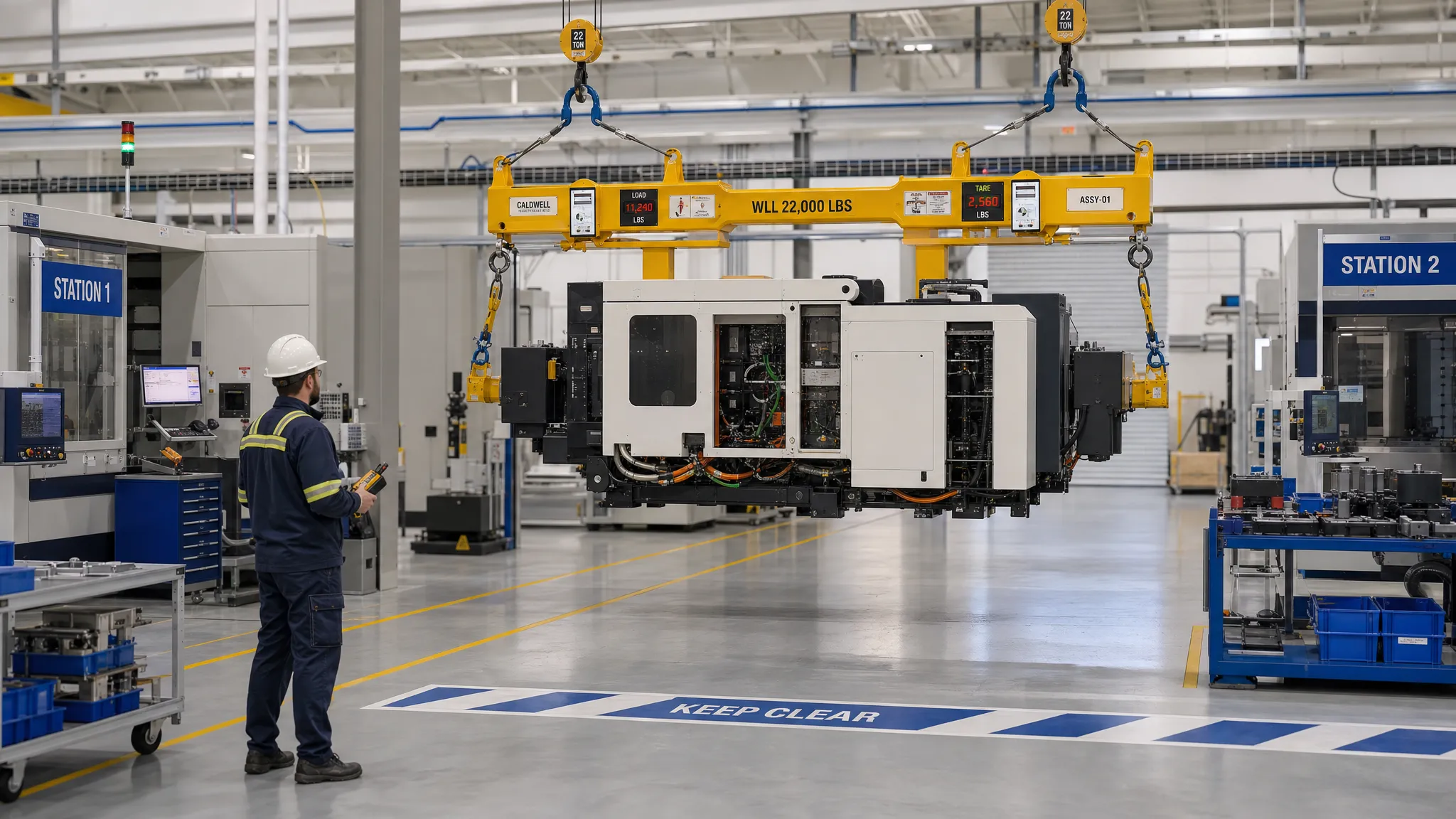
Complex industrial environments make every lift a systems problem. The load may be heavy, valuable, unstable, contamination-sensitive or difficult to access. The lifting route may cross production areas, cleanroom boundaries, transport zones or maintenance platforms. Operators may need to work close to the load, sometimes with limited visibility and tight clearances.
In this context, improving hoisting safety is not only a matter of buying a stronger crane or adding another checklist. It requires engineering decisions that connect load behavior, lifting equipment, operator usability, documentation, inspection, maintenance and the real conditions on the shop floor.
For OEMs, machine builders, high-tech manufacturers and industrial production teams, the practical goal is clear: lift, handle, transport, install and maintain equipment in a controlled way, without creating unnecessary risk for employees or unnecessary downtime for production.
Why hoisting safety becomes harder in complex environments
A standard lift is rarely the biggest challenge. Risk increases when the lifting task includes uncertainty, repetition, high-value equipment, tight space or multiple interfaces between tools, machines and transport systems.
A hoisting operation can become complex when the center of gravity is not obvious, when the load has fragile or precision-aligned components, when lifting points are not directly accessible or when the load must be rotated, tilted or guided into position. In high-tech, semiconductor, optical, aerospace and advanced manufacturing environments, these factors are common.
| Situation | Safety concern | Practical control |
|---|---|---|
| Unknown or shifting center of gravity | Load tilting, uncontrolled movement or overloaded lifting points | Calculate and verify mass properties before designing the lift |
| Low headroom or limited access | Operators may work too close to suspended loads | Use dedicated handling tools, guides or low-profile lifting solutions |
| Fragile or high-value equipment | Damage may occur before visible failure is noticed | Design interfaces that support the load at approved points |
| Repeated production lifting | Small usability issues become daily safety risks | Engineer for ergonomic, repeatable and clearly defined operation |
| Older lifting tools | Wear, cracks or deformation may be missed | Use periodic inspections, test reports and lifecycle records |
| Multiple suppliers involved | Gaps can appear between design, use, inspection and maintenance | Assign clear technical ownership and documentation responsibility |
The main lesson is that hoisting safety should be addressed before the equipment reaches the operator. If the lifting method is unclear, unstable or difficult to use, the operator is forced to compensate in the moment. Good engineering reduces that dependency.
1. Define the lifting task before choosing the lifting tool
A safe lifting solution starts with a complete description of the task. This sounds basic, but many safety problems originate from incomplete assumptions during early specification. A crane, hoist, spreader beam, lifting frame or custom tool can only be suitable when the actual use case is understood.
A practical lifting specification should clarify the load, the route, the working environment and the human interaction. For example, the same machine module may need different handling methods during production, internal transport, installation at the customer site and maintenance after several years of use.
A sound hoisting plan should define:
- Load mass, including tolerances, fluids, tooling, packaging and optional components
- Center of gravity, including whether it can shift during movement
- Approved lifting points and any restrictions from the machine or module design
- Lifting route, including clearances, turning points, floor conditions and overhead obstacles
- Required orientation changes, such as tilting, rotating or vertical insertion
- Operator position, visibility and distance from the suspended load
- Environmental conditions, such as cleanroom requirements, temperature, contamination control or outdoor use
- Inspection, storage and maintenance requirements for the lifting equipment itself
This information helps engineering teams decide whether a standard lifting accessory is sufficient, whether an existing tool can be modified or inspected, or whether a dedicated hoisting and handling solution is justified.
2. Engineer the lift around a stable load path
The load path is the route through which forces travel from the load into the lifting tool, hoist, crane and supporting structure. In a safe lifting design, that path is predictable, documented and suitable for the full range of expected use.
In practice, this means that the engineer should not only calculate the maximum load. The design must also consider eccentric loading, dynamic effects, sling angles, bending moments, locking mechanisms, tolerances and the effect of operator handling. A lifting frame that looks robust may still be unsafe if the load can rotate unexpectedly or if one lifting point receives a disproportionate share of the force.
Center of gravity and load stability
A complex load should be assessed for mass distribution before the lifting method is finalized. If the center of gravity is offset, the lifting tool may need an adjustable pick-up point, a balancing device or a dedicated frame that keeps the load in the required orientation.
For precision machinery and high-value modules, stability is also about protecting alignment and sensitive components. The safest solution is often the one that prevents unintended movement rather than relying on operators to correct it manually.
Interfaces between tool and load
The interface is where many lifting risks begin. Lifting eyes, pins, clamps, adapters, hooks and brackets must be designed for the actual load case. They must also be easy to connect correctly. If there are multiple similar connection points, the design should reduce the chance of incorrect attachment through geometry, labeling or clear physical constraints.
For custom lifting tools, the interface should match the product design and maintenance context. A lifting point that is safe during factory assembly may not be accessible after covers, cables or auxiliary systems are installed. This is why early cooperation between product engineering, tooling engineering, production and service teams is valuable.
Controlled movement during lifting and positioning
Many incidents occur not during the vertical lift itself, but during guiding, positioning, rotating or lowering. These phases often require fine control. Mechanical guides, end stops, alignment features, controlled actuators or mechatronic assistance can reduce the need for manual force near the load.
Where powered movement is used, safety functions must be evaluated in relation to the risk. This can include speed limitation, load holding, emergency stop behavior, prevention of unintended movement and safe recovery after a power loss.
3. Make the safest method the easiest method
Hoisting safety depends strongly on usability. A technically correct tool can still create risk if it is difficult to understand, awkward to connect, heavy to position or unclear during inspection. Operators work under production pressure, often in repetitive routines. The design should support correct behavior naturally.
Good lifting equipment makes the intended use obvious. Labels should be readable, attachment points should be logical and controls should match the sequence of operation. If a tool has several configurations, the status should be visible. If a locking pin must be fully engaged before lifting, the operator should receive a clear visual or mechanical confirmation.
Ergonomics also matters. If a lifting beam or adapter is difficult to maneuver into position, employees may improvise. If a tool requires hands near pinch points, the design should be reviewed. If the operator cannot see the load path, the handling method may need additional guidance, cameras, spotters or a different layout.
In safety-critical environments, user-friendly design is not a comfort feature. It is a control measure.
4. Treat CE and product safety as engineering inputs
For equipment placed on the EU market, machinery and lifting accessories may fall under product safety legislation. In 2026, the Machinery Directive 2006/42/EC remains central for many applications, while the Machinery Regulation (EU) 2023/1230 is already relevant for future planning and will apply from January 2027. The exact route depends on the equipment, intended use and responsibility within the supply chain.
Compliance should not be treated as paperwork at the end of the project. The risk assessment, design decisions, calculations, drawings, test results, manuals and technical file are connected. If a hazard is identified during the risk assessment, it should influence the design or the instructions for safe use.
Common technical references for lifting and machine safety can include standards such as ISO 12100 for risk assessment and risk reduction, EN 13155 for non-fixed load lifting attachments, and safety-related control standards where powered or automated functions are involved. The applicable standards should always be selected for the specific equipment and use case.
Documentation that supports safer use often includes:
- Risk assessment and risk reduction measures
- Design calculations and load assumptions
- Drawings, bills of materials and critical component specifications
- Test reports, including load or overload testing where appropriate
- User instructions, inspection instructions and maintenance guidance
- Marking, capacity information and configuration limits
- Technical file and conformity documentation where applicable
The objective is not simply to satisfy a formal requirement. Clear documentation helps engineering, operations, maintenance and safety teams understand how the tool is intended to be used and what limits must not be exceeded.
5. Control the whole handling chain, not only the vertical lift
A lifting operation rarely starts and ends with the hoist. Loads are prepared, connected, raised, transported, staged, rotated, lowered, installed and sometimes stored for later use. Each transition creates an opportunity for risk if responsibility or documentation is unclear.
For example, a machine module may be lifted from an assembly jig, placed on a transport frame, moved by forklift or AGV, stored temporarily, then lifted again during installation. The lifting tool may be safe in isolation, but the complete process can still introduce hazards if the transport frame, floor conditions, packaging or storage method are not considered.
For international projects or temporary site setups, storage and transport equipment may also become part of the handling plan. If containers are used as temporary storage, mobile workspaces or logistics interfaces, sourcing from reputable suppliers of premium shipping containers should be combined with a technical check of condition, ratings, access, securing methods and whether the container itself is intended to be lifted in the planned configuration.
The key point is simple: do not assume that every object in the logistics chain is suitable as a lifting accessory. Lifting points, frames, containers, pallets, skids and fixtures must be assessed for their intended use, condition and load path.
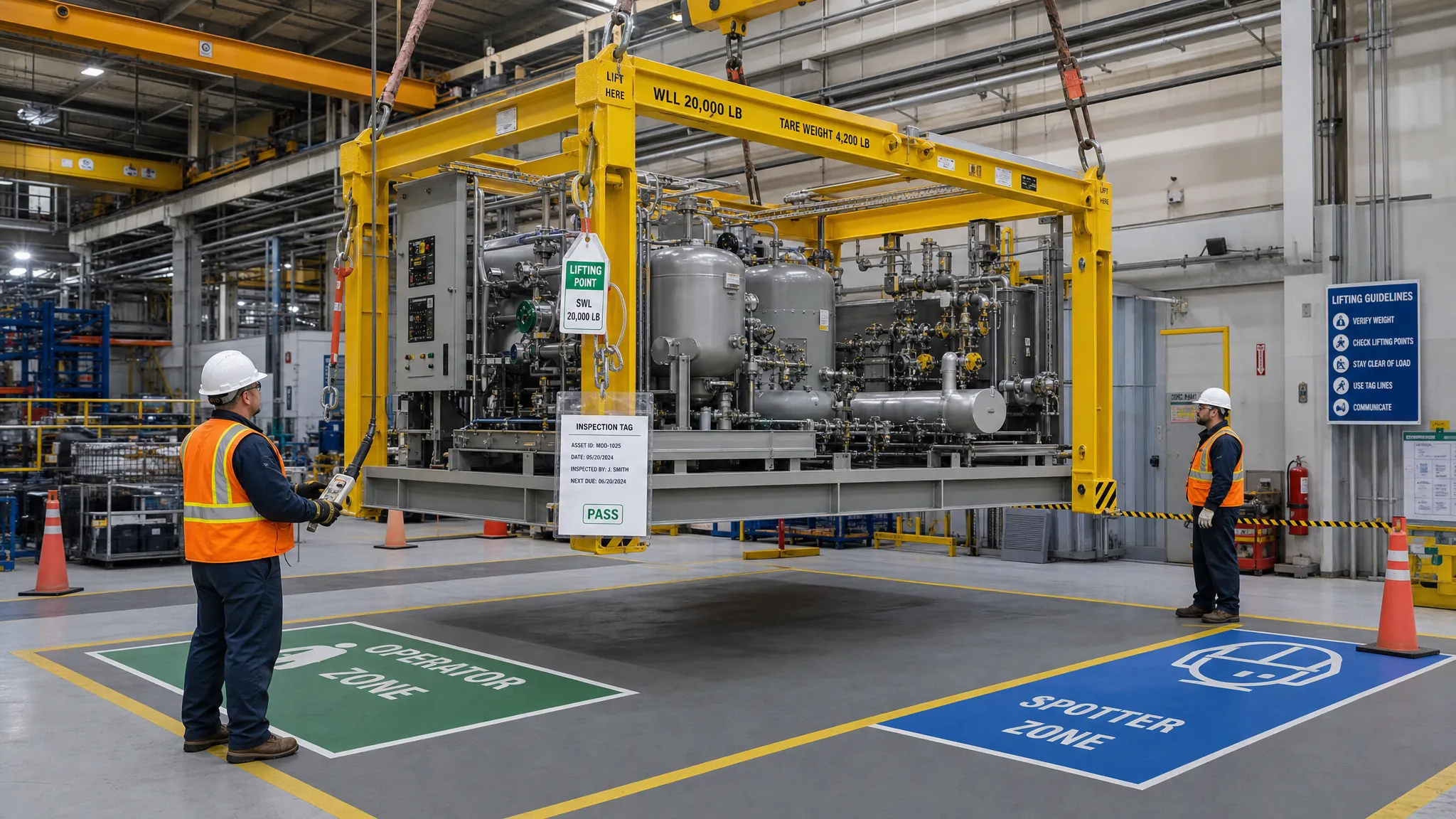
6. Use inspection, testing and maintenance as lifecycle controls
Hoisting safety changes over time. Even a well-designed lifting tool can become unsafe through wear, damage, corrosion, deformation, incorrect storage, undocumented modification or repeated overload. This is especially important for equipment used in production, transport, installation and maintenance over many years.
Periodic inspection should be risk-based and practical. The inspection interval depends on use intensity, environment, manufacturer guidance, applicable rules and the consequences of failure. A lifting tool used daily in a demanding production environment may need a different inspection approach than a rarely used tool stored under controlled conditions.
Visual inspection is important, but it is not always enough. Depending on the equipment and risk, inspection may include dimensional checks, functional checks, crack detection methods, examination of welds and fasteners, and load or overload testing. The output should not only be a pass or fail result. A useful inspection report gives clear findings, practical usage advice and traceability for future decisions.
BKL is accredited according to ISO 17020:2012 for inspections and supports visual inspections, testing, reporting and usage advice for hoisting and lifting tools. That matters because custom lifting equipment often requires more than a generic inspection checklist. The inspector must understand how the tool was designed to function and how it is actually used.
| Lifecycle stage | Hoisting safety focus | Typical output |
|---|---|---|
| Concept and engineering | Identify hazards and define the intended use | Risk assessment, design concept and load assumptions |
| Manufacturing and assembly | Build according to drawings and critical specifications | Production records, checks and controlled assembly |
| Initial testing | Verify function and load capacity where required | Test report, marking and release documentation |
| Daily or pre-use check | Detect visible damage before operation | Operator checklist and removal from service if needed |
| Periodic inspection | Confirm continued safe condition | Inspection report, advice and next inspection date |
| Repair or modification | Control changes that affect safety | Engineering review, updated documentation and retesting if needed |
| End-of-life decision | Avoid continued use of unsafe tooling | Replacement, refurbishment or disposal recommendation |
This lifecycle view helps avoid a common problem: equipment that was safe when delivered, but no longer has a reliable safety case after years of undocumented use.
7. Build a shared hoisting safety routine across departments
Hoisting safety is not owned by one department. Engineering defines the technical solution. Production uses it under real conditions. Maintenance keeps it available. Safety teams evaluate risk. Procurement selects suppliers. Management sets priorities and resources.
If these groups work separately, gaps appear. A tool may be purchased based on price without enough attention to lifecycle inspection. A design may meet the calculation but be difficult to use. A maintenance team may repair a tool without updated drawings. Operators may discover practical issues that never reach engineering.
A stronger routine connects these roles through clear ownership and feedback. Operators should be able to report usability problems before they become unsafe workarounds. Maintenance should know when a repair requires engineering review. Procurement should compare not only purchase price, but also documentation, inspection support, spare parts, repairability and total lifecycle cost.
For management, this is where safety and efficiency meet. Well-engineered lifting tools reduce uncertainty, improve repeatability and help keep production moving. They do not eliminate every risk, but they make risk easier to understand, control and monitor.
8. Know when a custom lifting solution is justified
Not every application needs a custom-made lifting tool. Standard certified equipment may be suitable when the load is simple, the lifting points are approved, the route is clear and the risk level is well understood. In those cases, the focus should be on correct selection, inspection, user instruction and documentation.
A custom solution becomes more relevant when the load geometry is unusual, the center of gravity is difficult, the working space is constrained, the load is sensitive to damage, or the operation must be repeated frequently with high precision. Custom tooling can also be valuable when the operator needs better ergonomics, when installation requires controlled movement or when multiple handling steps must be combined safely.
The best custom tools are not necessarily the most complex. A simple dedicated adapter, alignment feature or lifting frame can sometimes remove more risk than an over-engineered system. The question should always be: what technical measure makes the intended safe method reliable, repeatable and easy to follow?
How BKL supports safer hoisting and lifting applications
BKL works as a technical service provider in mechanics and mechatronics, with a strong focus on safer, smarter industrial solutions. For hoisting and lifting applications, that means support can start at concept development and continue through engineering, manufacturing, inspection, testing, service and lifecycle support.
This broader view is useful for companies that need more than a drawing or a one-time inspection. A lifting tool must be designed for the load, manufactured accurately, documented clearly, inspected correctly and maintained in a way that keeps it available for production. BKL can support individual process steps or provide a more complete solution, depending on the project and internal capacity of the customer.
For OEMs, high-tech companies, semiconductor equipment manufacturers, aerospace suppliers and industrial manufacturers, the value lies in combining practical engineering with safety-focused execution. The result is not only a tool that can lift a load, but a controlled handling solution that fits the working environment, the operator and the lifecycle of the equipment.
FAQ's about hoisting safety in complex industrial environments:
What is hoisting safety in an industrial environment? Hoisting safety is the controlled management of risks during lifting, handling, moving, positioning and lowering loads. It includes equipment design, load calculations, operator instructions, inspection, maintenance, documentation and the surrounding work process.
How often should lifting equipment be inspected? Inspection frequency depends on the type of equipment, use intensity, working environment, manufacturer guidance, applicable regulations and risk assessment. Equipment used frequently or in demanding conditions usually requires closer monitoring than equipment used rarely and stored under controlled conditions.
Is overload testing always required for lifting tools? Not always. Load or overload testing depends on the equipment type, applicable standards, company procedures, inspection findings, repairs, modifications and legal context. Where testing is appropriate, it should be planned and documented by competent specialists.
Can standard lifting equipment be sufficient for complex industrial work? Yes, if it is suitable for the load, route, environment and intended use. A custom solution is mainly justified when standard equipment cannot control the risks adequately or cannot support safe, repeatable and practical operation.
What documentation supports safer hoisting operations? Useful documentation includes a risk assessment, design calculations, drawings, instructions for use, inspection and maintenance guidance, test reports, capacity markings and conformity documentation where applicable. This information helps teams understand the limits and correct use of the equipment.
How can BKL help improve hoisting safety? BKL can support engineering, manufacturing, inspection, testing, maintenance and lifecycle services for hoisting and lifting tools, modules and machines. The team can help with partial tasks or complete solutions, depending on the technical challenge and customer requirements.
Improve hoisting safety with engineering that fits the real working environment
If your team is developing a new lifting tool, reviewing existing hoisting equipment or facing a complex handling challenge, the safest next step is to evaluate the complete process. That includes the load, operator, route, documentation, inspection status and lifecycle requirements.
BKL supports companies with safety-focused engineering, production, inspection and service for hoisting and lifting tools, industrial modules and machines. To discuss a specific application or explore how your existing tooling can be improved, contact BKL through www.bkl.nl.