
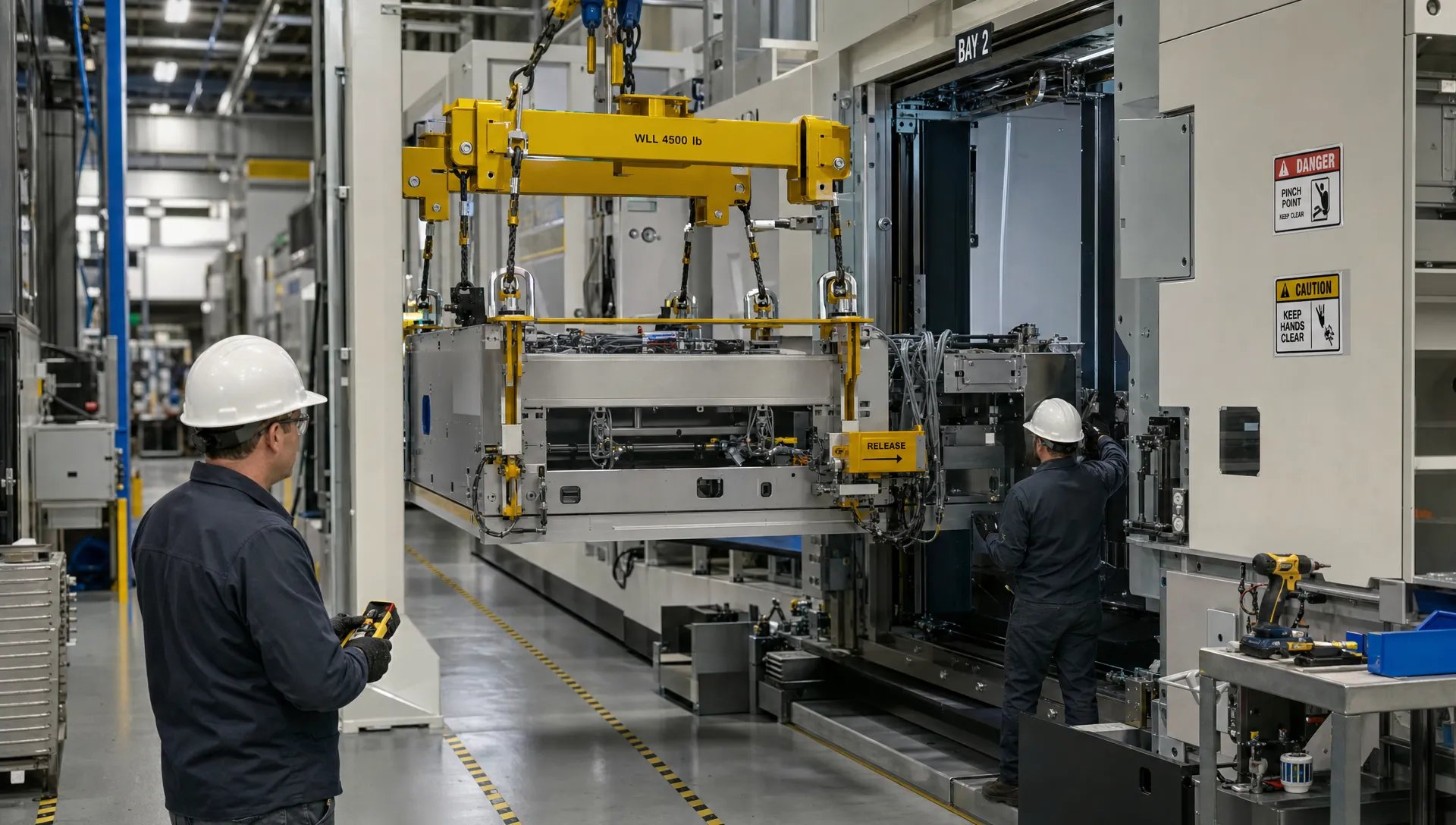
A standard equipment hoist is often the right choice when the load is predictable, the lifting path is open and the operating conditions are well understood. But in high-tech manufacturing, aerospace, semiconductor equipment production and other safety-critical environments, the task is not always that simple.
An equipment hoist may need to move a valuable module through a narrow service opening, keep a fragile assembly level within a small tolerance or interface with a machine frame that was never designed for standard lifting hardware. In those cases, the question is not only “Can it lift the weight?” The more important question is: Can it lift, handle, position and release the equipment safely and repeatably in the real working environment?
That is where a custom engineering approach becomes relevant. Not as a preference for complexity, but as a practical way to control risk, improve usability and support reliable operation throughout the tool’s lifecycle.
Standard equipment hoists are not the problem
A custom solution is not automatically better than a standard one. Many lifting tasks can be handled safely with certified standard hoists, lifting beams, slings, spreaders, trolleys or lifting accessories, provided they are selected correctly and used within their intended limits.
A standard equipment hoist may be sufficient when the load has clearly defined lifting points, the center of gravity is stable, there is enough space around the load and operators can work without awkward movements. In these cases, the focus should be on correct selection, operator instructions, inspection intervals and safe working procedures.
If your team is still in the selection phase, BKL’s article on how to select lifting and hoisting equipment wisely explains how to evaluate the lifting task, load path, usability and lifecycle requirements before committing to a solution.
The need for custom engineering usually appears when the standard solution no longer fits the technical, safety or operational context. This may be caused by the shape of the load, the value of the equipment, the available workspace, the required precision or the consequences of failure.
When an equipment hoist needs more than load capacity
Load capacity is only one part of a safe lifting solution. It tells you whether the hoist is rated for a certain mass, but it does not answer whether the complete handling method is stable, ergonomic, repeatable or suitable for the environment.
A custom engineering approach becomes important when several risk factors come together. The table below shows common triggers and the type of engineering response they often require.
| Trigger in the lifting task | Practical risk | Engineering response |
|---|---|---|
| The center of gravity is offset or uncertain | Load tilt, rotation or uncontrolled movement | Defined lifting geometry, balancing features and validated load path |
| The equipment is fragile, high-value or contamination-sensitive | Damage to components, optics, frames or interfaces | Controlled contact points, protective supports and precise positioning aids |
| The work area has limited clearance | Collision risk during lifting, transport or installation | Compact tool design, guided motion and verified access envelopes |
| Operators must repeat the lift frequently | Fatigue, inconsistent handling and process variation | User-friendly controls, ergonomic access and repeatable positioning features |
| The hoist must interface with a machine, module or transport fixture | Poor fit, side loading or unsafe improvisation | Engineered interfaces, locking features and documented usage instructions |
| Existing lifting equipment has been modified or repurposed | Unknown safety margin or unclear compliance status | Inspection, reassessment, documentation update and possible redesign |
In complex environments, these factors are rarely isolated. A semiconductor module, for example, may be heavy, expensive, sensitive to misalignment and installed in a confined machine area. A general-purpose hoist can lift it, but may not control how the module behaves during the most critical part of the operation.
The load path should be engineered, not improvised
The load path is the route through which forces travel from the equipment being lifted, through the lifting points and tool structure, into the hoist and supporting structure. If that path is unclear, operators may compensate with experience, extra straps, manual guidance or improvised positioning. That may work once, but it is not a robust industrial process.
Custom engineering defines the load path before the tool is built. This includes assessing the lifting points, expected load cases, dynamic effects, potential side loads and the conditions during lifting, transport, positioning and release. Depending on the application, this may involve mechanical calculations, 3D design, physical testing, overload testing and documented verification.
For safety-critical tools, the design should also consider what happens if the operation does not go exactly as planned. Can the load be secured before final release? Are pinch points reduced? Can operators keep a safe position? Is the safest method also the easiest method to follow?
These questions are especially important when the same equipment hoist is used by different operators, across shifts or over many years. A solution that depends heavily on individual experience is more vulnerable than a tool that guides the correct behavior by design.
Custom engineering is also about usability
In industrial lifting, poor usability can become a safety issue. If a tool is difficult to connect, hard to align or uncomfortable to operate, people may look for shortcuts. A custom equipment hoist should therefore be engineered around the real task, not only around the theoretical load.
Usability considerations include operator reach, visibility, connection time, access for hands and tools, control layout, locking feedback and the sequence of actions. A lifting device that provides clear engagement, stable movement and intuitive release can reduce uncertainty during critical handling steps.
This is where mechanics and mechatronics often meet. A mechanical lifting frame may need sensors, interlocks or controlled motion. A machine module may need a handling interface that supports both production and maintenance. A service tool may need to be compact enough for tight spaces, but robust enough for repeated use.
BKL approaches these challenges as a technical service provider in mechanics and mechatronics. The work can include engineering, production, inspections and service support, depending on what the client needs. Sometimes the best answer is a complete custom solution. In other cases, the right contribution is a design review, a practical improvement, a manufactured subassembly or an inspection of existing tooling.
Compliance should be considered from the first concept
For equipment hoists, lifting tools and related machines used in Europe, safety and conformity cannot be treated as final paperwork. Requirements related to machinery safety, risk assessment, technical documentation, instructions and verification influence design decisions from the beginning.
This does not mean every project has the same conformity route. A manually operated lifting accessory, a powered hoisting tool, a machine-integrated handling module and a service fixture can have different requirements and responsibilities. The exact approach depends on the intended use, configuration, control system, interfaces and applicable legislation.
A sound engineering process helps create the evidence needed to support safe use. This may include design calculations, risk assessment input, drawings, material information, test reports, inspection records, user instructions and maintenance advice. Documentation is not only useful for audits. It also helps operators, maintenance teams and safety managers understand the limits and correct use of the equipment.
BKL can support manufacturers with product safety, risk assessment, CE-related documentation and conformity assessment activities. This support should not be seen as a legal guarantee, but as practical engineering assistance to help clients structure the process and build a technically defensible file.
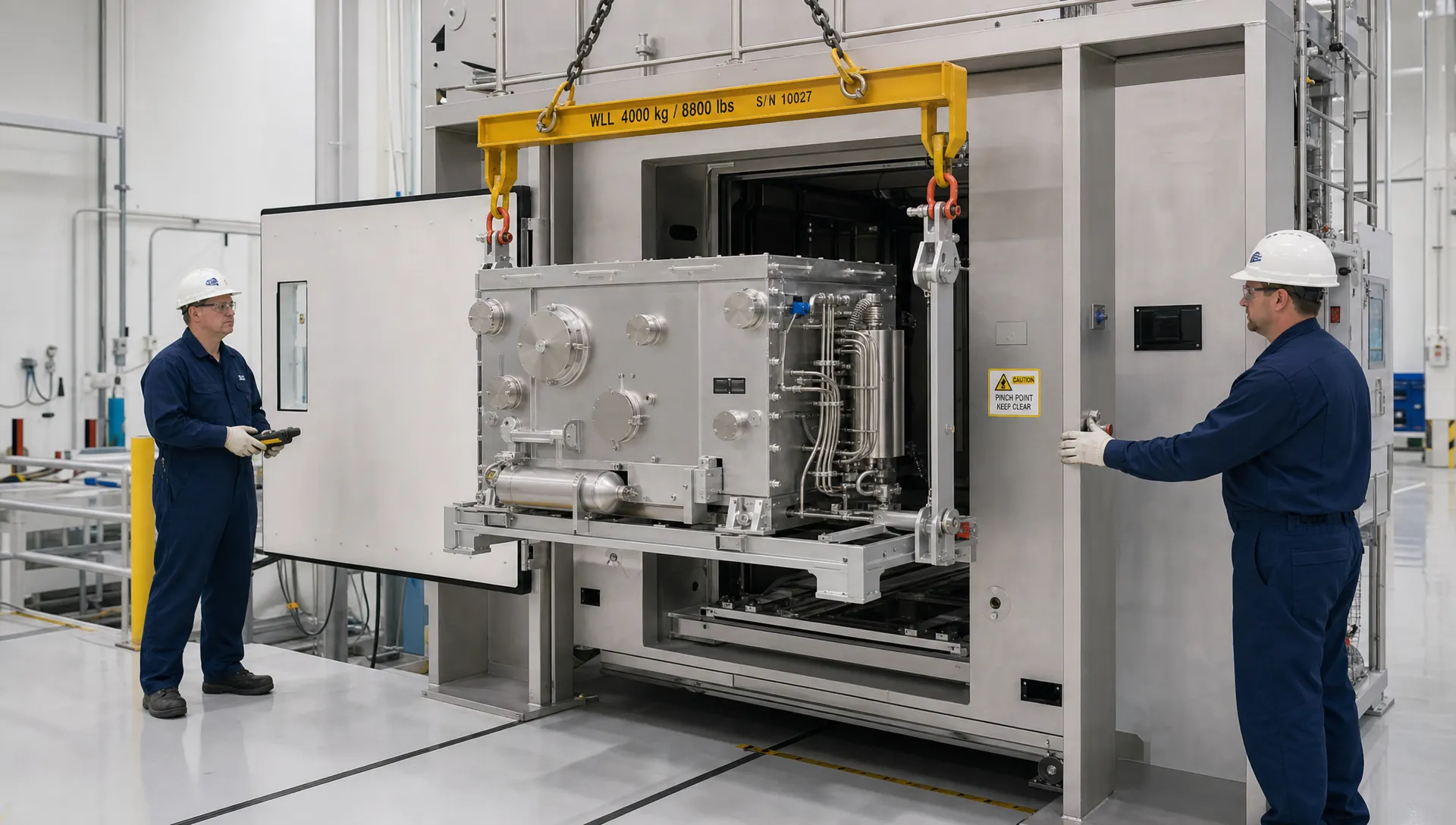
Inspection and lifecycle support matter after delivery
A custom equipment hoist does not stop being safety-critical after the first successful lift. Wear, overloads, collisions, changes in use and environmental conditions can affect the condition of the tool over time. For high-value or frequently used lifting equipment, lifecycle support is part of the safety strategy.
Periodic inspections can help detect visible damage, deformation, wear, cracks, missing markings or incorrect use. Load testing and examination may be required depending on the type of equipment, use intensity and internal safety policy. The value of inspection is strongest when the inspector understands the original design intent and the actual working environment.
BKL is accredited according to ISO 17020:2012 for inspections and can provide visual inspections, overload testing, examinations, reports and usage advice. This is particularly relevant for custom lifting tools, where a generic checklist may not capture all application-specific risks.
Inspection timing also matters. If equipment has been overloaded, dropped, modified, involved in an incident or used outside its original scope, waiting for the next planned inspection may not be appropriate. BKL’s article on when lifting equipment inspections should not be delayed explains the practical triggers that should prompt earlier reassessment.
When a custom approach may not be necessary
A custom engineering approach has clear value in complex lifting tasks, but it is not always the right first step. If a certified standard hoist can be used within its limits, with clear instructions and suitable inspection planning, that may be the most efficient and reliable solution.
The decision should be based on risk, not preference. A standard solution may be sufficient when the load is simple, the environment is open, the frequency is low and the consequences of minor positioning variation are acceptable. A partial engineering service may also be enough, such as validating lifting points, designing an adapter, reviewing the load path or producing clear instructions for an existing tool.
This is important for procurement and engineering teams. Custom does not have to mean a large project by default. The aim is to close the gap between the task and the available equipment. Sometimes that gap is small. Sometimes it affects safety, compliance, uptime and product quality.
Building the business case for a custom equipment hoist
The cost of a custom equipment hoist should not be compared only with the purchase price of a standard hoist. The better comparison is total risk and total lifecycle cost. For safety-critical handling, the business case may include reduced product damage risk, fewer improvised handling steps, faster installation, less operator strain, improved repeatability, clearer documentation and better maintainability.
For OEMs and machine builders, the case may also include customer confidence. If equipment must be installed, serviced or transported safely, the lifting and handling method becomes part of the product experience. A well-engineered hoist or tool can make maintenance easier and reduce uncertainty for field teams.
For operations and maintenance managers, availability is often the deciding factor. A tool that is difficult to inspect, repair or reproduce can become a bottleneck. Engineering choices such as accessible wear parts, robust interfaces, clear markings and documented test procedures can support continuity.
Project control also matters. Engineering, production, inspection and financial administration all need traceability. In the same way that companies may use centralized online invoicing and company management tools to keep financial records organized, technical teams should keep lifting calculations, test results, inspection reports and usage instructions structured and accessible throughout the lifecycle of the equipment.
A practical engineering process for custom hoisting equipment
A reliable process starts with understanding the real use case. The engineering team should not only ask for the load weight, but also how the equipment is handled before, during and after the lift. This includes transport, storage, connection, operator position, service access, release sequence and inspection needs.
From there, the concept can be developed around the required load path, stability, interfaces and usability. Design reviews should challenge the assumptions behind the tool. What if the operator connects the tool in the wrong order? What if the load is slightly misaligned? What if the tool is used after years of intensive service?
Manufacturing quality is equally important. A sound design can still fail to deliver value if production tolerances, welding quality, material selection or assembly details are not controlled. For small-scale and complex series, the connection between engineering and manufacturing can reduce interpretation errors and improve consistency.
Before release for use, the tool should be verified against the defined requirements. This may include dimensional checks, functional testing, load testing, documentation review and clear handover information. For custom lifting equipment, operators should understand not only how to use the tool, but also what the tool is not intended to do.
For a deeper look at safe use practices after design and delivery, see BKL’s guide on how to work safe with custom lifting equipment.
Where BKL adds value
BKL supports companies that need safer, smarter industrial solutions for lifting, handling, production, installation and maintenance. The team combines mechanical and mechatronic engineering with manufacturing, inspection and service capabilities. That combination is valuable when an equipment hoist needs to be more than a purchased component.
For high-tech, semiconductor, optical, aerospace and industrial manufacturing environments, BKL can help define the task, engineer the solution, produce the tool, support documentation and provide lifecycle services. The scope can be partial or complete, depending on the client’s internal capacity and project requirements.
The strongest results usually come when safety is addressed early. If lifting points, operator access, load stability and inspection needs are considered during the concept phase, the final tool is more likely to fit the work process. If those questions are delayed until after equipment has already been built, teams may be forced into compromises.
FAQ's about custom engineering for an equipment hoist:
When does an equipment hoist need custom engineering? An equipment hoist needs custom engineering when standard equipment does not adequately control the load path, stability, positioning, operator safety or interface with the equipment being handled. This often occurs with high-value modules, limited access, offset centers of gravity or repeated precision lifting tasks.
Is a custom equipment hoist always safer than a standard hoist? Not automatically. A standard hoist can be safe when it is correctly selected, inspected and used within its intended limits. Custom engineering is valuable when the lifting task creates risks that standard equipment cannot address effectively.
What information is needed before designing a custom hoisting solution? Useful input includes load weight, center of gravity, lifting points, available space, required movement path, operating frequency, environmental conditions, operator access, interface details, inspection requirements and applicable documentation needs.
How does documentation support safer lifting? Documentation gives operators, maintenance teams and safety managers clear information about intended use, limits, inspection requirements, test results and maintenance advice. It also supports traceability when equipment is inspected, repaired, modified or reassessed.
Can existing lifting equipment be adapted instead of replaced? Sometimes, yes. Existing equipment may be improved with engineered adapters, revised instructions, inspection, testing or documentation updates. However, any modification should be assessed carefully because changes can affect load paths, safety margins and conformity responsibilities.
If your equipment hoist is being used in a complex, high-value or safety-critical application, the best time to evaluate the engineering approach is before operators need to compensate for limitations in the tool. BKL can help assess the lifting task, define practical risks and develop a solution that supports safer use, efficient operation and reliable lifecycle management. To discuss a project or existing tool, contact BKL.