
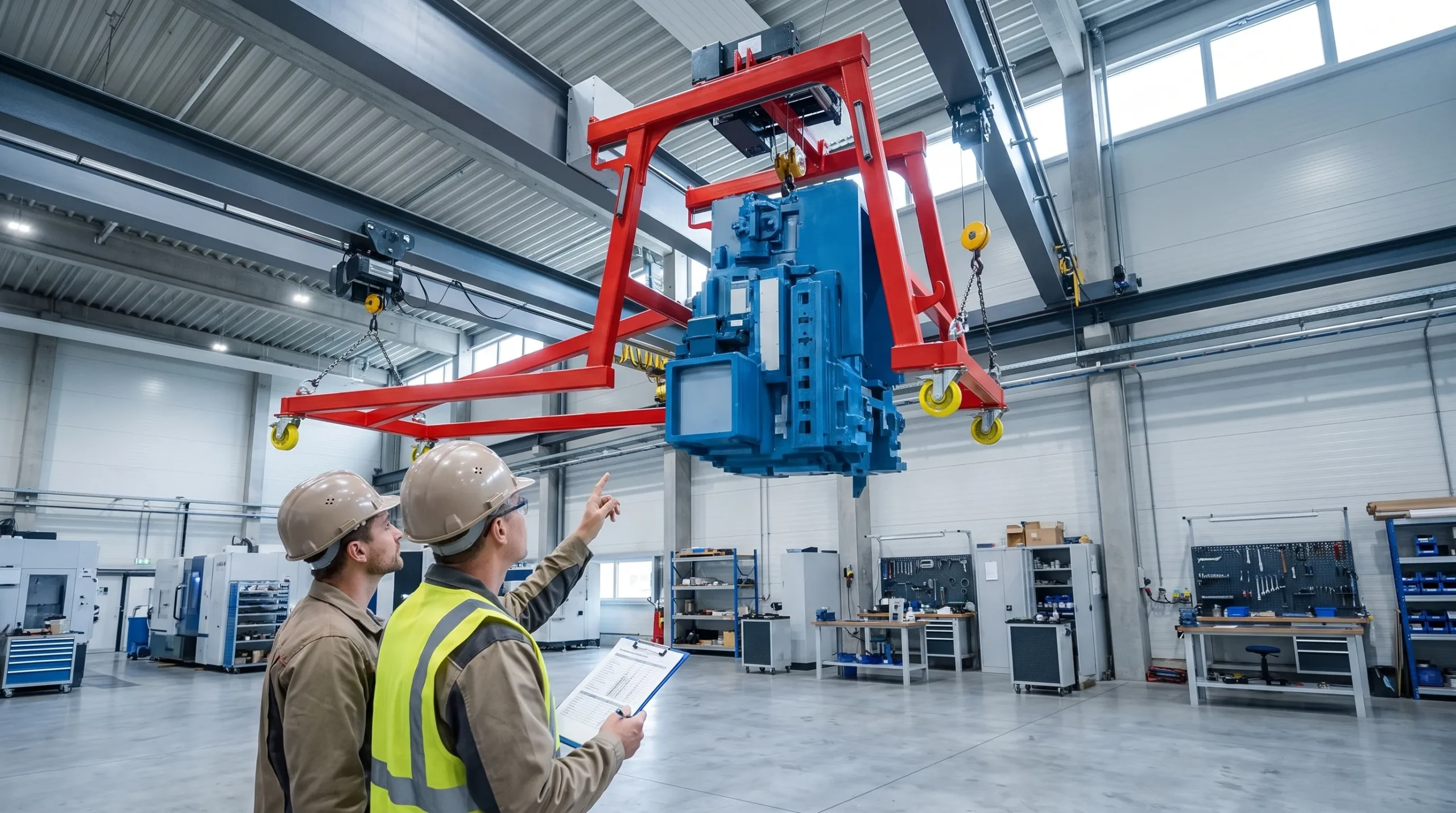
A bridge crane is often treated as fixed plant infrastructure. It is above the production floor, it has a rated capacity and it may have been in service for years. That familiarity can hide an operational risk: when the crane is unavailable, the work below it may also stop.
For OEMs, first-tier suppliers and high-tech manufacturers, bridge crane uptime is rarely a convenience issue. A stopped crane can delay module assembly, tool changeovers, maintenance interventions, cleanroom logistics or the handling of high-value equipment. At the same time, continuing to use a crane with unknown defects creates unacceptable safety and business risks.
Effective bridge crane safety checks sit between these two pressures. They are not just compliance tasks and they should not be reduced to a box-ticking exercise. Used properly, they help maintenance, operations and safety teams identify early warning signs, plan corrective work and keep critical lifting operations available in a controlled way.
The goal is not to inspect more than necessary. The goal is to use the right checks at the right moments, with clear acceptance criteria, practical documentation and follow-up actions that support safe uptime.
Bridge crane safety is part of uptime engineering
A bridge crane is a system, not a single component. The hoist, trolley, bridge, runway, end stops, electrical supply, controls, brakes, limit switches, load-bearing structure and below-the-hook lifting tools all influence whether a lift can be performed safely.
This is why uptime depends on more than an annual inspection. Periodic technical inspections remain essential, but many failures begin between planned inspection moments. Operators may notice a changed sound, a slight hook latch issue, a control delay or a longer stopping distance before a defect becomes visible to the wider organization.
A good safety check structure combines operator observations, maintenance checks and independent technical inspection where appropriate. It also links findings to decisions: continue using, monitor, repair during a planned window or take the crane out of service until the risk is resolved.
For a broader view of inspection value across tools and machines, BKL has also explained how a technical inspection company supports safer uptime in industrial environments.
Where bridge crane downtime often begins
Bridge crane downtime does not normally begin as a dramatic failure. It often starts with small changes in condition or behavior that are easy to normalize during busy production.
A wire rope may show localized wear. A hook may have a latch that no longer closes correctly. A brake may still hold the load, but with a different response than before. A runway rail may show abnormal wear patterns. A pendant or radio control may respond inconsistently. None of these findings should automatically trigger the same response, but each deserves attention because it can affect both safe operation and availability.
High-tech environments add extra pressure. Loads may be expensive, sensitive to shock or contamination, difficult to replace or part of a tightly scheduled production flow. A small lifting problem can therefore become a production issue, a quality issue and a safety issue at the same time.
The most useful inspections focus on early detection. They look for wear, deformation, cracks, corrosion, loosened fasteners, control faults and documentation gaps before they escalate. This principle is covered in more depth in BKL's article on what safety inspections reveal before failures escalate.
A practical bridge crane safety check structure
Inspection intervals and methods should be based on the crane type, manufacturer instructions, local regulations, intensity of use, environment, load criticality and previous findings. A crane used occasionally for low-risk maintenance work needs a different approach than a crane used daily for precision handling in a high-tech assembly area.
The following structure can help engineering, safety and maintenance teams organize checks without turning every observation into an unplanned stoppage.
| Check level | Typical purpose | Typical responsibility | Uptime value |
|---|---|---|---|
| Pre-use check | Identify visible damage, abnormal behavior or unsafe conditions before operation | Trained operator | Prevents unsafe lifts and catches obvious defects early |
| Functional check | Verify controls, travel movement, brakes, limit switches and abnormal sounds | Operator or maintenance team | Detects performance changes before they become failures |
| Periodic technical inspection | Assess structural, mechanical, electrical and safety-related condition against defined criteria | Competent inspector or specialist inspection partner | Supports compliance, documentation and planned maintenance |
| Event-based inspection | Check the crane after overload, collision, modification, relocation or changed use | Technical specialist or competent inspector | Reduces risk of returning damaged equipment to service |
| Post-repair verification | Confirm that repaired or replaced parts perform as intended | Maintenance team, specialist or inspector | Helps return equipment to production with confidence |
This structure only works when the organization defines what happens after a finding. A defect that affects load control requires a different response than cosmetic paint damage. Clear criteria prevent both unsafe continuation and unnecessary downtime.
Core checks that influence both safety and availability
A bridge crane safety check should cover the components that carry, control and guide the load. The level of detail differs between daily use and a formal technical inspection, but the logic is the same: identify anything that could affect the crane's ability to lift, travel, stop and hold the load safely.
Key check areas include:
- Hoist, wire rope or chain: Look for wear, broken wires, corrosion, kinks, poor reeving, damaged chain links, lubrication issues and irregular winding on the drum.
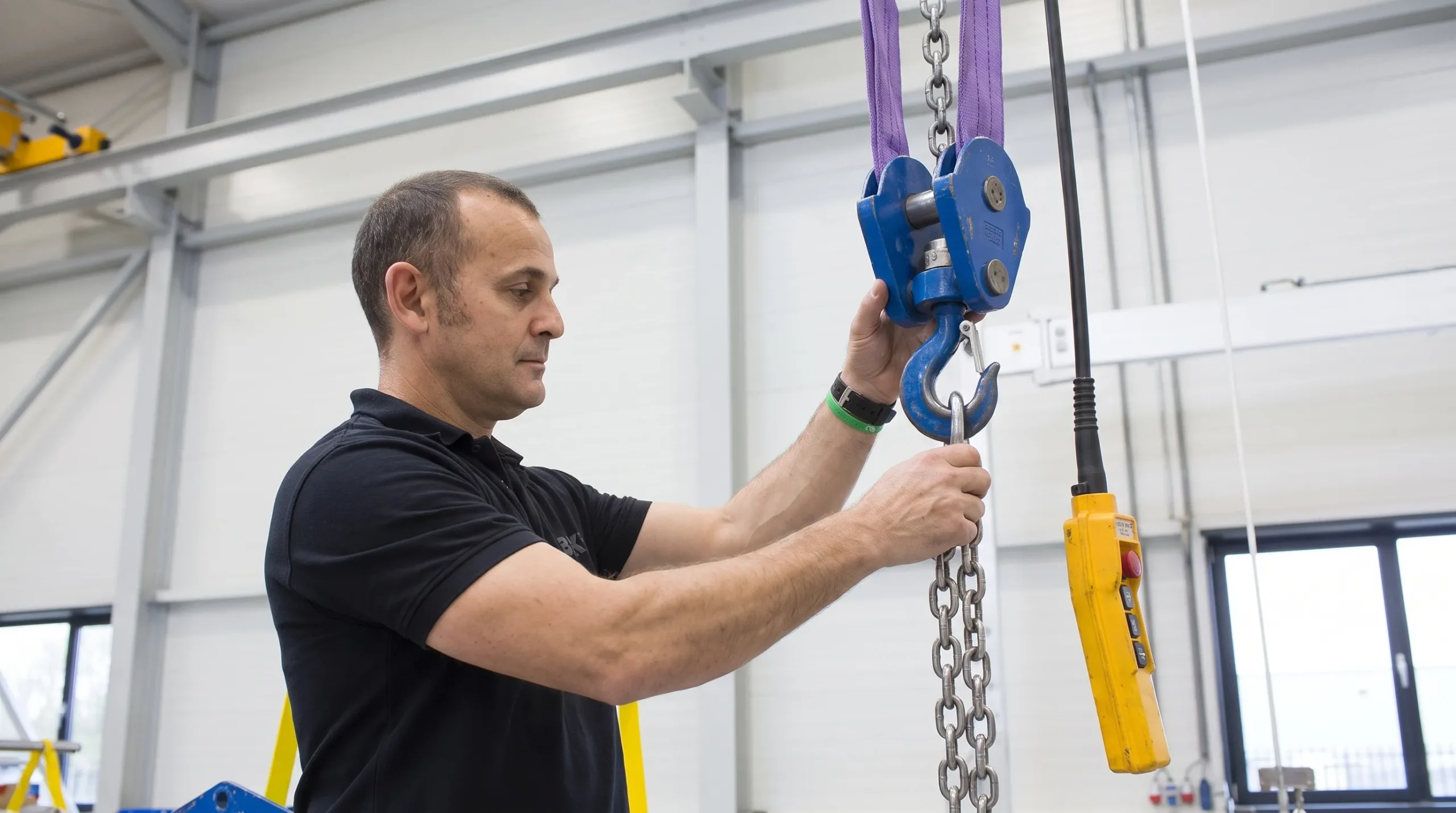
- Hook and hook block: Check the hook throat opening, deformation, cracks, swivel function, safety latch, markings and signs of impact or heat damage.
- Brakes and load holding: Verify that the load can be stopped and held without drift, unusual delay, vibration or unexpected movement.
- Limit switches and safety functions: Confirm that upper and lower limits, travel limits and emergency stop functions operate as intended.
- Bridge and trolley movement: Listen for abnormal noise, check smooth travel, observe skewing and look for signs of wheel, rail or drive wear.
- Runway, rails and end stops: Inspect rails, connections, alignment indicators, buffers, end stops and the surrounding structure where accessible.
- Controls and electrical supply: Check pendant controls, radio controls, cable festoons, power rails, warning devices, labeling and response consistency.
- Below-the-hook equipment: Include lifting beams, spreader beams, lifting adapters, slings and special lifting tools used with the bridge crane.
The last point is often underestimated. A bridge crane with a valid inspection can still be part of an unsafe lift if the lifting adapter, lifting beam or load connection is unsuitable for the real load case.
Additional attention points for OEM and high-tech lifting tasks
In semiconductor, medical technology, aerospace, energy, optical and analytical equipment environments, the crane is often only one part of a larger handling concept. The load may have a sensitive surface, limited lifting points, an offset center of gravity or strict cleanliness requirements. The available working area may be restricted by surrounding machines, mezzanines, cleanroom ceilings or maintenance platforms.
In these cases, the bridge crane safety check should not stop at the crane. It should also consider whether the lifting method still fits the current process. Production layouts change, products evolve and maintenance tasks are sometimes added after the original crane was selected. A setup that was acceptable for an earlier load may no longer be suitable for a heavier, more sensitive or more complex module.
A standard crane and standard accessories may be sufficient when the load is simple, the load path is clear and the lifting points are designed for the task. Custom engineering becomes relevant when standard catalogue equipment cannot provide the required fit, stability, ergonomics, cleanliness, access or risk control.
For example, a bridge crane may need to work with a custom lifting adapter that keeps a high-value module level during installation. A spreader beam may need to prevent side loading on delicate lifting points. A cleanroom handling tool may need surfaces, materials and operating methods that suit the production environment. In those cases, safe uptime depends on the complete lifting system, not only on the crane's rated capacity.
BKL covers this broader design perspective in its article on how bespoke lifting solutions improve safety and uptime.
From findings to uptime actions
A safety check only supports uptime when the findings lead to practical decisions. Reports that simply list defects without prioritization can leave operations, safety and maintenance teams uncertain about the next step.
Useful inspection output should make the risk and action clear. It should distinguish between immediate safety concerns, planned corrective maintenance, monitoring points and documentation improvements. This allows production managers to plan around the work instead of being surprised by avoidable stoppages.
| Finding category | Example | Practical response | Uptime benefit |
|---|---|---|---|
| Immediate safety concern | Brake behavior, structural deformation or damaged load-bearing component | Stop use, isolate the crane and assess before return to service | Prevents unsafe continuation and secondary damage |
| Planned repair item | Wear that is within limits but trending in the wrong direction | Schedule repair, order parts and plan downtime | Reduces emergency maintenance |
| Monitoring point | Minor abnormal noise or early wear pattern | Record condition and recheck at a defined moment | Creates evidence for maintenance planning |
| Documentation gap | Missing inspection history, unclear load data or outdated instructions | Reconstruct records and verify required information | Improves decision-making and compliance confidence |
| Process mismatch | Crane is used for a load or route not considered in the original setup | Review the lifting method and engineering controls | Reduces recurring operational risk |
Event-based checks deserve special attention. If a bridge crane has been overloaded, involved in a collision, exposed to abnormal shock loading, modified or used in a changed process, waiting for the next planned inspection may be the wrong decision. BKL discusses these triggers in more detail in the article on when lifting equipment inspections should not be delayed.
Documentation, compliance and traceability
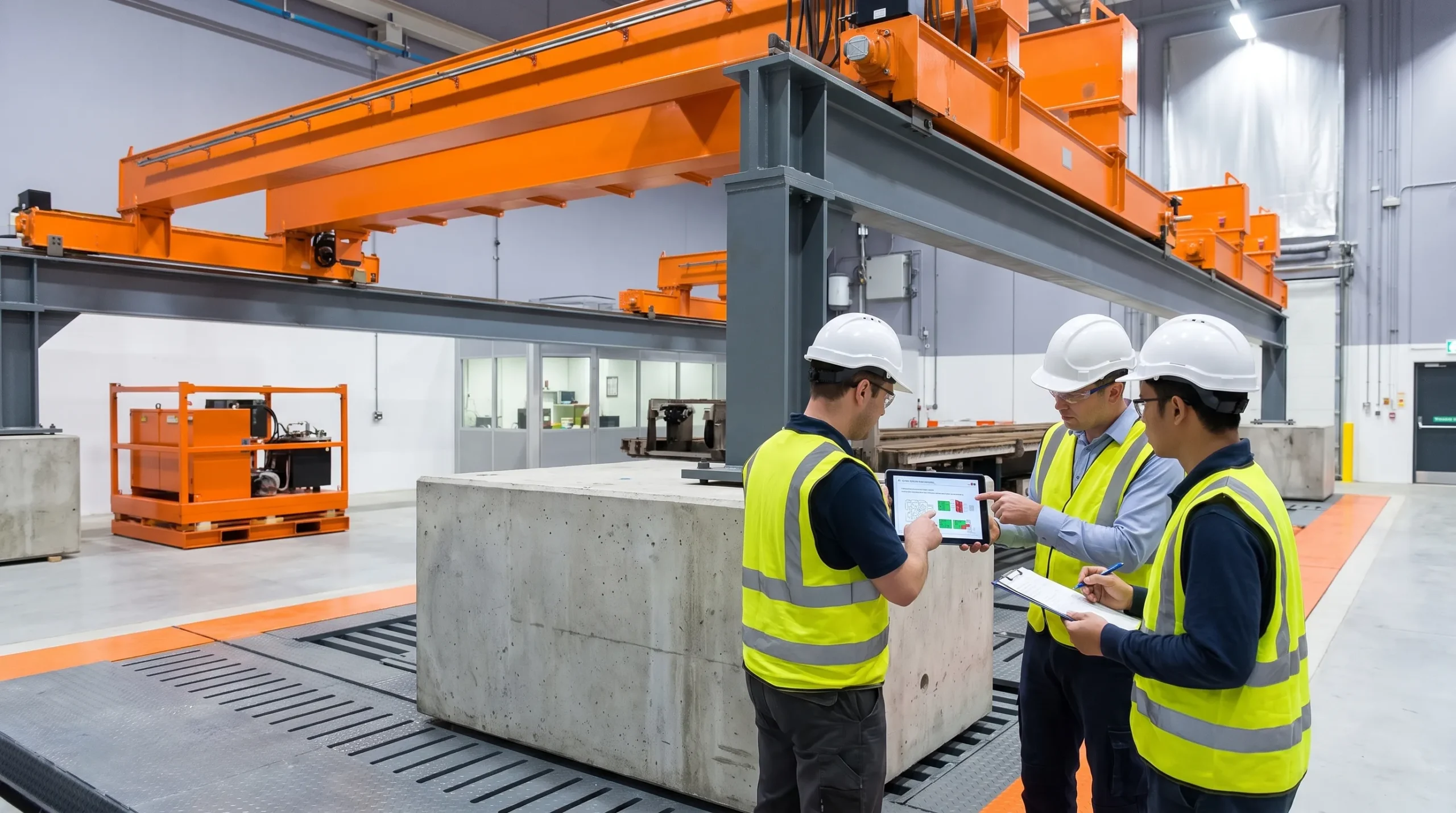
For safety-critical lifting equipment, documentation is part of the control system. Without reliable records, it becomes harder to prove what was inspected, what was repaired, what the crane is allowed to do and whether findings have been closed.
In the EU, machinery safety requirements are shaped by the current Machinery Directive 2006/42/EC and the Machinery Regulation (EU) 2023/1230, which applies from 20 January 2027. The exact obligations depend on the equipment, modification scope, role of the organization and whether machinery is being placed on the market or put into service. The European Commission's machinery legislation overview provides the official policy context.
For bridge crane owners and users, practical documentation often includes inspection reports, maintenance records, load test reports where applicable, manuals, risk assessments, repair records, usage instructions, certificates where applicable and records of modifications. The value is not only compliance. Good traceability helps maintenance teams spot recurring defects and helps operations teams understand the safe limits of the equipment.
Documentation should also be usable. A technically correct report that does not help the responsible manager decide what to do next has limited operational value. Clear findings, photos, acceptance criteria, urgency levels and practical usage advice make safety information easier to act on.
Planning checks without creating unnecessary downtime
Maintenance and inspection work can interrupt production if it is poorly planned. That is one reason some organizations postpone checks until the crane still appears to function normally. This approach can increase risk and may create larger downtime later if a defect is found at the wrong moment.
A better approach is to integrate bridge crane safety checks into production planning. Critical cranes can be mapped by function, load criticality and availability impact. Inspection windows can be coordinated with planned maintenance, product changeovers or lower-demand periods. Spare parts for known wear items can be prepared in advance. Access equipment and lockout arrangements can be organized before the inspector arrives.
The same principle applies to findings. If wear is identified early and still within acceptable limits, maintenance teams may have time to plan a repair. If the first detection happens after performance has degraded, the organization may have fewer options and a stronger chance of unplanned downtime.
For high-use cranes, trend information can be valuable. Repeated findings on the same wheel, runway section, brake component or control issue may indicate an underlying design, alignment, use or maintenance problem. In that case, solving the root cause can provide more value than repeatedly replacing the same part.
When to involve a specialist partner
Internal maintenance teams often know their equipment and production environment very well. A specialist partner adds value when the task requires independent inspection competence, load test support, mechanical or mechatronic engineering knowledge, CE and documentation support or custom lifting expertise.
This is especially relevant when the bridge crane is used with custom lifting tools, when the load is valuable or sensitive, when equipment has been modified, when defects recur or when the organization needs clear inspection reports and practical usage advice. It is also relevant when several suppliers currently handle engineering, manufacturing, installation, inspection and maintenance separately, creating extra coordination work.
BKL is a technical service provider in mechanics and mechatronics. The team supports clients with safe lifting, hoisting, handling and working-at-height solutions, including engineering, production, assembly, installation, inspections, maintenance and lifecycle services. BKL is accredited according to ISO 17020:2012 for inspections and can support visual inspections, overload testing, reports, certification where applicable and usage advice.
Because BKL also designs and manufactures lifting tools, industrial modules and machines, inspection findings can be connected to practical engineering decisions. That is useful when a crane issue is not only a maintenance defect, but part of a wider handling challenge involving ergonomics, load control, operator access, documentation and production continuity.
FAQ's about bridge crane safety checks:
How often should a bridge crane be inspected? The interval depends on manufacturer instructions, local regulations, intensity of use, environment, load criticality and previous findings. Many organizations combine pre-use checks, routine functional checks, periodic technical inspections and event-based inspections after overloads, collisions, modifications or changed use.
What should operators check before using a bridge crane? Operators should look for visible damage, abnormal sounds, control problems, hook or latch issues, warning device faults, unsafe surroundings and any sign that the crane behaves differently than expected. If something affects safe load control, the crane should not be used until the issue has been assessed.
When should a bridge crane be taken out of service? A crane should be taken out of service when a defect could affect safe lifting, travelling, stopping or load holding. Examples include brake problems, structural deformation, damaged wire rope or chain, malfunctioning controls, damaged hooks or uncertainty after an overload or collision.
Do bridge crane checks include lifting beams and custom lifting tools? They should. The crane, hoist and runway may be in acceptable condition, but the lift can still be unsafe if the below-the-hook equipment is damaged, unsuitable for the load or missing required documentation. Lifting beams, spreader beams, lifting adapters and slings should be included in the lifting safety approach.
Can safety checks improve uptime instead of reducing it? Yes, when they are planned and acted on correctly. Safety checks can reveal wear and defects early, allowing maintenance to be scheduled before failures interrupt production. The key is to connect inspection findings to clear priorities, repair planning and documentation.
Discuss your bridge crane safety checks with BKL
If your bridge crane is critical to production, maintenance or installation work, a structured safety check approach can help you manage risk without unnecessary disruption. Share the crane type, application, load characteristics, current inspection records, production constraints and any recurring issues with BKL.
BKL can help assess whether you need inspection, maintenance support, load testing, documentation review, engineering improvements or a custom lifting solution. To discuss your application or schedule an appointment, contact BKL and start with the lifting task that creates the highest operational risk.