
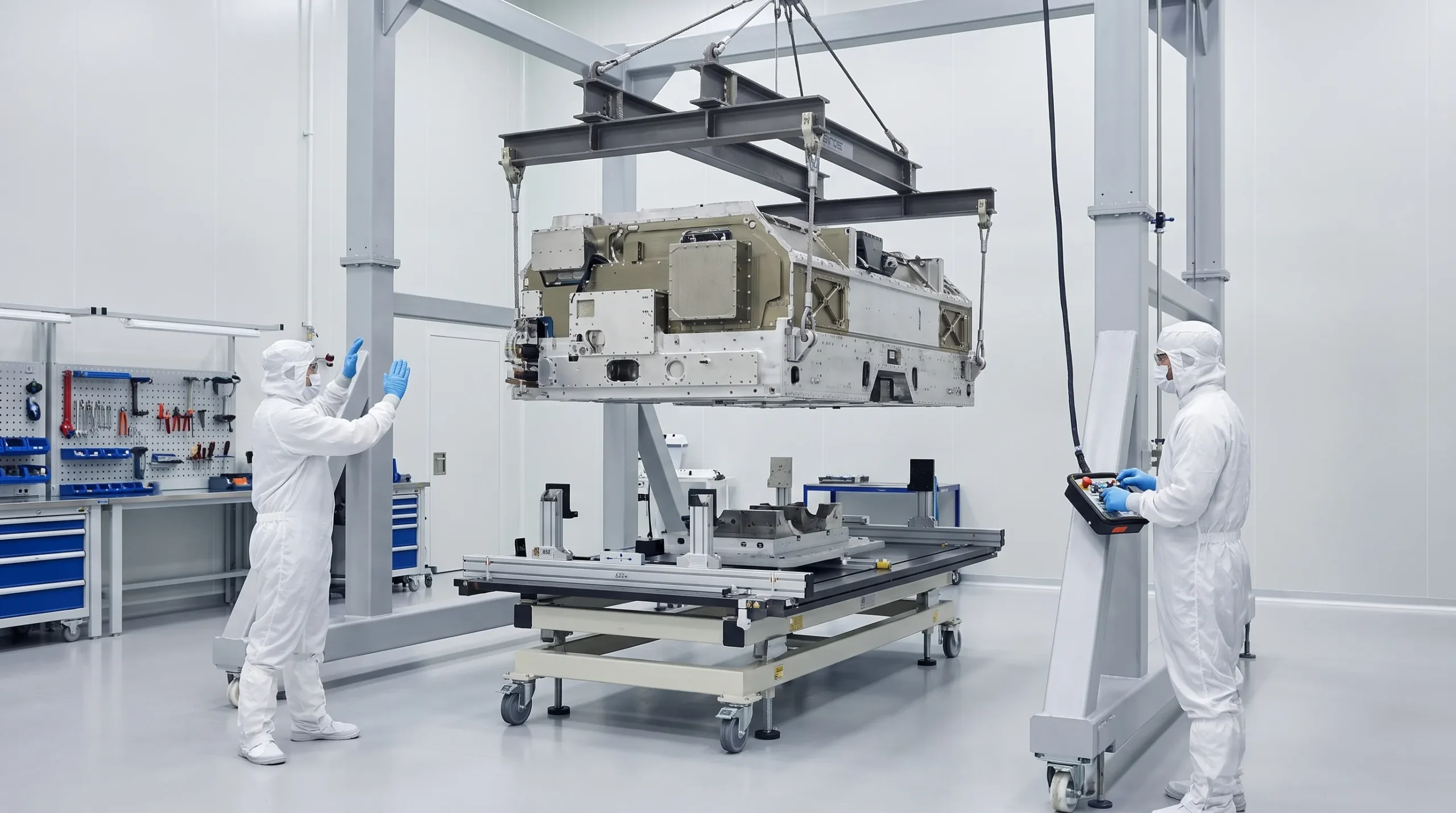
Heavy-duty cleanroom assembly sits at the intersection of two demanding priorities: keeping sensitive products clean and keeping people safe while they handle large, valuable or awkward components. In high-tech, semiconductor, optical, aerospace and precision manufacturing environments, a heavy module is rarely just heavy. It may also be contamination-sensitive, geometrically complex, difficult to grip, expensive to replace and critical to production continuity.
That is why heavy-duty cleanroom assembly cannot be treated as a standard cleanroom task with a stronger hoist added at the end. The handling method, lifting interfaces, operator access, cleanroom compatibility, inspection approach and documentation all need to be considered together. Safety is not a final check. It is an engineering requirement throughout the full lifecycle of the tool, module or machine.
For OEMs, machine builders and operations teams, the real question is not simply whether a cleanroom has enough space or whether a lifting device has enough rated capacity. The question is whether the complete assembly process can be executed repeatedly, safely and cleanly under real working conditions.
Why heavy-duty cleanroom assembly is different
Cleanroom assembly already requires controlled behavior, careful material flow and disciplined working methods. Heavy-duty assembly adds additional risk because the consequences of small errors become larger. A minor positioning issue can damage a precision interface. A poorly supported load can create dangerous pinch points. An unsuitable lifting fixture can generate particles, restrict visibility or force operators into unsafe postures.
The challenge becomes more complex when the product is both heavy and sensitive. A frame, optical module, vacuum component, tooling cassette or machine subassembly may require controlled lifting, stable positioning, accurate alignment and clean contact surfaces at the same time. In many cases, the assembly must also be performed in a constrained environment, where gowning, gloves, limited floor space and cleanroom procedures affect how operators move and communicate.
This is why the design of the tooling often matters as much as the cleanroom itself. A clean environment reduces contamination risk, but it does not automatically solve load control, ergonomics, safe access or compliance. Those elements need to be engineered into the process.
| Risk area | Typical cleanroom concern | Additional heavy-duty concern |
|---|---|---|
| Contamination | Particles, residues, fibers and FOD | Particles from tooling, wheels, friction points or protective covers |
| Handling | Controlled contact and careful movement | Load stability, center of gravity and lifting path |
| Operator safety | Gowning discipline and controlled behavior | Pinch points, posture, visibility and emergency access |
| Product quality | Surface protection and repeatability | Alignment damage, deformation or uncontrolled contact |
| Compliance | Cleanroom procedures and documentation | Machinery safety, lifting equipment checks and usage instructions |
Start with the complete handling scenario
A safe heavy-duty cleanroom assembly process starts before the component enters the cleanroom. Engineering teams need to understand the full route and all moments where the load changes condition. This includes unpacking, cleaning, transfer through an airlock, temporary storage, lifting, rotating, positioning, fastening, testing and removal of tooling.
Looking only at the final assembly position can lead to blind spots. A lifting tool may work well above the assembly table but fail to address the transfer from transport packaging. A fixture may provide excellent alignment but leave no safe way to release straps or remove protective covers. A hoist may have sufficient capacity but not enough fine control for the final millimeters of positioning.
For this reason, the most useful engineering input often comes from observing or mapping the real process. Operators, maintenance specialists, safety managers and production engineers each see different risks. The operator may notice poor visibility. Maintenance may identify access problems. Safety may question the emergency stop strategy or lifting method. Engineering can then translate those findings into practical design requirements.
In projects where space is limited or the product value is high, many of the same principles used for safe lifting for high-value equipment and tight spaces apply inside the cleanroom as well. The load path, surrounding equipment, access points and human movement all need to be considered before the tooling concept is finalized.
Engineering controls that support clean and safe assembly
Heavy-duty cleanroom assembly becomes safer when risk is reduced through engineering controls rather than operator improvisation. Procedures and training remain important, but they should not compensate for tooling that is difficult to use or unsuitable for the environment.
A strong concept usually combines mechanical stability, controlled motion, cleanroom-compatible materials and clear operator interaction. Depending on the application, this may include custom lifting beams, positioning frames, support carts, alignment aids, rotating fixtures, guided interfaces or mechatronic assistance. The goal is not to overcomplicate the process. The goal is to make the safe method the easiest method to follow.
Important design questions include:
- Can the load be lifted and positioned without side loading, twisting or uncontrolled swinging?
- Are lifting points clearly defined, accessible and compatible with the cleanroom procedure?
- Can operators keep hands away from pinch points during the critical stages of movement?
- Are surfaces, coatings, wheels and moving parts suitable for the cleanroom requirements?
- Can the tool be cleaned, inspected and maintained without creating unnecessary downtime?
The answers should be visible in the design. For example, a fixture may use guided stops to prevent incorrect positioning, defined lifting interfaces to avoid makeshift rigging and ergonomic handles to reduce awkward body positions. If operators must use the tool while wearing gloves, the controls, labels and locking mechanisms need to remain usable under those conditions.
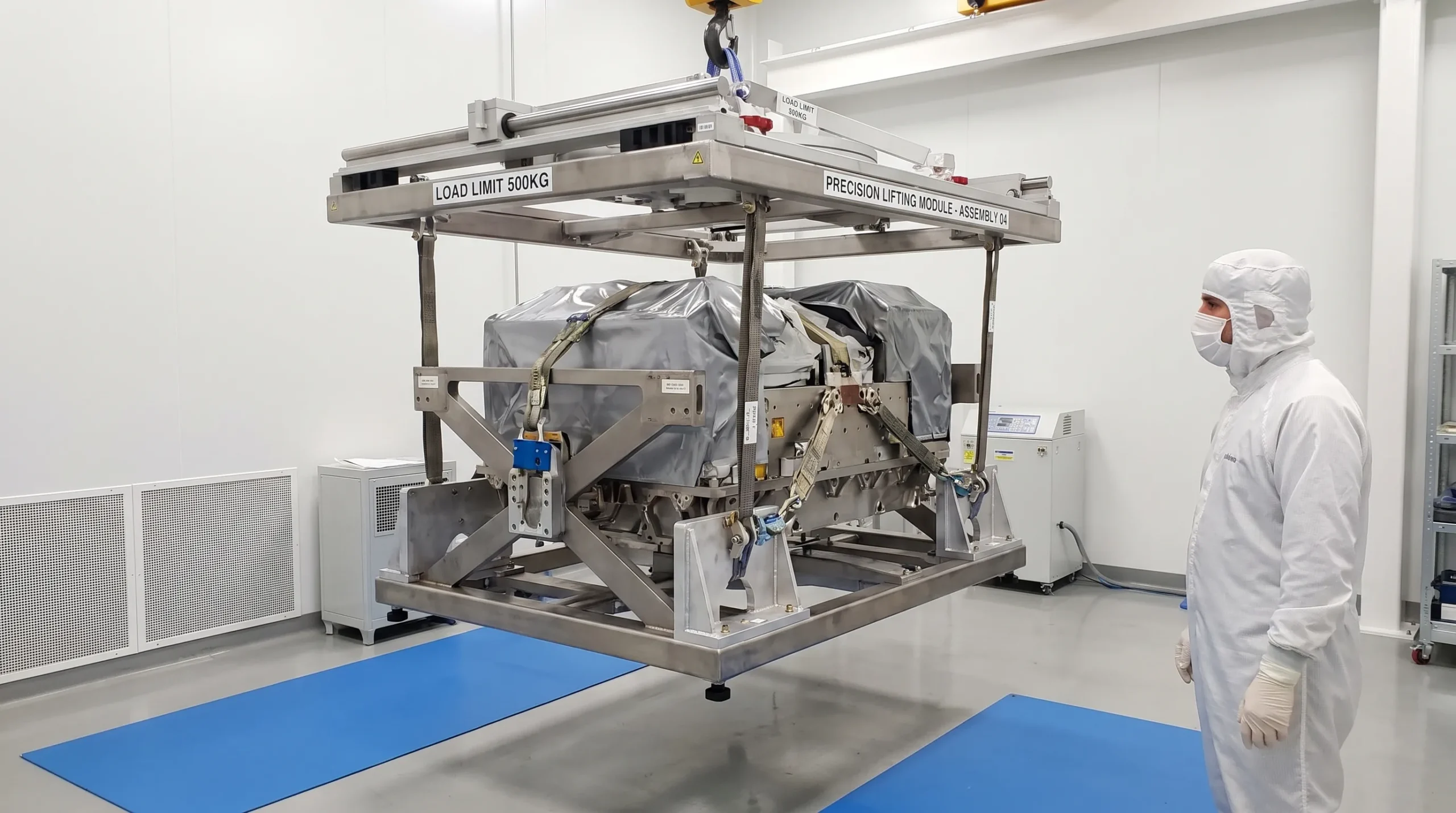
Cleanliness and safety must be designed together
In heavy-duty cleanroom assembly, a solution that is mechanically strong but difficult to clean can create quality risk. A solution that is very clean but hard to handle can create safety risk. The best approach is to bring cleanliness and safety requirements into the same design conversation from the start.
Cleanroom compatibility can influence material selection, surface finish, lubrication strategy, fastening methods, packaging, transport wheels and protective covers. It can also affect how components are staged before assembly. Any unnecessary contact, sliding movement or unprotected interface can increase the chance of particles or damage.
At the same time, the assembly team needs predictable, repeatable movement. Heavy components should not depend on manual correction at the last moment. Fine positioning, stable support and clear reference points help reduce both contamination risk and handling risk, because operators do not need to touch sensitive areas or force components into position.
This is also where workflow design becomes important. Material should move logically through the cleanroom. Tools should have defined storage and cleaning steps. Operators should not have to cross paths with heavy moving loads more than necessary. These details may appear practical rather than technical, but they often determine whether the engineered solution works safely in daily production.
For precision builds, cleanroom assembly quality depends on more than air classification. It also depends on repeatable handling, controlled interfaces and tooling that supports the process. BKL discusses this broader relationship in more detail in its article on how cleanroom assembly improves quality in precision builds.
The role of documentation, inspection and lifecycle support
A heavy-duty cleanroom assembly tool is not finished when it is delivered. It needs to remain safe and usable throughout its operating life. That requires clear documentation, defined inspection intervals and practical maintenance instructions.
For lifting and handling equipment, documentation may include design calculations, risk assessment input, test reports, inspection records, usage instructions and maintenance guidance. For machinery or machine-like equipment, CE-related obligations may also require a structured conformity assessment process, technical documentation and instructions for safe use. In 2026, many organizations are also preparing for the EU Machinery Regulation that becomes applicable in 2027.
The key point is that documentation should help people use and maintain the equipment correctly. A technical file may be necessary for compliance, but operators and maintenance teams also need clear, practical information. Which lifting points may be used? What is the rated capacity? What visual checks are required before use? What wear indicators should trigger service or removal from operation?
Periodic inspections are especially important in safety-critical cleanroom tooling because damage is not always obvious. Small wear, deformation, cracks, loose fasteners or damaged protective surfaces can create larger risks over time. BKL is accredited according to ISO 17020:2012 for inspections and can support visual inspections, overload testing, examinations, reports and usage advice for lifting and hoisting tools.
Lifecycle support also reduces operational uncertainty. When a tool is inspected, repaired or improved by a partner that understands the original design and the real operating context, decisions can be made more quickly and with better technical grounding. That supports availability without treating safety as an afterthought.
When outsourcing makes sense
Not every company needs to outsource every part of heavy-duty cleanroom assembly. Some OEMs and machine builders have strong internal engineering teams, established cleanroom procedures and experienced operators. In those cases, external support may still be useful for a specific process step, such as tooling design, load testing, documentation, inspection or small-scale production.
Outsourcing becomes especially valuable when the application requires specialist knowledge that sits between disciplines. Heavy-duty cleanroom assembly often requires mechanics, mechatronics, lifting technology, ergonomics, safety engineering, manufacturing knowledge and cleanroom awareness. Coordinating separate suppliers for each area can create gaps, especially when responsibility for the complete process is unclear.
Procurement teams naturally look for cost transparency. In simpler service markets, cost comparison can be straightforward, such as platforms that help people see how much tradespeople charge. Heavy-duty cleanroom assembly needs a different evaluation method. Hourly rates matter, but they do not show whether a partner can reduce handling risk, provide usable documentation, manufacture the tooling, inspect it later and support the equipment during its lifecycle.
For companies considering external support, BKL’s guidance on what to consider before outsourcing work to a cleanroom is a useful starting point. The right partner should help define the cleanliness objective, safety requirements, handling method, documentation needs and practical acceptance criteria before production pressure makes changes more difficult.
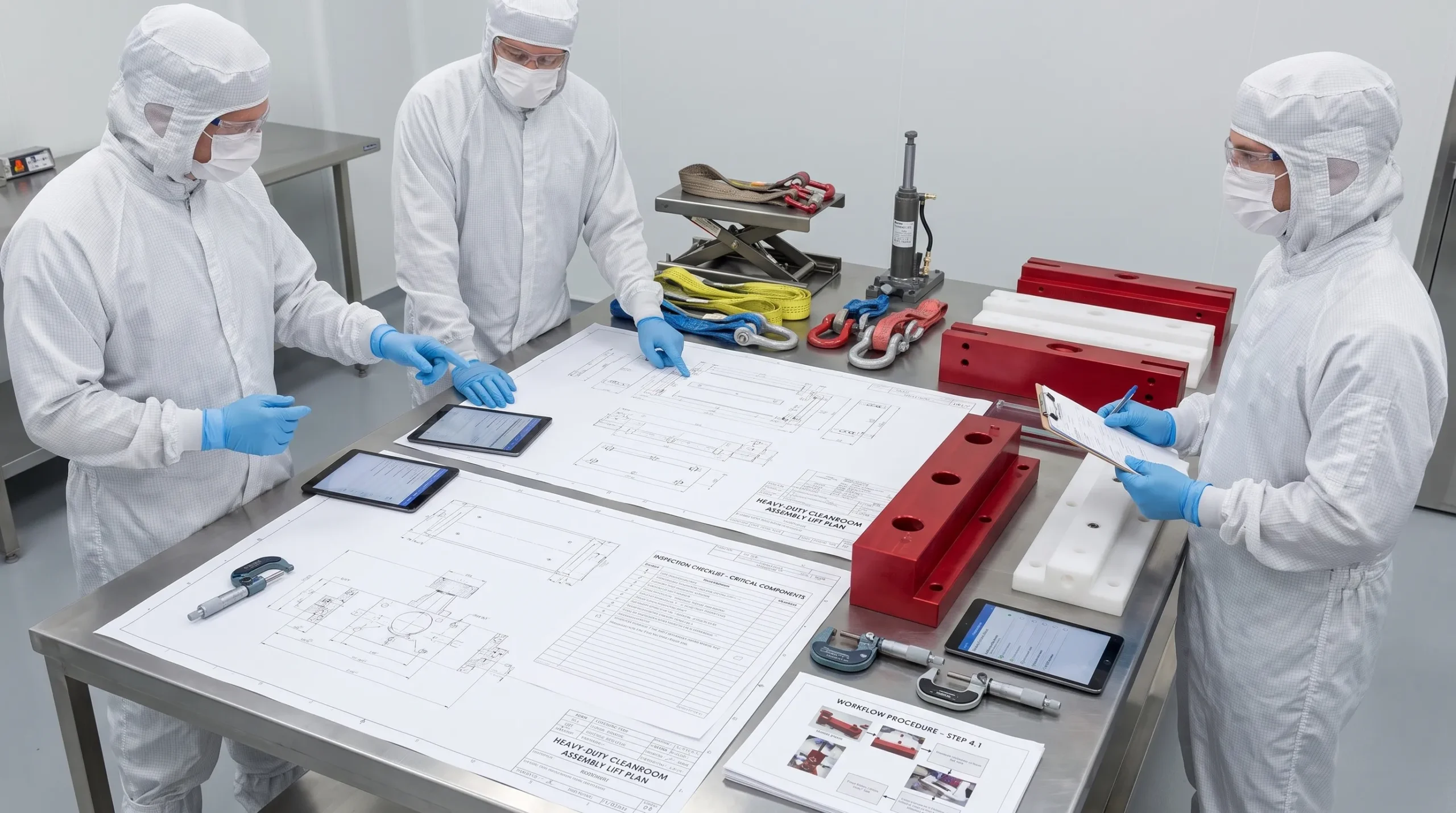
Practical decision factors for heavy-duty cleanroom assembly
Before approving a cleanroom assembly concept, decision-makers should look beyond the basic question of whether the component can be assembled. The better question is whether it can be assembled repeatedly, safely and efficiently by the people who will actually perform the work.
| Decision factor | What to verify | Why it matters |
|---|---|---|
| Load control | Weight, center of gravity, lifting points and stability | Prevents uncontrolled movement and unsafe handling |
| Operator interaction | Access, visibility, posture and hand positions | Reduces ergonomic strain and pinch point exposure |
| Cleanroom suitability | Materials, surfaces, wheels, covers and cleaning method | Limits contamination sources from tooling and movement |
| Process repeatability | Alignment aids, stops, guides and defined steps | Reduces variation and handling errors |
| Documentation | Instructions, reports, maintenance guidance and inspection records | Supports correct use and lifecycle management |
| Serviceability | Repair access, spare parts strategy and inspection intervals | Helps maintain availability and safe condition over time |
This decision process should involve engineering, operations, quality, safety, maintenance and procurement. Each discipline protects a different part of the business case. Engineering focuses on technical feasibility. Operations focuses on throughput and usability. Safety looks at people and risk reduction. Quality protects the product. Maintenance protects availability. Procurement ensures that the investment is justified and that responsibilities are clear.
How BKL supports safer heavy-duty cleanroom assembly
BKL combines mechanical and mechatronic engineering with production, inspection and service capabilities. For heavy-duty cleanroom assembly, that combination is important because the safest solution is rarely a single component. It is usually a coordinated set of design choices, handling tools, manufacturing quality, documentation, testing and lifecycle support.
Depending on the project, BKL can support an individual step or take responsibility for a broader solution. That may involve developing a lifting or handling tool, producing a complex module, supporting CE-related documentation, performing inspections or helping improve an existing process that no longer fits current safety or operational requirements.
The value for OEMs, semiconductor equipment manufacturers, aerospace companies and industrial manufacturing teams is practical. A tool or module should fit the real working environment. It should be understandable for operators, inspectable for maintenance teams and documented well enough for safety and quality stakeholders. It should support production efficiency without relying on shortcuts.
BKL’s controlled environment cleanroom also supports clean assembly, testing and prototyping for demanding technical applications. Combined with its experience in hoisting and lifting tools, industrial modules, machines, inspections and lifecycle services, this enables a more integrated approach to heavy-duty cleanroom assembly.
FAQ's about heavy-duty cleanroom assembly:
What makes heavy-duty cleanroom assembly more complex than standard cleanroom assembly? Heavy-duty cleanroom assembly combines contamination control with load control, operator safety, ergonomic access and product protection. The component may be heavy, sensitive, difficult to position and expensive to damage, so the tooling and workflow need to be engineered around the complete handling scenario.
Does every heavy-duty cleanroom project require custom tooling? No. Sometimes a standard solution, a modified existing tool, an inspection or a process improvement is sufficient. Custom tooling becomes more relevant when the load, geometry, cleanliness requirements, space constraints or safety risks cannot be addressed properly with standard equipment.
How can companies reduce safety risks during cleanroom lifting and handling? Risk can be reduced by defining the load path, using suitable lifting interfaces, controlling the center of gravity, keeping operators away from pinch points, designing cleanroom-compatible tooling, training users and inspecting equipment periodically. The safest approach is usually a combination of engineering controls, clear procedures and lifecycle support.
What documentation is important for heavy-duty cleanroom assembly tools? Relevant documentation can include design calculations, risk assessment input, operating instructions, inspection records, load test reports, maintenance guidance and technical documentation for CE-related processes where applicable. The exact documentation depends on the type of tool, machine or module and its intended use.
Why involve maintenance and operators during the design phase? Operators understand the real handling steps, visibility challenges and usability issues. Maintenance teams understand service access, inspection needs and common wear points. Involving both groups early helps create tools that are safer, easier to use and easier to keep available.
Discuss your heavy-duty cleanroom assembly challenge
If your organization needs to assemble, lift, position or maintain heavy precision equipment in a cleanroom environment, BKL can help assess the technical and safety requirements. From engineering and production to inspections, documentation and lifecycle support, BKL develops practical solutions that help teams work safely, efficiently and with greater control over critical assembly processes.